
By the Numbers: What NYC's Own Field Data Shows
A follow-up to our letter to NYC Parks Commissioner Tricia Shimamura
This spring, we wrote to NYC Parks & Recreation Commissioner Shimamura about field access and equity — the seasonal priority framework, the case for lighting, and what it's like to run the city's largest soccer league inside a system that wasn't built to accommodate changes in demand by sport or age, with both soccer and adult sports struggling to find time when so few fields have lights.
We shared that letter with our community and received a great public response, ultimately leading to great exposure through interviews that helped drive the summer light extension from 10pm to 11pm.
But there remained an opportunity to understand just how much this city suffers due to a lack of lights, and we set out to do the maths. The data was far more eye opening than anyone at team Footy expected.
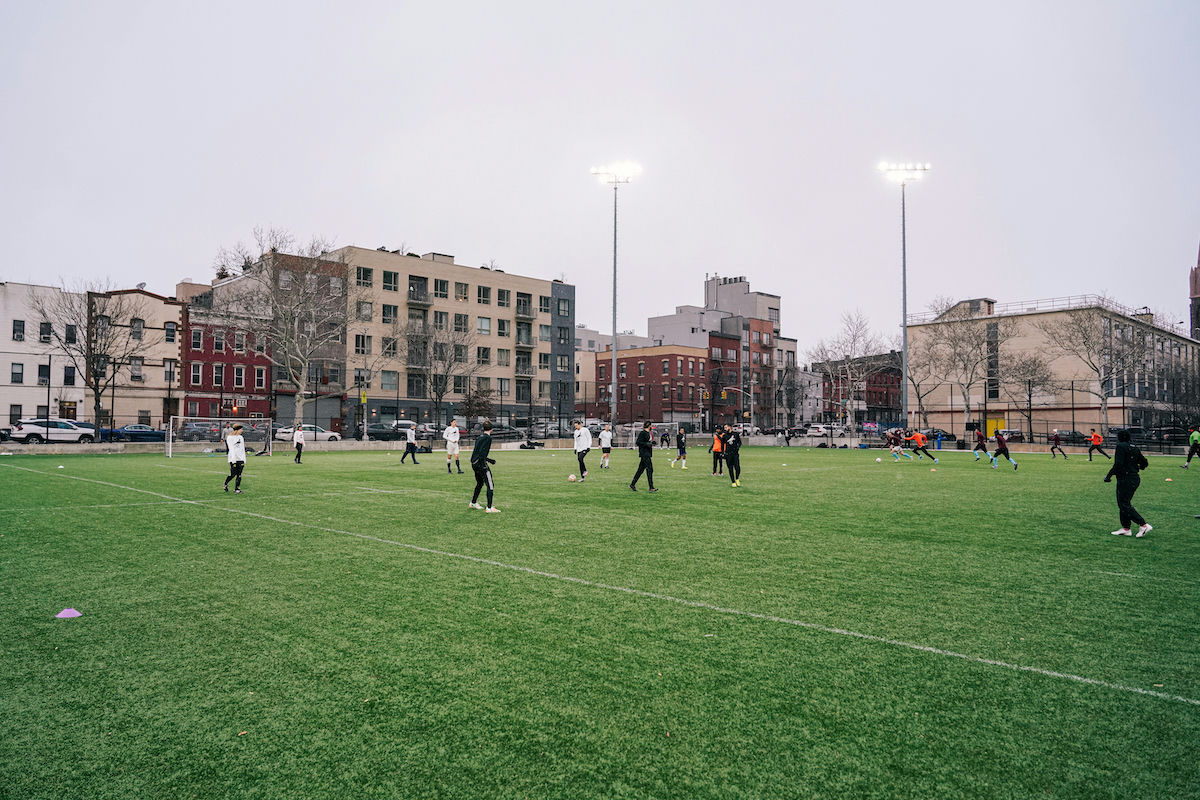
Sternberg Park. One of the few fields where soccer can be played under the lights
We started with NYC Parks' own citywide facility dataset, added in the actual permit rules, and — for good measure — used our own Fall 2026 permits, broken down field by field, hour by hour, to see what the impact of lighting could be.
What we found didn't just support the letter. In a few places, it made a stronger case than we'd realized we had.
1. Soccer isn't fairly resourced.
Rank NYC's sports by how much physical field space each one gets, and soccer comes in 5th on the list — behind handball, basketball, diamond sports (baseball and softball, combined), and tennis. Diamond sports alone hold more than double soccer's citywide field inventory: 760 fields to soccer's 376. If this were a conversation about who's taking up too much field space, especially with soccer demand outpacing all sports, diamond sports would be the ones fielding the question, not soccer.
Worth noting, these spaces include concrete fields as well.
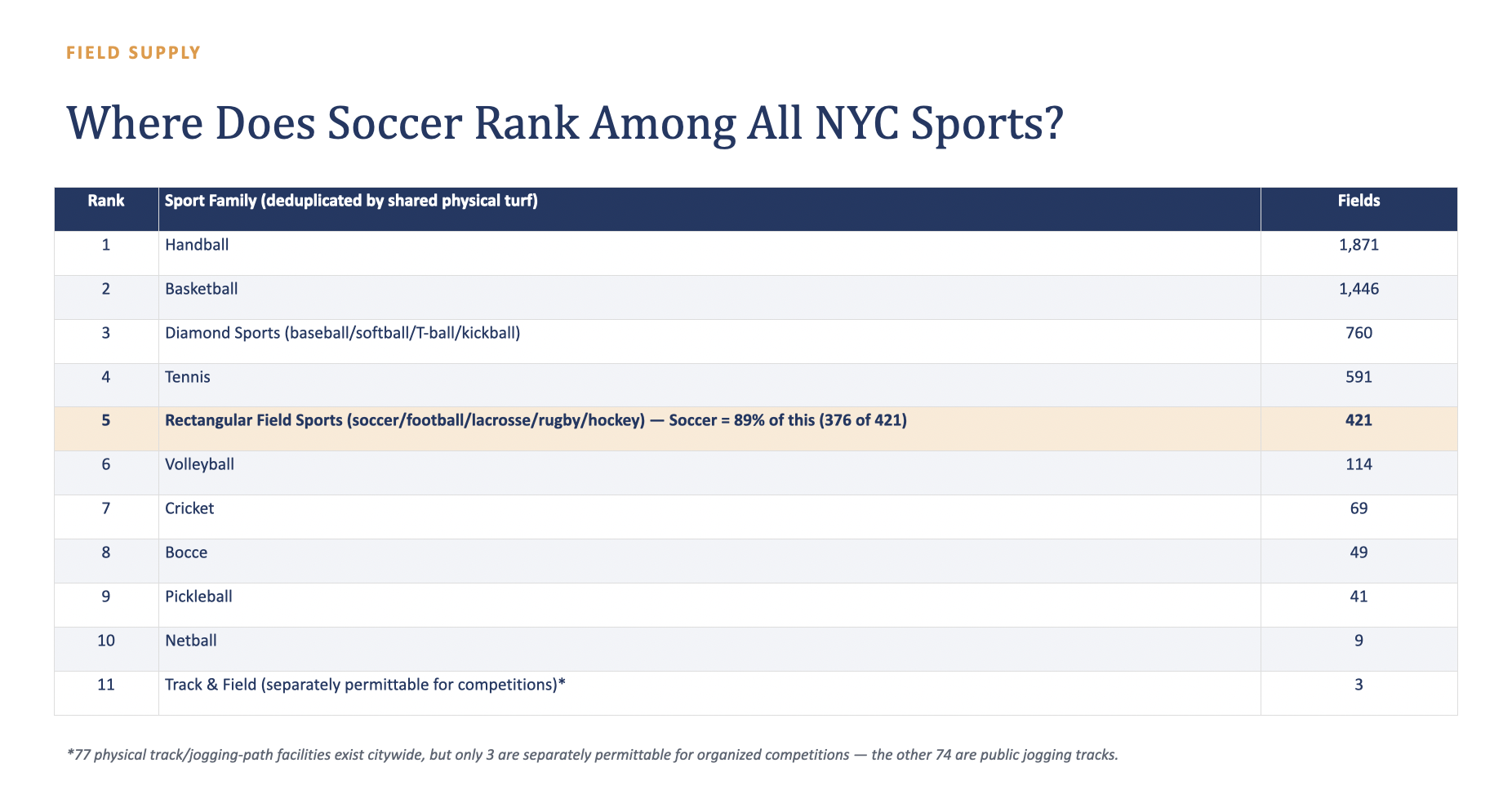
Source: NYC Parks Athletic Facilities dataset (Active + Closed Temporarily)
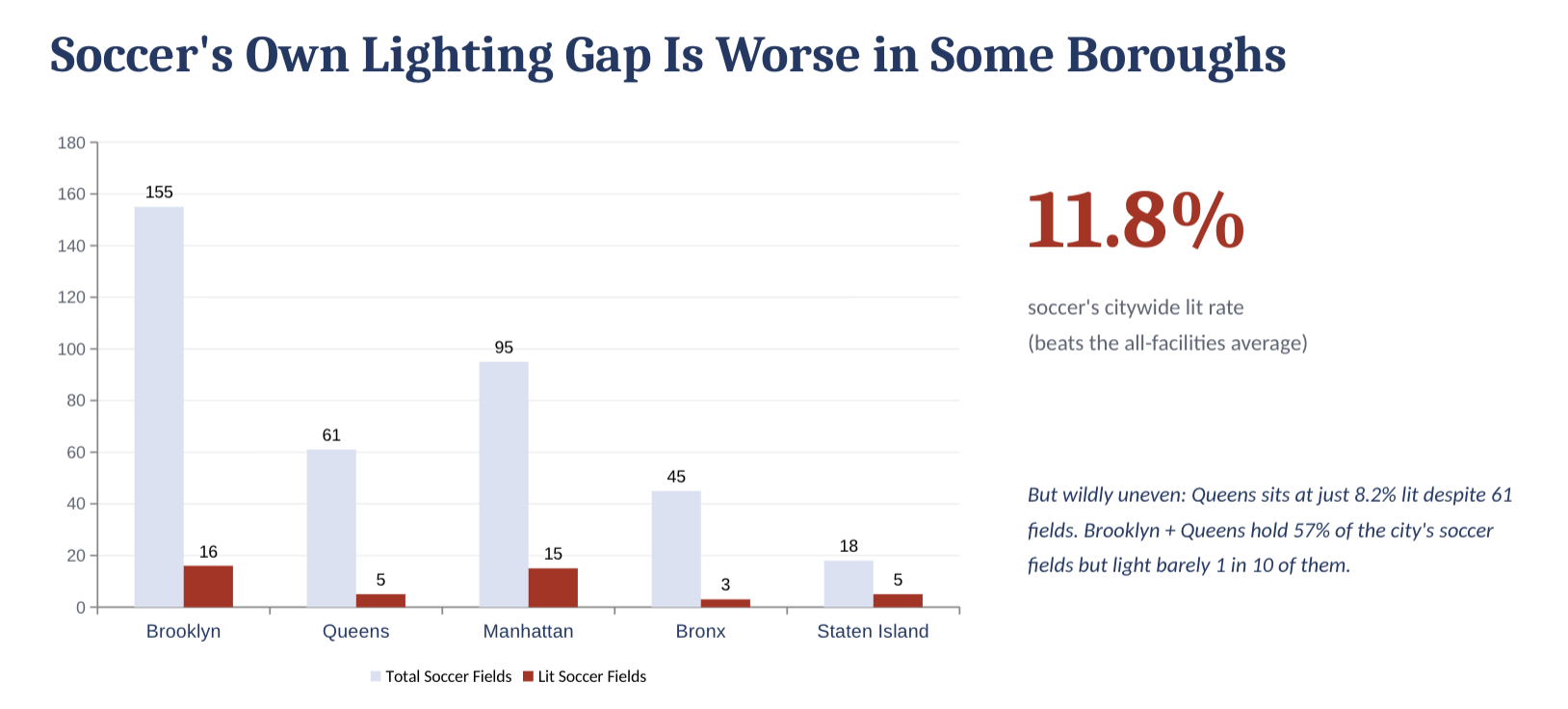
2. Only 11.8% of NYC's soccer specific play spaces have lights.
This is the number that explains almost everything else in this post. Roughly 1 in 10 soccer fields are lit. Worse, when you consider all parks citywide, just 318 of 5,890 total athletic facilities — across every sport, not just soccer — have lighting. That’s just 5.4%! Queens is the worst-served borough at 3.9%; even Manhattan, the best, is under 7%. This isn't a soccer problem. It's an infrastructure problem that happens to hit soccer hard, because soccer plays in the exact hours — after work, after school, after the sun goes down — that unlit fields simply can't offer.
3. Fall & winter are soccer-priority seasons with an urgent need for lights.
Fall loses 122,000 light hours across all play spaces compared to summer. You read that number right. And winter loses over 180K, which is half of summer’s total supply!
Fall, being the season directly in front of us, sees a 43.6% drop from summer on unlit fields during peak-time hours (3pm and later Monday-Thursday). If we wait until winter to talk about lighting, we've already lost the season where the problem is most severe against the backdrop of demand (winter having less overall demand than fall).
4. We ran the numbers on our own permits — and found the same problem, live.
Talk is one thing. So, as one of the city’s largest permit holders, we opened up our own Fall 2026 permit sheet and did the same analysis on ourselves that we'd want NYC Parks to do citywide.
Here's what we found: Of the 15 unique fields where we have games during peak Monday-Thursday times across NYC, over half (8) are unlit. We call these "sunset permits" internally, because that's exactly what they are: games that have to kick off as early as 5:00pm to get a full session in before dark. Across these 8 unlit weeknight fields, we lose roughly 80 hours of playable time, in a single season (enough to accommodate a minimum of 400 additional New Yorkers into a full league season).
5. Footy is a rounding error against the city's total supply.
However you slice it — full-day citywide capacity, peak-time hours only, hours after 5pm specifically — NYC Footy's entire Fall footprint stays under 1% of total citywide soccer field-hours. Even measured against the single scarcest resource in the whole system (lit fields, Monday through Thursday, after 5pm), we hold just 2%.
Think about that. As the city’s largest soccer league by far and one of the city’s largest permit holders, we hold about 2% of available soccer field time after 5pm on peak hours (Monday through Friday after work) in the fall.
We’re sharing this because so often the focus is on redistributing soccer field space amongst groups already severely underserving their own communities, when it couldn’t be more clear that this will not even remotely move the needle.
So, what’s the solution for NYC Footy and all soccer organizations throughout the city?
6. The fix is smaller and the benefit far larger than people think.
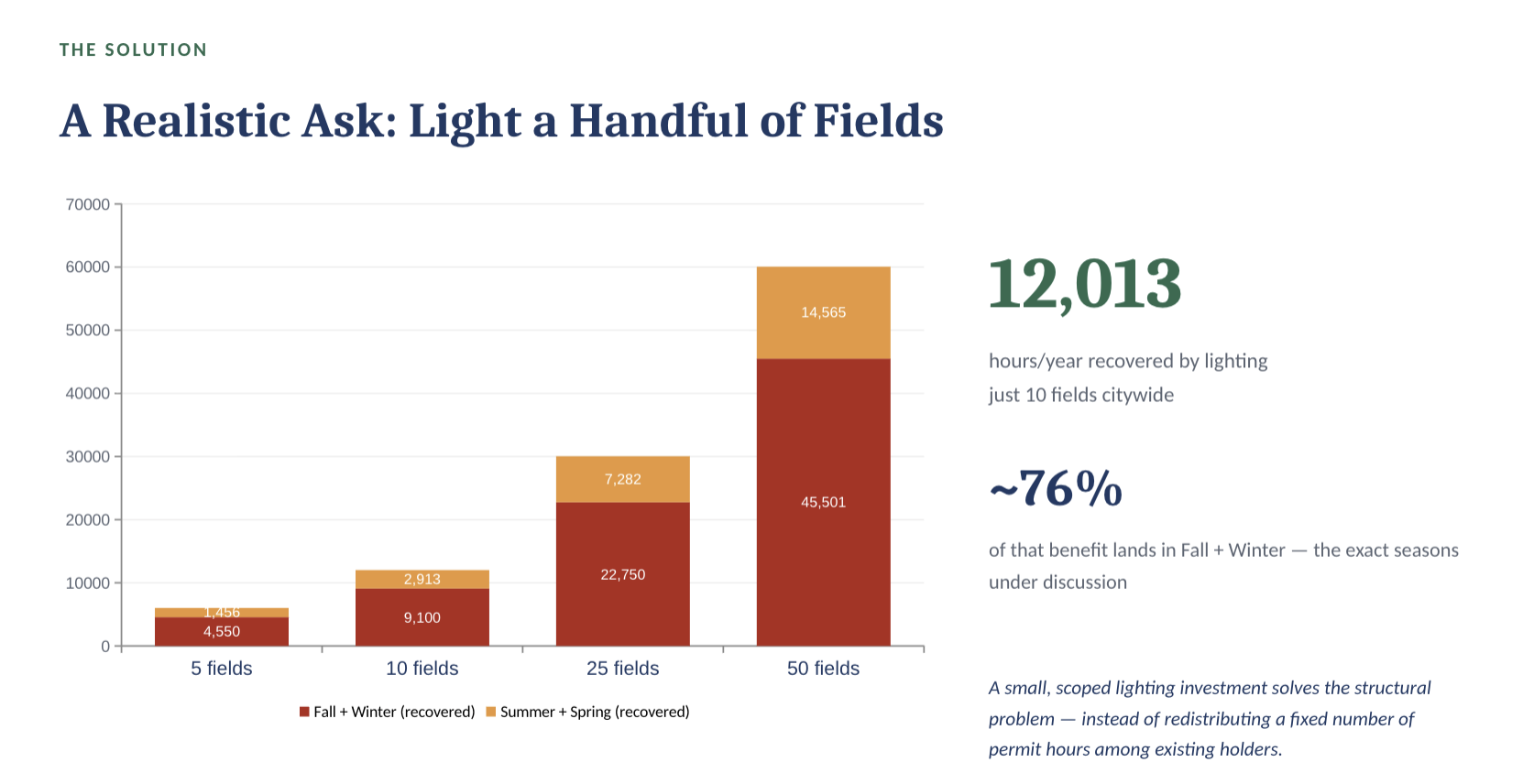
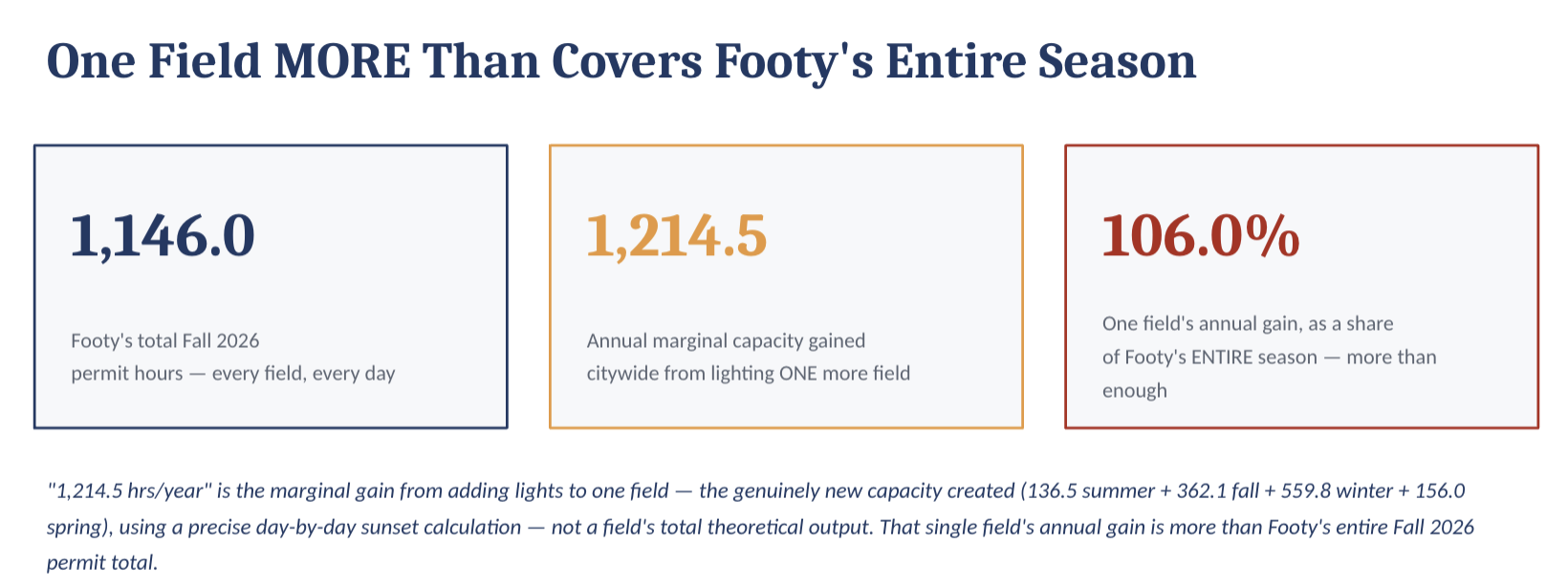
This is the most important number in this whole post: lighting just one additional currently-unlit field adds an estimated 1,215 hours of new playable capacity per year, citywide. If lights stay on till 11 (as it used to), that number jumps to 1580 hours!
Currently, NYC Footy’s entire Fall 2026 season — every game, every field, every hour from Monday through Sunday we've permitted as an organization — adds up to 1,146 hours.
So, a single lit field provides more extra hours of play than NYC Footy’s entire fall season of play!
Not only does this solve the city’s field accessibility challenges without having to build a single new field, but it unlocks a real revenue opportunity for the city.
We’re going to share this same data directly with NYC Parks, because we think the strongest version of this conversation is one built on shared facts, not competing impressions. The Department is managing an enormously complex system with real constraints, and we don't take that lightly. But the numbers are the numbers: New Yorkers are playing more soccer than ever, the fields that could serve them best are sitting dark most evenings, and the fix — lighting a handful of fields — is smaller and more immediate than the scale of the problem might suggest.
As always, we’ll be reporting back on our progress.
Meet the Winners of the $50k Vanta World Classic Championship
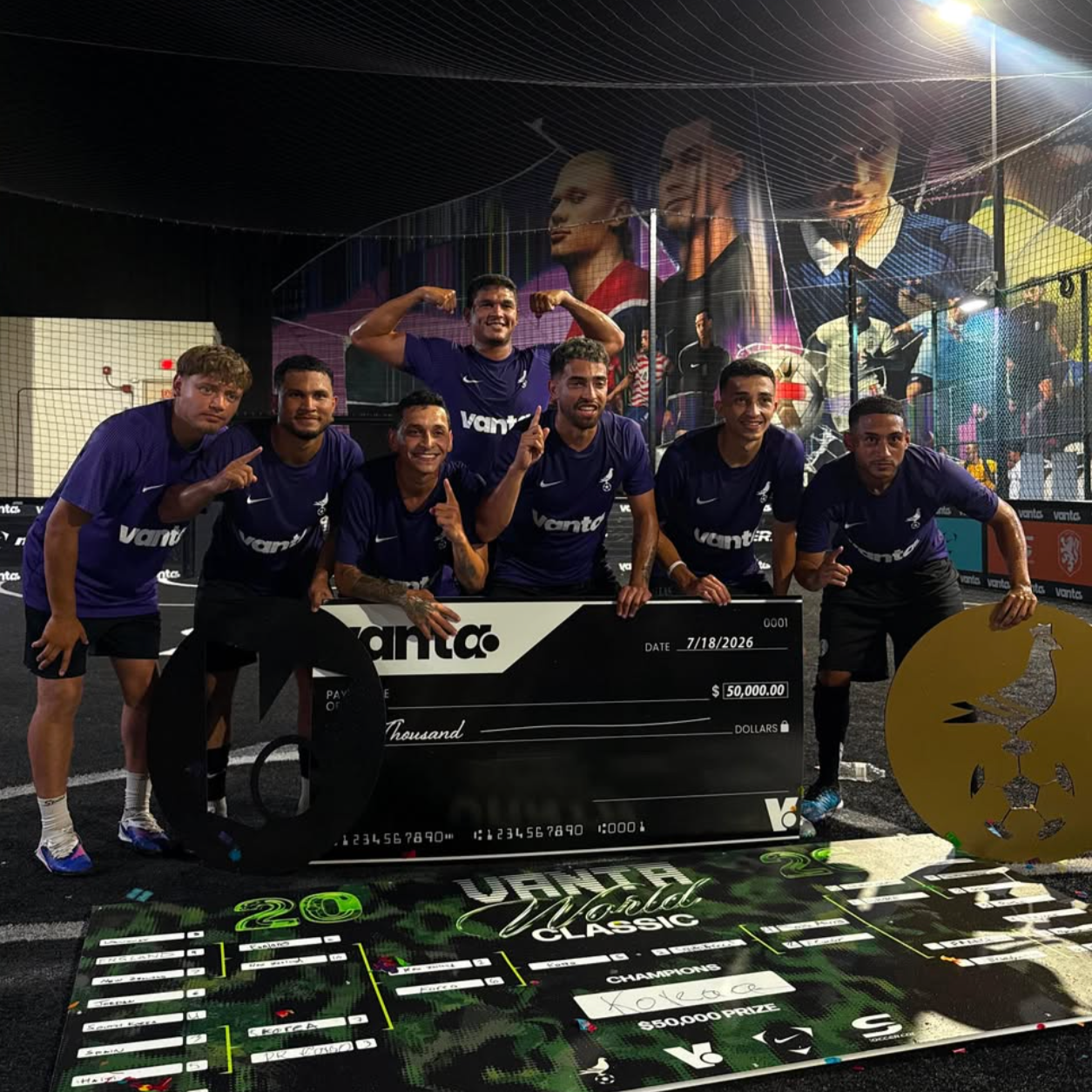
South Korea's Championship Squad: Dylan Perez (Captain), Daniel Torrealba, Julio Arecho, Juan Rodriguez, Dayerson Graterol, Samuel Blanco and Gabriel Garcia.
Winning a soccer tournament is one thing. Winning $50,000 along the way is something else entirely.
South Korea emerged victorious from the inaugural Vanta World Classic in Dallas, overcoming a 48-team field inspired by the 2026 FIFA World Cup to claim one of the biggest prizes in amateur soccer.
Afterwards, we caught up with team captain Dylan Perez to find out how his side handled the pressure, what it felt like to lift the trophy, and what comes next after landing such an extraordinary payday.
1. What were your expectations going into the tournament? Did you genuinely believe you could win it?
I genuinely believed we were going to win. As soon as we stepped onto the field, I trusted my teammates and believed in all of our abilities. From that moment on, I felt we had what it took.
2. How did the final unfold from your perspective? Was there a defining moment?
It was a great game. It was high-energy, intense and a lot of fun to play. We were definitely feeling the effects of a long tournament, which is why it stayed so close, but we came together when it mattered most and found a way to win.
3. Did the $50,000 change the way you approached the final, or did it become just another soccer match once the whistle blew?
Honestly, the prize money changed the way we approached the whole tournament. Fifty thousand dollars is a lot of money, and we wanted to win it from day one.
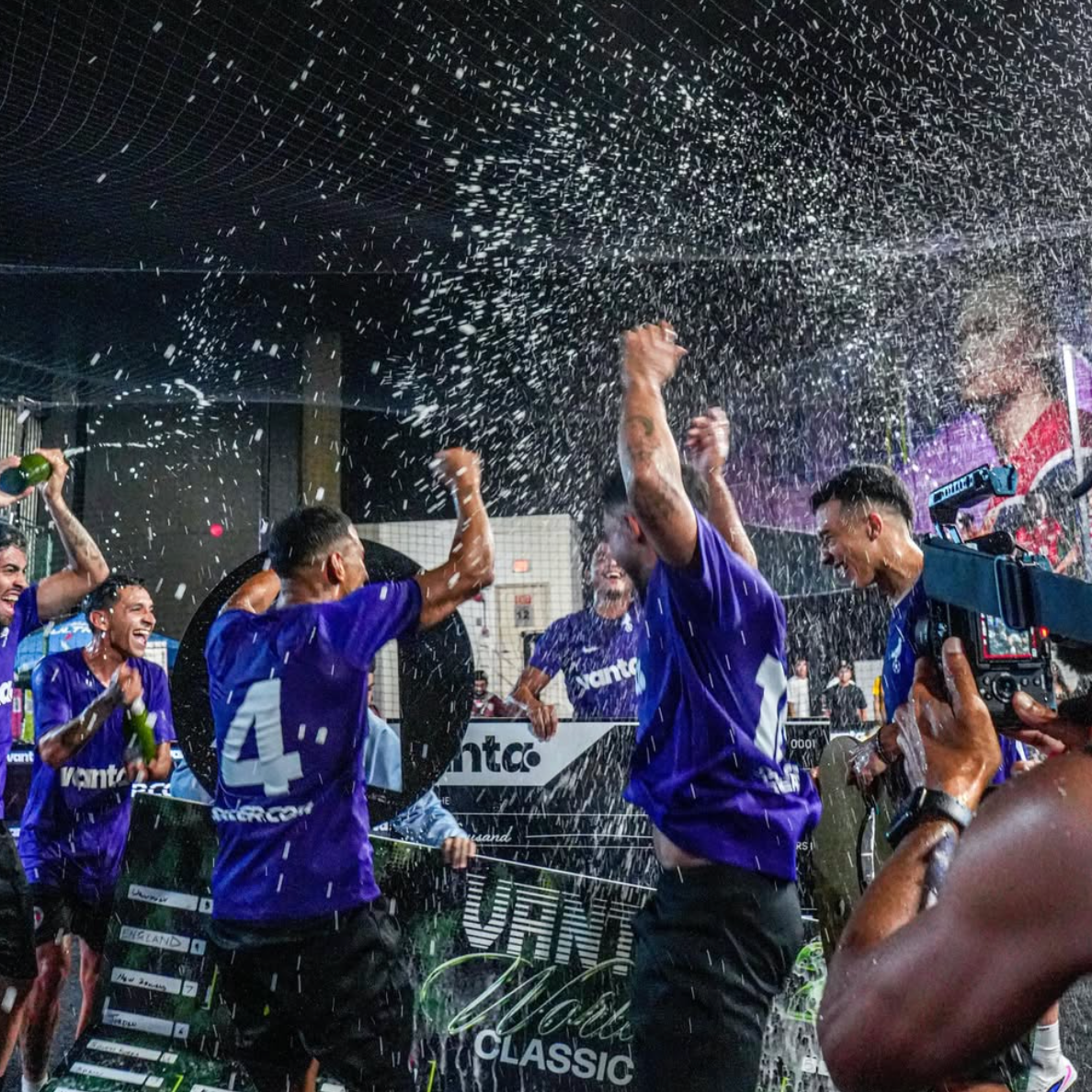
The greatest feeling in the world looks exactly like this!
4. What went through your mind when the final whistle blew?
My first thoughts were to thank God and celebrate with my friends. We'd worked so hard throughout the tournament, and it was an incredible feeling to see everything pay off.
5. Have you decided what you'll do with your share of the prize money?
I'm planning to save most of it and hopefully use it one day to start my own company. Before that, though, I'll definitely be treating my girlfriend to a well-deserved dinner!
Congratulations once again to the champions, and thanks to Dylan (and Victoria at Vanta!) for taking the time to speak with us.
Top 10 Best Values: Fall ‘26
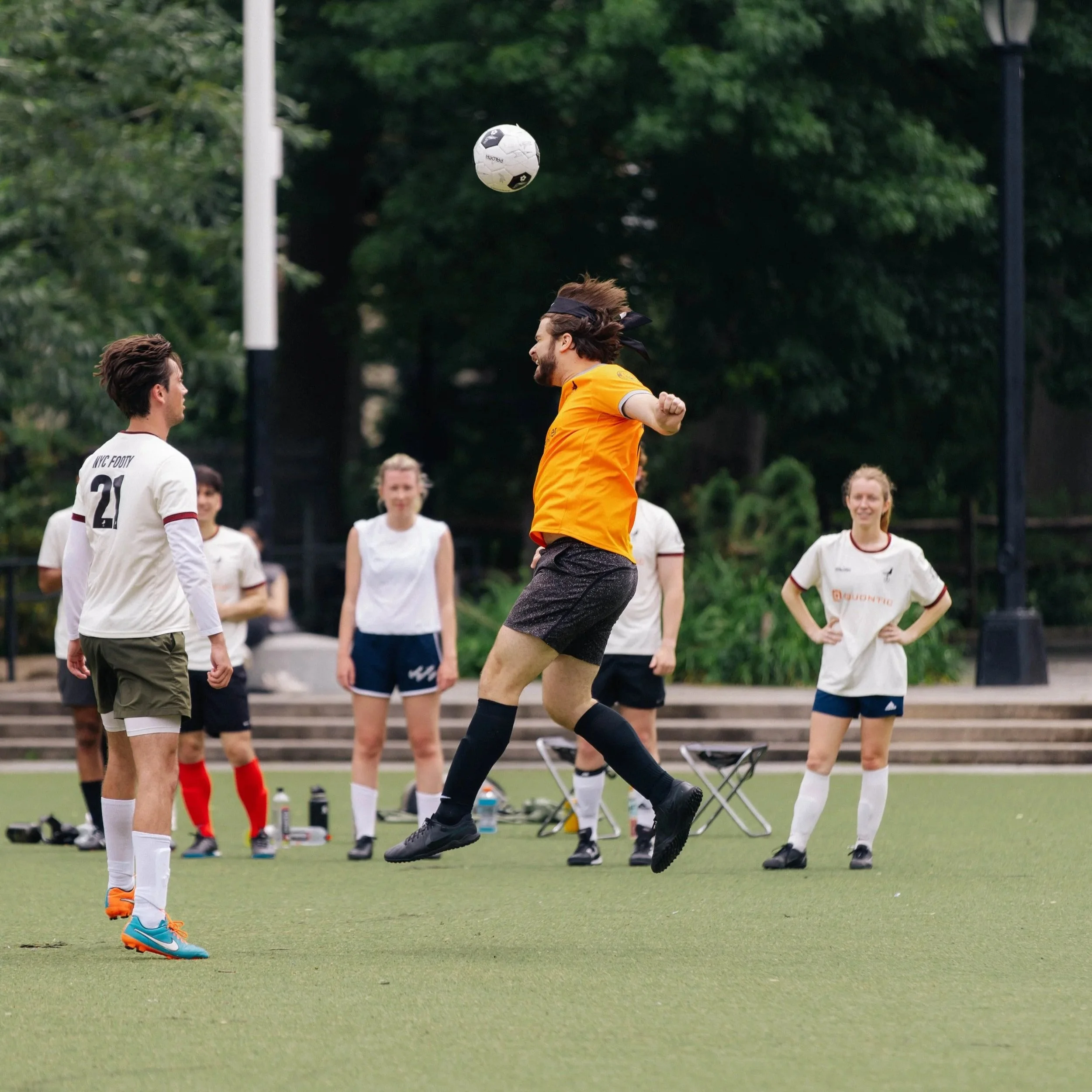
Park Slope’s Washington Park made our list of top Fall ‘26 values.
Paying top price for pristine fields is all well and good, but playing all the angles is really what winning the registration game is all about.
Want to stack saves before your season even starts?
Here are 10 top values to consider when searching for a Fall ‘26 league with NYC Footy:
1. Sundays | Sunset Park (Bush Terminal Park) | 7v7 (by BetterPlayer) | NTS
2. Sundays I LIC (Murray Playground I 6v6 I P4
3. Sundays | West Village (Gansevoort Peninsula) | 7v7 | P3
4. Mondays | Crown Heights (Socceroof) | 6v6 | P3
5. Tuesdays | Crown Heights (Socceroof) | 6v6 | P4
6. Tuesdays I Sunset Park (Sunset Park) I 7v7 I P4
7. Tuesdays & Thursdays | Park Slope (Washington Park) | 7v7 | P4
8. Wednesdays I Sunset Park (Bush Terminal Park) I 7v7 I P3/P4
9. Saturdays | Chelsea (Chelsea Waterside Park) | 6v6 (Flip League) | P4
10. Saturdays | Prospect Heights (Dean Playground) | 6v6 | P3
The NYC Footy Neighborhood Guide: Frederick Douglass Playground
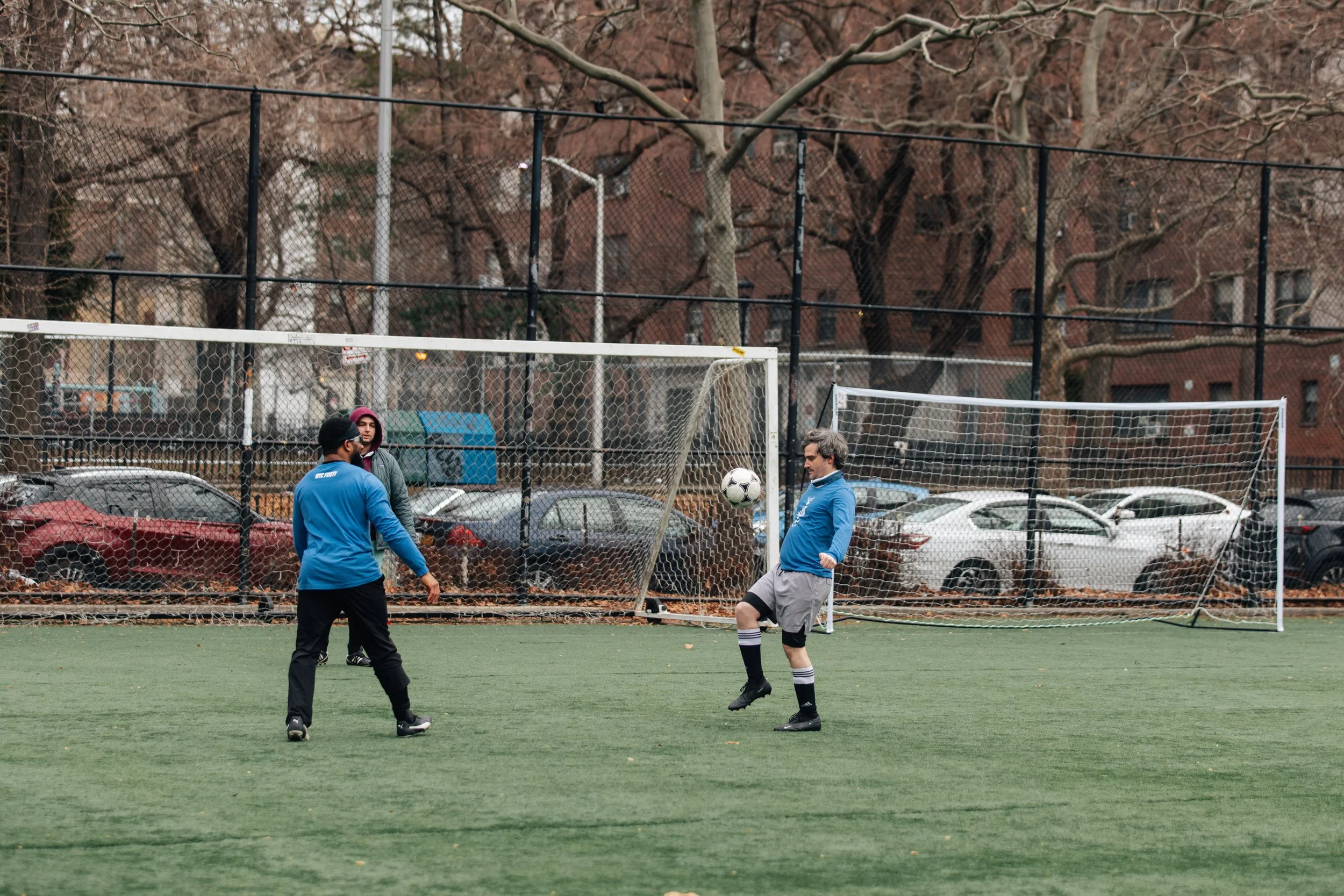
Frederick Douglass Playground, a perfect uptown Manhattan pick!
Some venues excel at one thing. Great pitch, awkward journey. Fantastic neighborhood, average facilities. Frederick Douglass Playground is different. It quietly ticks every box.
Every football team needs an all-rounder - and this is NYC Footy's equivalent: the dependable engine room powering fantastic leagues from January through December.
Room for Two
Frederick Douglass Playground runs two 7v7 turf pitches side by side, which makes it Footy's busiest and most popular home on the Upper West Side. There's almost always a game in progress, often two at once, and a comfortable buzz of families, kids on the swings, and pickup basketball running alongside whatever's happening on the turf.
It's a small footprint doing a lot of work: under two acres carrying a full sports complex, and somehow never feeling cramped for it.
The Name Behind It
The playground opened on September 10, 1958, built the year before on land the city acquired for the benefit of the neighbouring Frederick Douglass Houses. It's named, fittingly, after the remarkable man himself.
Born into slavery in Maryland around 1818, Douglass taught himself to read in secret - literacy for enslaved people being illegal at the time - before escaping to New York in 1838.
He went on to become one of the towering figures of the abolitionist movement: an orator, publisher of The North Star, and author of the era-defining Narrative of the Life of Frederick Douglass. Nearby Frederick Douglass Circle also honours his legacy.
Getting There
The 1 train is the easy option, with a stop at 103rd Street putting you a short walk from kick-off. The B and C also run along Central Park West a little further east, handy if you're coming from that side of the park.
The park is also served by nearby Citibike stations and by the M7 and M11 buses.
The Facility
Good-quality artificial turf throughout, split into two side-by-side 7v7 pitches, with basketball and handball courts, swings and a spray shower rounding out the rest of the space. It's a genuine neighbourhood hub - as much a place for families and after-school kids as it is for Footy on a weeknight - and it stands up well to New York's seasons, remaining playable year-round.
Pre-Game
Broadway gives this stretch of the Upper West Side its easy-going character, lined with neighbourhood cafés, independent shops and long-standing local institutions.
Head to Sal & Carmine's on Broadway, between 101st and 102nd Streets - close enough to the pitch that there's really no good excuse not to. Founded by the late Sal Malanga in 1959, the pizzeria has since earned a place in the Pizza Hall of Fame. Sal, once dubbed the "Dom DeMarco of Manhattan", built its reputation the old-fashioned way: hand-making every pizza, and more than 65 years on, it's still one of the Upper West Side's great slice institutions.
Post-Game
The Throwback, on Amsterdam Avenue near 95th Street, is an official NYC Footy bar partner - which means an actual Footy drinks menu waiting for you, not just a friendly welcome. Think a proper sports bar done right: walls of memorabilia, plenty of screens, and a downstairs pinball setup for anyone not ready to call it a night.
Wear your NYC Footy jersey to score a few discounts.
Team Bonding
Riverside Park is a few blocks west, and the stretch overlooking the Hudson around 100th Street is one of the best sunset spots in Manhattan - benches, breathing room, and a view across the water that's hard to beat after a hard-fought 7v7.
Walk east, and you will find Central Park and one of its greatest hidden secrets, The Pool, a shaded pond and paths where you can relax and bird-watch any day of the week.
Stoppage Time
Walk about ten blocks north, and you'll hit Frederick Douglass Circle, the "Gateway to Harlem" at 110th Street and Central Park West - the city's principal monument to the man this playground is named for.
The intersection was named in Douglass's honour back in 1950, yet the striking bronze statue at its centre didn't arrive until 2011. For sixty-one years, the circle carried his name before it carried his likeness.
Frederick Douglass believed that public spaces, education and opportunity should belong to everyone. More than a century after his death, it's somehow fitting that one of New York's busiest little neighbourhood playgrounds continues to bring people together in his name.
The NYC Footy Neighborhood Guide: Grover Cleveland Playground (Ridgewood)
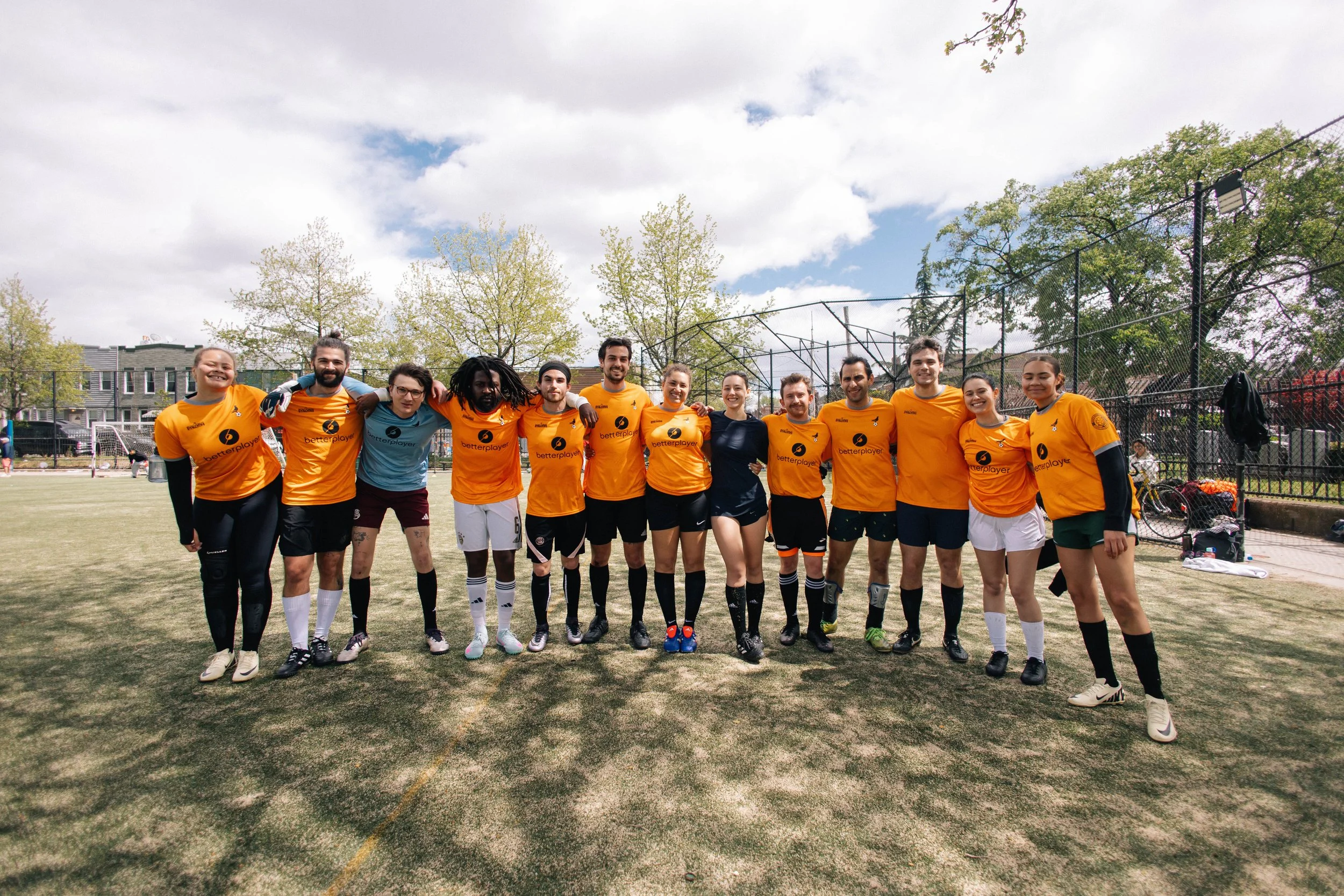
Need a funky field vibe? Ridgewood is the neighborhood for you!
Get Stuck In At Grover Cleveland!
There's plenty to be said for pristine surfaces and glossy facilities, but soccer is a rough-and-ready sport at heart - and Grover Cleveland Playground doesn't pretend otherwise.
Tucked into the heart of Ridgewood, this is Footy at its most authentic: a proper neighbourhood pitch in a neighbourhood bursting with character.
A View With Neighbors
Grover Cleveland Playground occupies one of Ridgewood's higher points, and from here the view is unexpectedly good - the Manhattan skyline sitting on the horizon beyond a foreground of two cemeteries, Ahawith Chesed and Linden Hill, that flank the park on either side.
It's an unexpectedly poetic outlook for five-and-a-bit acres of playground, pitches and basketball courts - and having two sprawling cemeteries as your nearest neighbours certainly isn't something you encounter at many soccer venues.
Some History
The land was acquired by the city in 1924 and developed a few years later as Anawanda Park, named for the Anawanda Democratic Club - one of the small, Tammany Hall-style political outfits that ran neighbourhood politics in early twentieth-century Queens.
Their rivals across the local political scene happened to be a rather more direct outfit called the Grover Cleveland Democratic Club. So, in December 1939, when the city renamed it Grover Cleveland Park, the Anawanda faithful were not happy. Losing their own park's name to their opponents' chosen president was a bitter pill to swallow.
Getting There
The L train to Dekalb Avenue is the most straightforward option for most players, while Citibike is another excellent choice if you're coming from North Brooklyn. The M train to Seneca Avenue also serves the area, though it's a little less convenient for most journeys.
The ride in by bike is quick and flat, making this one of the easier venues to reach once you've clocked the route.
Top tip: Grover Cleveland Playground is separate from the nearby Grover Cleveland High School field, which catches out plenty of first-time visitors. Make sure you're heading to the playground rather than the school pitch.
The Facility
A synthetic field shared with baseball and softball, hosting NYC Footy's 8v8 leagues alongside pickup basketball and volleyball right next door. This isn't a pitch that's been buffed for Instagram - it's a proper, well-used neighbourhood ground with a local crowd who treat it like their own backyard.
Thousands of local players have passed through Grover Cleveland over the years, and plenty of NYC Footy regulars now know every bobble and bounce of the surface. It feels lived in - in the best possible sense. There's a playground for younger siblings and future signings too, and enough activity around the edges that the park stays lively well beyond kick-off.
Pre-Game
Ridgewood has quietly become one of Queens' most interesting neighbourhoods, with old-school bakeries sitting alongside independent cafés, beer bars and restaurants that draw visitors from well beyond the borough.
Fresh Pond Road is the obvious destination. Pupusas Ridgewood serves genuinely excellent Salvadoran pupusas - try the loroco flower filling if you want something you won't find everywhere - while Burek's Pizza does exactly what it says on the tin.
Post-Game
Windjammer, on Grandview Avenue, is one of the closest spots for a post-match drink. Better still, it's something of a local tradition to order a pizza over from nearby Fazio's while you're there - the ideal reward after 60 minutes on the field.
If you're after something with a bit more food behind the bar, The Seneca on Seneca Avenue does a smash burger regulars rave about, and has a pool table and a beer list that might just tempt you into more than one post-match pint.
Team Bonding
Head to Nowadays, the sprawling indoor-outdoor venue that sits somewhere between beer garden and nightlife hotspot. Expect picnic tables, hammocks, food vendors and plenty of room for the team to spread out before DJs take over later in the evening. It's flexible enough for a squad that can't quite agree on how big a night it wants.
Stoppage Time
Though competitive, our NYC Footy leagues are law-abiding affairs - but this neighborhood's sporting history involves bending the rules a little.
The Brooklyn Bridegrooms - forerunners of the Brooklyn (and later Los Angeles) Dodgers - used to play their Sunday home games just around the corner at Ridgewood Park, a long-vanished ground near Wyckoff and Halsey.
Brooklyn enforced its Sunday blue laws strictly, while Queens, just over the county line, didn't. Playing baseball for money on the Sabbath was illegal only a few blocks south, but here you could (mostly!) get away with it until Sunday baseball was finally legalised citywide in 1919.
Grover Cleveland Playground has never seemed too concerned with doing things the tidy, official way - and neither, on a good Sunday, does Footy.
NJ Footy Neighborhoods: Thistle FC Field (Kearny)
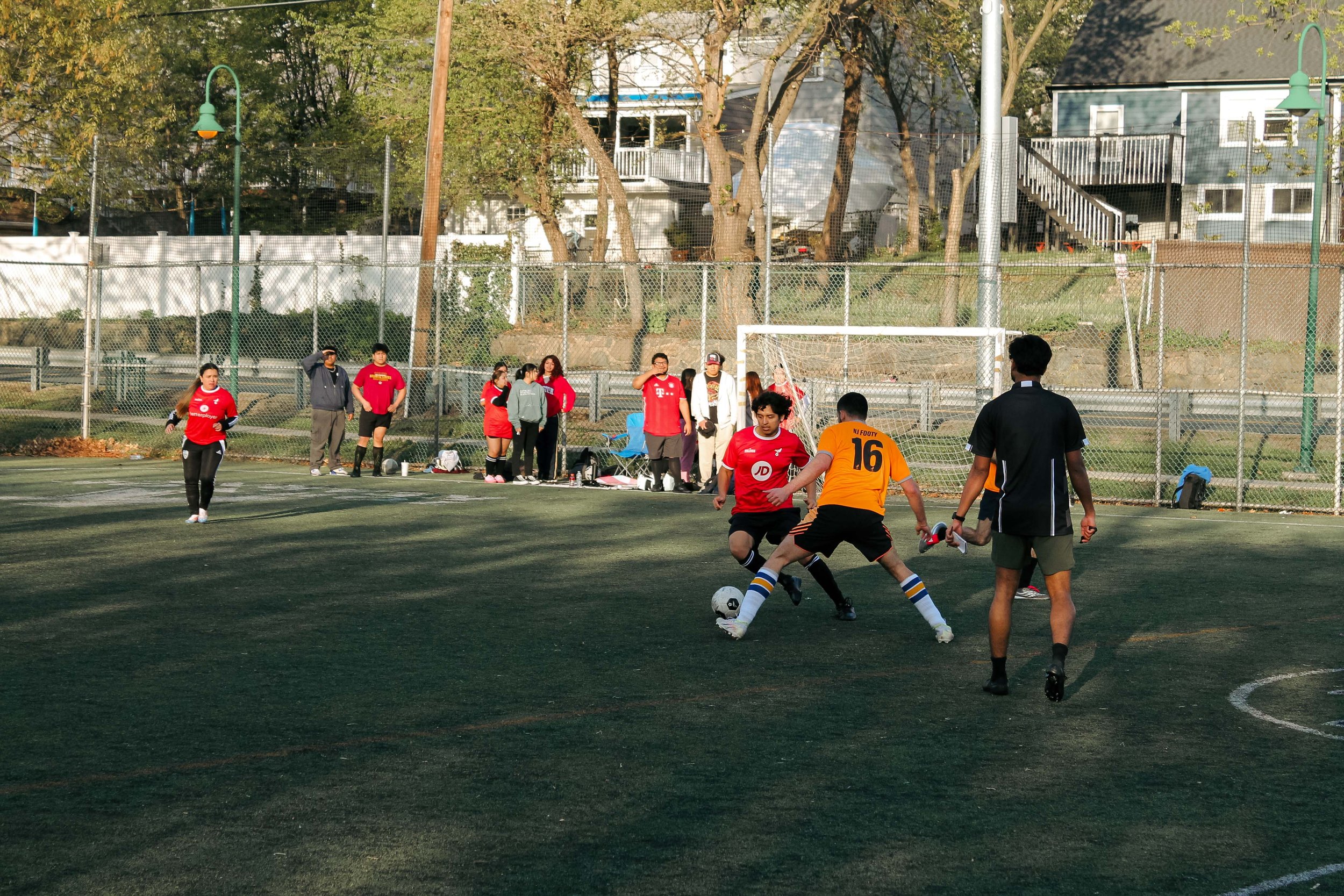
Thistle FC field is now home to an NJ Footy league, the latest add to a great legacy.
NJ Footy kicked off its first-ever spring league at the Thistle FC Field earlier this year, and the pristine outdoor turf makes it one of the best soccer destinations in the tri-state area.
A hidden gem in its own right, the field is also steeped in history - and comes with one of the most extraordinary backstories in American soccer.
An unassuming industrial town of around 40,000 people, Kearny (pronounced CAR-nee) is tucked just west of Manhattan in the shadow of the New York skyline. But its soccer roots run deeper than almost anywhere else in the United States.
Historians have called it the cradle of American soccer - and that's not hyperbole when you see the players Kearny has produced and the influence it has had on a sport which, even today, plays in the shadow of more traditional US pastimes.
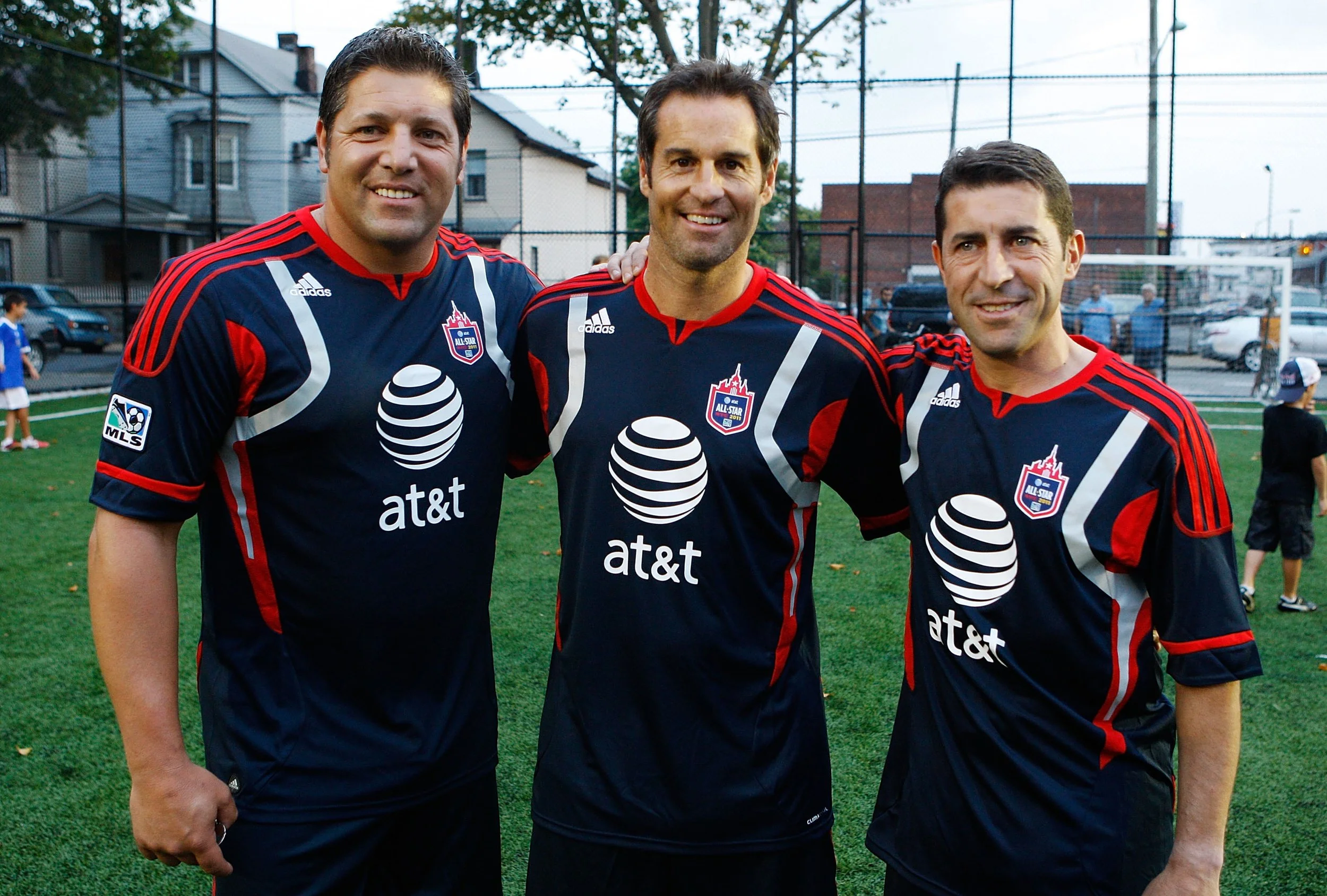
One club - three incredible World Cup caliber talents. Photo: Getty Images Mike Stobe
Harkes, Meola and Ramos
Kearny's passion for the beautiful game traces back to the Scottish immigrants who worked in the mills on the banks of the Passaic River in the late nineteenth century. By the 1880s, a Kearny club had won the country's first three national championships - and that culture has never left the town.
But let's cut to the chase: the extraordinary emergence of three Kearny kids in the 1980s who went on to become senior internationals for their country.
That trio featured Tab Ramos, John Harkes and Tony Meola - three kids from the same small town, the same club, the same streets. Think about that for a second. One World Cup player emerging from a town of 40,000 is fortunate. Two is remarkable. Three, from the same club, at the same time, is the kind of thing that doesn't happen in real life.
Except it did. Right here.
"It's not like this everywhere?"
What makes it even more extraordinary is the backdrop. This was 1980s America - a country that barely knew soccer existed. No MLS, no national footprint, no culture of the game beyond tight-knit immigrant communities.
But Harkes, for one, had no idea. "On the street, on the corners, we did it all the time," he later recalled. "We didn't realise that it wasn't like that everywhere else. We thought Kearny wasn't any different than anywhere else." They were kids with a passion for the game in a country that didn't share it - they just didn't know it yet.
The passion came from Kearny itself - and specifically from the Scottish immigrant coaches who shaped them. Harkes was the son of Jimmy Harkes, a Dundee-born footballer who'd grown up in the shadow of Tannadice. The coaches who drilled Ramos and Meola were cut from the same cloth - Scottish fathers who'd arrived in Kearny and carried the game with them.
Never mind that Ramos was of Uruguayan heritage and Meola Italian-American. In Kearny, they were football players, and that meant being schooled the Scottish way. Ramos became "wee man." Meola was "big man." The nicknames said everything.
The careers of midfielders Ramos and Harkes took them in different directions - the former never leaving the US, while Harkes made a name for himself in the English Premier League, primarily with Sheffield Wednesday.
Meola, meanwhile, had a brief spell in English football early in his career before returning home, where he starred for Sporting Kansas City and the New York Red Bulls.
All-Stars
Remarkably, Ramos (82), Harkes (91) and Meola (100) went on to make a combined 273 appearances for the US - the goalkeeper captaining his country at the 1994 World Cup and one of only 17 players to hit a century of games for the Stars and Stripes.
At World Cups, the three Kearny-ites played six times together across the 1990 and 1994 tournaments, Ramos notably with an assist in the US' sole victory during that timeframe (a 2-1 win over Colombia).
Their remarkable journey from Kearny's streets to two World Cups became the subject of the documentary Soccertown, USA - a portrait of three childhood friends who helped inspire future generations across the nation.
Thirty-plus years on, NJ Footy is keeping that spirit alive at Thistle FC Field - where Ramos, Harkes and Meola's stellar footballing journeys began.
With the 2026 World Cup back on US soil this summer, there's never been a better time to play in 'Soccertown'.
Want in? Take the first step and register for our summer league at Thistle Field here.
The NYC Soccer Neighborhood Guide: Riverbank State Park (Hamilton Heights)
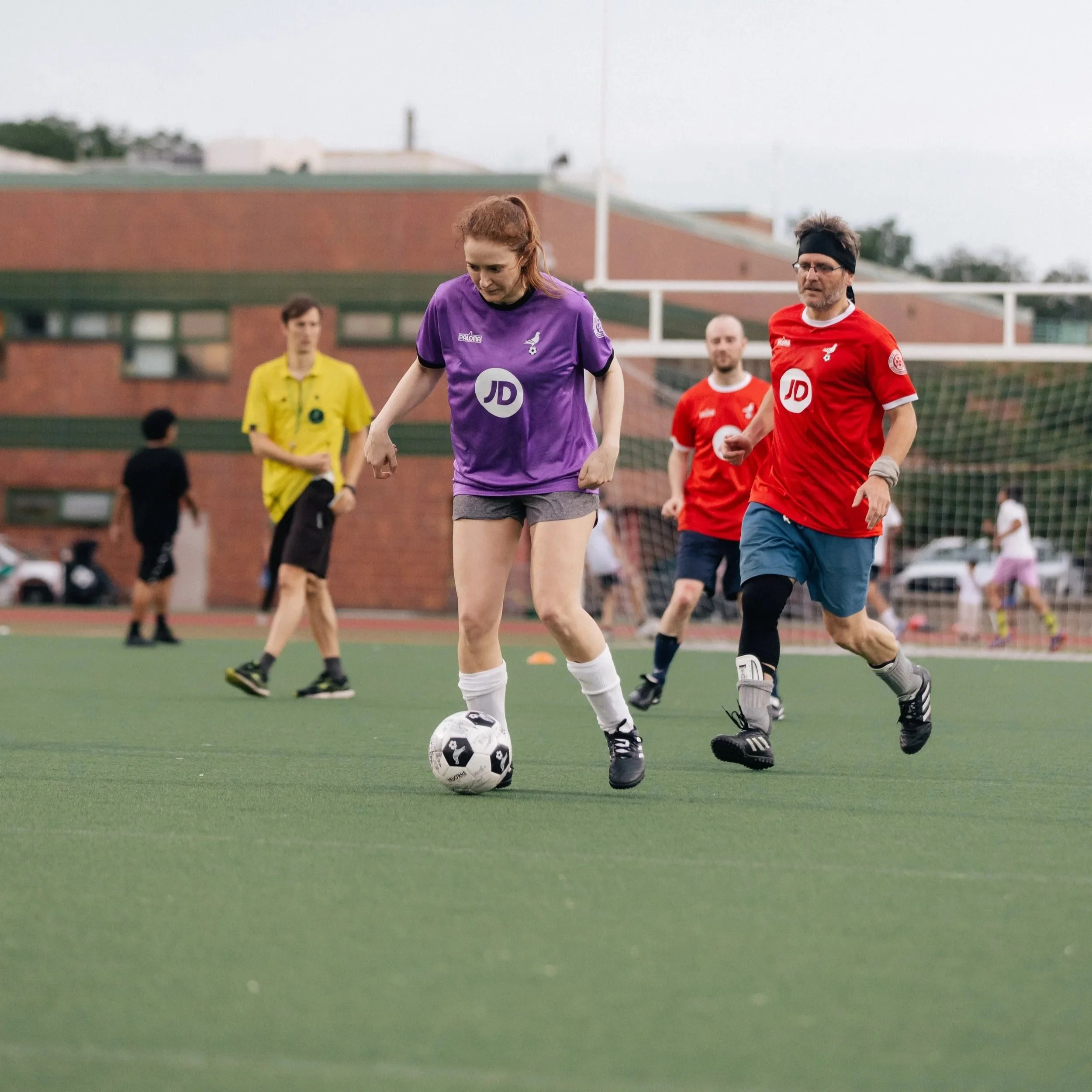
There's Something in the Air at Riverbank State Park
It's a picture perfect spot to ping a long diagonal pass - but there's something truly special in the air at Riverbank State Park.
Located on the rooftop of the North River Wastewater Treatment Plant in Hamilton Heights just north of West Harlem Piers, it draws inspiration from rooftop park facilities in Tokyo - where public green space is built directly on top of working industrial infrastructure. There's nowhere quite like it on this side of the planet, let alone the city, and you would simply never know you were strutting your stuff with 125 million gallons of sewage per day being pumped underfoot.
Cross the pedestrian bridge from 145th Street and Riverside Drive and take in the view. You'll be looking out onto 28 acres of park sitting above the Hudson River: the sweep of the Palisades on one side, upper Manhattan on the other. What a backdrop for a game of soccer.
Getting There
The 1 train drops you at 145th Street, one block from the park entrance and the bridge crossing. The A, B, C, and D trains all stop at 145th Street as well, a few blocks further east - meaning that from almost anywhere in the city, the connections are clean and the journey is straightforward.
If you're coming by bike, the Hudson River Greenway runs at water level along the park's western edge - one of the more pleasurable pre-game rides in the city. From Midtown, around thirty minutes up the Hudson, flat and scenic. Just note that bikes aren't permitted inside the park itself, so lock up before you cross the bridge.
The Destination
Riverbank's pitch sits within a 2,500-seat athletic complex that has recently been renovated, and the freshly relaid turf is up there with the best NYC Footy has to offer.
The broader facility is something else entirely: an Olympic-sized pool, an ice rink that doubles as a roller rink in summer, an 800-seat cultural theatre, tennis courts, basketball courts, and a carousel - all sitting on top of a treatment plant processing 125 million gallons of wastewater every day. How did this happen, we hear you cry.
In the 1960s, the city needed a treatment plant for Manhattan's west side. The original site at 72nd Street - a predominantly white, affluent neighbourhood - was quietly moved north to West Harlem, whose residents only found out when construction was already underway in 1968. The community fought hard, and when it became clear the plant would be built regardless, the fight shifted: if it was coming, they would at least get something in return. After years of battles over odour problems, design flaws, and broken promises, Riverbank State Park finally opened in 1993. Nearly four million people visit every year. Most of them have no idea what lies underneath.
Pre-Game
Mofongo del Valle on Broadway is the move - one of the best Dominican restaurants in Hamilton Heights. Order some rotisserie chicken, crispy pork chicharrón, fried sweet plantains, and a side of rice and beans. Eating all of this before a match will indeed impact your performance so pace yourself!
Post-Game
Sofrito on the Hudson is right there inside the park - a Puerto Rican restaurant and bar with outdoor seating and Hudson River views. Hard to beat for convenience, harder still to argue with the margaritas.
A block or two into the neighbourhood, At the Wallace on Broadway is the go-to - cheap drinks, a vintage jukebox, giant Jenga, and shuffleboard. The kind of place where a post-game debrief can quickly morph into a full-on session.
For sweet teeth: Sugar Hill Creamery's West Harlem location makes small-batch ice cream with flavours rooted in Caribbean culture and Harlem history. A good scoop and a good story.
Team Bonding
Riverside Park is right there at the foot of the bridge - 511 acres of parkland running along the Hudson, quieter up here at the northern end than the stretches further downtown. After a game, on a warm evening, a walk along the river with the Palisades across the water and the George Washington Bridge in the distance is about as good as New York gets. No plan required. Just walk. If you need a photo opp, pay your respects to The Little Red Lighthouse
Stoppage Time
We're not the gambling type, but if we were, we'd wager you've never had a pint on an aircraft carrier. Down at the West Harlem Piers on 125th Street, moored in the Hudson, sits The Baylander.
Originally a US Navy harbour vessel in the Vietnam War, it was later converted into a helicopter landing trainer, earning the unlikely distinction of being the world's smallest aircraft carrier. Decommissioned in 2011, it has operated as a bar and restaurant since 2020 and is well worth a visit.
The NYC Soccer Neighborhood Guide: Astoria Park
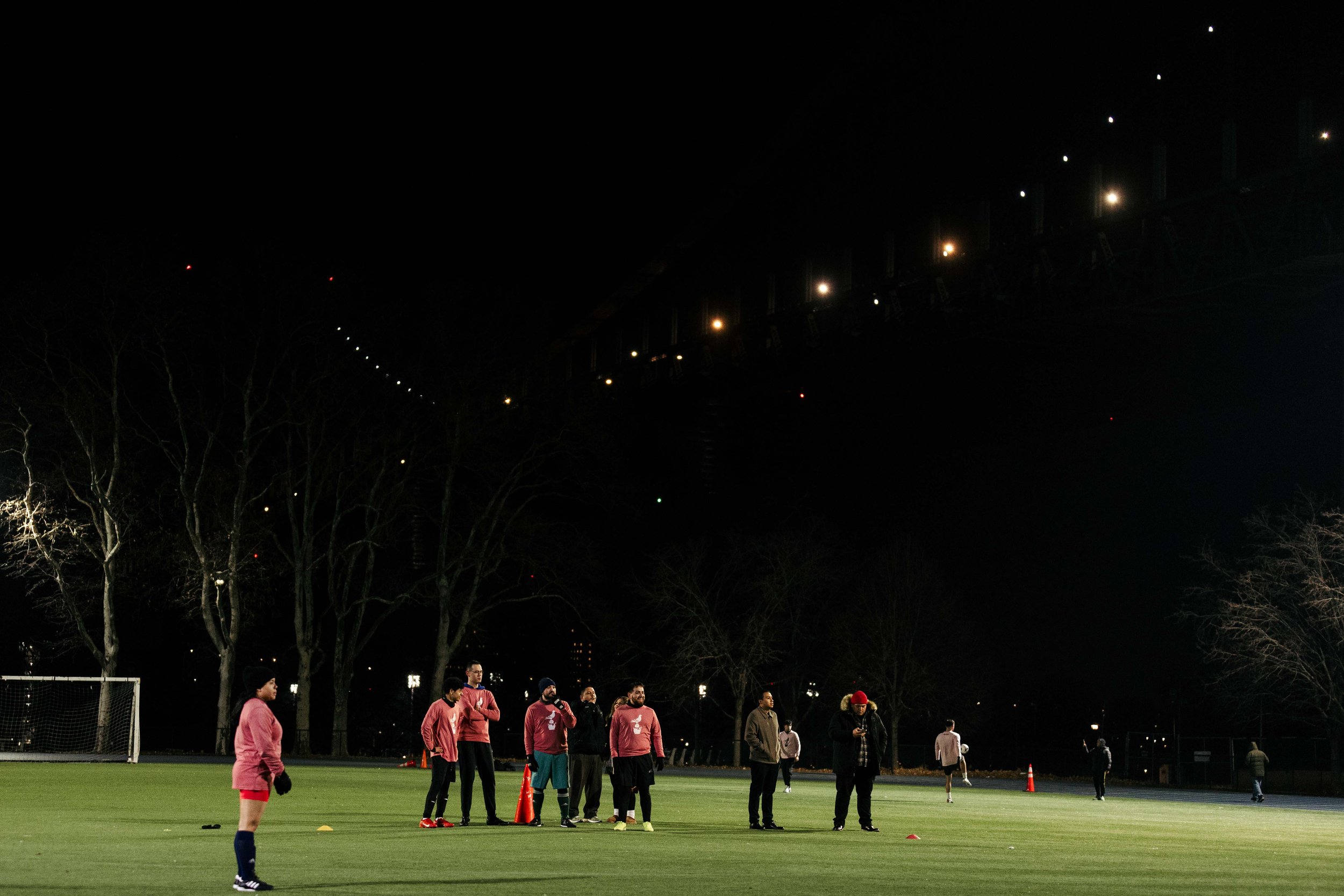
Day or night, Astoria Park brings out the ballers from Queens and beyond!
There's a recurring conversation that reads like a Seinfeld script where people discover Astoria and announce it like they found a new planet. "Have you been to Astoria? It's incredible. The food, the energy, the prices—" Yes. Yes, we know. Astoria has been incredible for a very long time, largely because the people who live there aren't particularly interested in being discovered. They're interested in getting on with it.
We're playing at Astoria Park this summer, and if you've never played soccer within sight of the Hell Gate Bridge and the Triborough, with the Manhattan skyline visible across the water, then you have been living an incomplete life. The park is 60 acres of green space sitting on the East River waterfront in a neighborhood that will feed you exceptionally well before and after your match. This is not a complicated pitch to make. Astoria is excellent. Come play soccer there.
Getting There
The N/W trains to Astoria-Ditmars Blvd drop you about a 15-minute walk from the park. The Q18 bus is another option. If you're driving from Manhattan, the Triborough (RFK) Bridge deposits you practically into the neighborhood. From Brooklyn, the N train makes this a seamless trip. Astoria is, logistics-wise, much easier to get to than people give it credit for.
Pre-Game
Astoria is one of the great food neighborhoods in New York City, and the Greek food in particular is genuinely transportive. Taverna Kyclades on Ditmars Boulevard has a line most nights because it deserves a line — the grilled fish, the octopus, the saganaki — but for a pre-game meal the move is something lighter. Butcher Bar on 31st Street does excellent smash burgers and has the kind of casual outdoor seating that is perfect for a game day afternoon.
For coffee, Patis Pastry is the real deal — a French pastry shop that takes its croissants and espresso with complete seriousness. Pre-game and a pain au chocolat: European in all the ways that actually matter.
The Post-Game
Astoria's bar scene is robust and unpretentious, which is exactly what you want after 60 minutes of chasing a ball. Queens Brewery is the local choice and the right call — a neighborhood craft brewery that actually feels like it belongs in the neighborhood, which is rarer than it should be. The outdoor seating in summer is among the best post-game spots we can recommend anywhere in the five boroughs.
For watching soccer specifically, Café Bar on 31st Street is Astoria's de facto soccer watching hub, with screens that run Champions League, Premier League, Serie A, and whatever else is on. The crowd actually knows what they're watching, which is the baseline requirement for a good soccer bar and, depressingly, still not universal across the city.
Team Bonding
Astoria Park itself is worth at least an hour of your time after the match. The views from the park's upper section, looking south toward the Hell Gate Bridge and across the water to Randall's Island, are some of the most quietly spectacular in the city. Most tourists never see this. That's their problem.
The neighborhood's cultural landscape is anchored by the Museum of the Moving Image on 35th Avenue, which is one of the most underrated museums in New York and a perfect rainy-day option if the weather turns. On a clear summer day, though, there's really nowhere better than the waterfront park, with something cold in hand, decompressing from the match.
Stoppage Time
Astoria has been one of New York's great neighborhoods for a very long time and it will continue to be long after every trend has moved on. Playing soccer at Astoria Park — with those views, that neighborhood at your back, Queens Brewery waiting for you at full-time — is the kind of afternoon that converts people. We've seen it happen. Come play here and see for yourself.
Check nycfooty.com for current league listings by location, and visit our bar partners page for exclusive deals at the spots featured in this series.
The Right Call: Why Inwood Manhattan Fields Are Where Ballers Need to Play This Summer
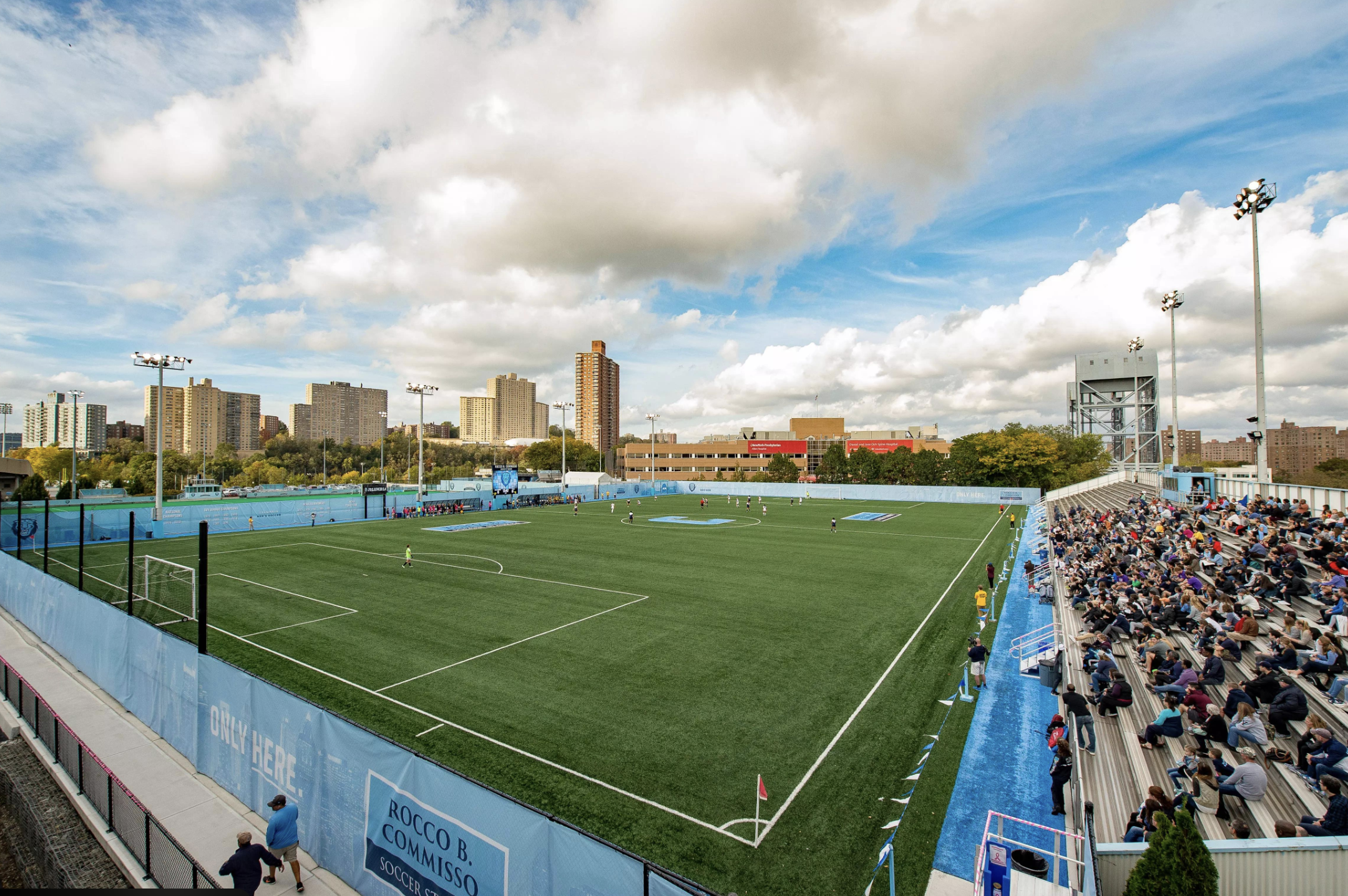
Rocco B. Commisso Stadium, home of the Columbia Lions and now your NYC Footy team!
This summer, make Manhattan's wild northern tip your preferred setting for soccer supremacy - especially if you’ve ever wanted to play in an NCAA dedicated soccer stadium!
Most leagues hand you a field. NYC Footy is here to give you that stadium feel.
We're talking about Rocco B. Commisso Soccer Stadium and Robert K. Kraft Field at Lawrence A. Wien Stadium — Columbia University's home soccer and football venues, sitting on 21 acres at the very northern tip of Manhattan, with views of the Hudson River and the Palisades framed behind the west stands. Sports Illustrated once called it "one of the most beautiful places in the country to watch a football game." And now, it’s yours for the taking!
Kicking off on April 27th with a full spring season ahead, NYC Footy teams will battle it out on Monday nights - check out our registration page for the full details here.
If this is your first time hearing the name Inwood, we’re here to outline the highlights of Manhattan’s northernmost neighborhood.
Here's what you need to know before you make the trip.
The Fields
Rocco B. Commisso Soccer Stadium has been the home of Columbia Lions soccer since 1984, seats 3,500, and features a FieldTurf Revolution 360 playing surface — a hybrid fiber, rubber and sand infill designed for a more consistent feel and a faster pace. Columbia University The stadium is named for Rocco Commisso, Columbia's former soccer co-captain, founder of Mediacom Communications, and current owner of ACF Fiorentina in Serie A. The man played on this field and went on to buy an Italian football club. No pressure.
Right next door is Robert K. Kraft Field at Lawrence A. Wien Stadium, a 17,000-seat football stadium on the banks of the Hudson and Harlem Rivers, ranked the No. 1 football stadium in the Ivy League and No. 9 nationally among all FCS stadiums by Stadium Journey. Columbia University If you've ever wanted to know what it feels like to line up for kickoff with a proper stadium atmosphere around you — stands, press box, river views — this is your Monday night.
Both fields sit at 505 West 218th Street within Columbia's Baker Athletics Complex, a 21-acre facility that has served the university since 1923 and borders the Hudson and Harlem Rivers to the north and west. Columbia University
Getting There
By Subway: Take the A train to 207th Street, then it's a short walk north and west to the complex. Alternatively, the 1 train to 215th Street puts you right at the Broadway entrance to Baker. No transfers, no drama — this is one of the most straightforwardly subway-accessible venues in the league.
By Bus: The M100, Bx7, and Bx12 all stop along Broadway near 207th and 218th Streets. If you're coming up from Washington Heights or crossing from the Bronx, this is likely your smoothest option.
By Car: Henry Hudson Parkway exits practically into the complex. Street parking on Monday evenings in this part of Inwood is more forgiving than you'd expect. If you're organizing a carpool from downtown, this is a reasonable drive.
Pre-Game Meals and Points of Interest
Monday night games mean you're heading up after work, which is perfect — Inwood's restaurant scene, anchored by a deep Dominican and Latin American dining culture, is fully operational and ready for you.
Dinner Before the Match
Cachapas y Más on Dyckman is an Inwood institution — always playing Latin music videos from a better decade, and serving what The Infatuation calls the best patacon in New York City. That's a Venezuelan sandwich where fried plantains replace bread entirely, and it will genuinely make you question every sandwich decision you've made before this one.
Patok by Rach is a casual Filipino spot near the 215th Street station where they know their way around pork. The lechon kawali is equal parts thick crunchy skin and thick melty fat, and the short menu of Filipino classics is exactly as good as it sounds. The Infatuation Order one more dish than you think you need, spoon vinegared onions and cucumbers onto your pork belly, and show up to kickoff ready.
For small plates and something to drink before the match, FiTo on Broadway does South American-inspired bites and killer sangria on a cozy sidewalk patio. It makes a Monday evening feel like a choice rather than a consolation.
A Pre-Game Beverage:
Buunni Coffee on Broadway is Inwood's neighborhood coffeeshop done right — Ethiopian-sourced beans and enough tables for the whole team to decompress after the commute. If the occasion calls for something stronger, The Hudson at Dyckman Marina has waterfront seating on the Hudson River and a relaxed, beach-concession vibe that's genuinely hard to beat on a warm evening.
Victory Drinks:
When the final whistle goes, the move is back to The Hudson for a cold drink by the water, or to FiTo's bar where the sangria hits differently when you've earned it.
Team Bonding: What Makes Inwood Worth the Trip
Baker Athletic Complex doesn't exist in a vacuum — it sits right against Inwood Hill Park, which contains the last natural forest on the island of Manhattan. If you arrive early enough, walk the tree line before warmups. There's a boulder near the park marking the spot where Peter Minuit supposedly purchased Manhattan from the Lenape people. There are caves where Hessian soldiers sheltered during the Revolutionary War. Bald eagles have been released here by Urban Park Rangers. The views of the Palisades from the ridge are, frankly, unreasonable for a place accessible by subway.
The neighborhood hasn't been discovered the way Red Hook or Williamsburg have. It still belongs to the people who live here. That's the whole appeal.
Final Minutes + Stoppage Time Thoughts
Most of the fields we play on are just fields. This one has stands, a press box, river views, and a history that runs from Columbia Lions doubleheaders to MLS Open Cup semifinals to a field hospital built during the worst weeks this city has ever seen. The A train takes you there in under half an hour. The FieldTurf is fast. The stadium atmosphere is real.
We spend so much time complaining about where we play that we forget to notice when we've landed somewhere genuinely special. Monday nights at Baker Athletic Complex are special. Make the trip.
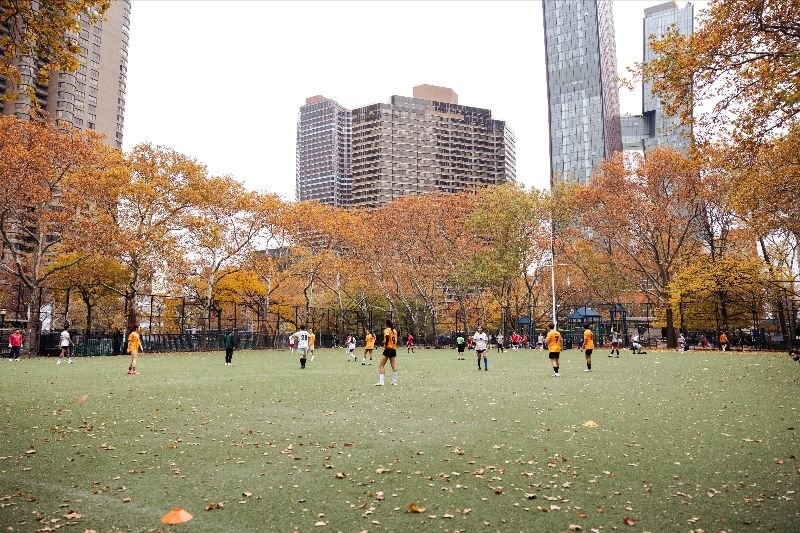
A Letter on the Status of Recreational Soccer in NYC
NYC Has a Soccer Problem — and the World Cup Can't Fix It Alone
Hi Footy Friend,
I certainly don't expect you to prioritize this letter over the many other important matters in your life. But if your recreational soccer experience is important to you, please take the time to give it a read (as it is a lengthy update) or drop it into CGPT or Claude and prompt an appropriate summary.
It is worth noting, that though we've done our best to shield the below burden from you, it remains the most important we're faced with as a community and this fight belongs to all of us.
Having written and rewritten a draft to you numerous times over the past 18 months, it's finally time to hit send. I hope that together with you and the collective energy of this great community, we can finally make change happen.
Here's the gist:
With the World Cup coming to New York City, we have a rare opportunity not just to celebrate the game, but to force a long-overdue conversation about why access to soccer remains so difficult in one of the world’s great soccer cities.
We might be the largest participation league in this city. We may have leagues all over the boroughs (we'll get there soon, Staten Island). But the truth is that we can't accommodate the vast majority of our community in any given season and we're one of many community organizers sharing in this struggle.
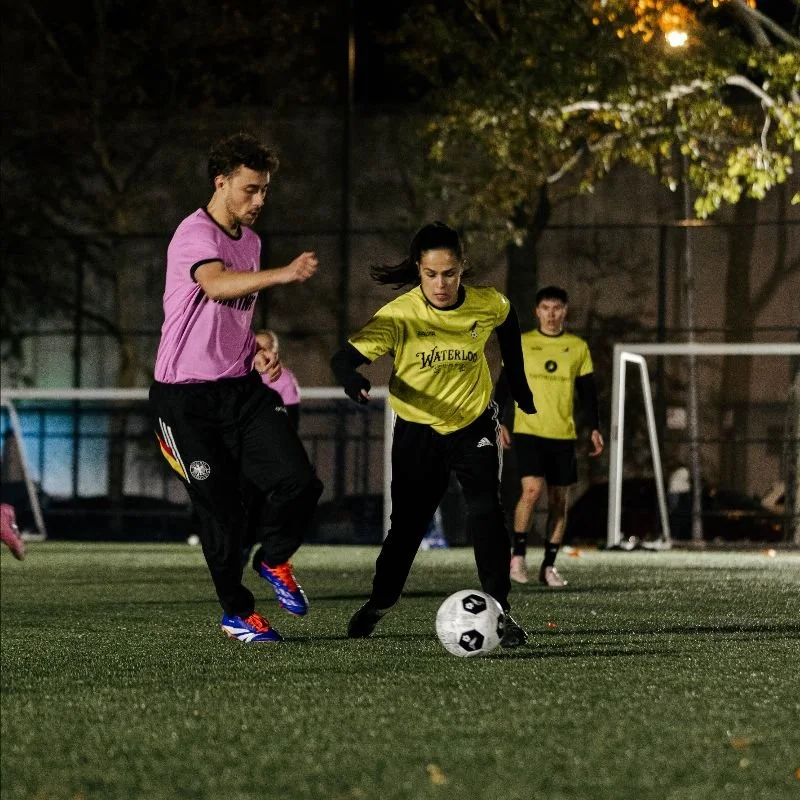
Just breaking up the text a bit with a photo of Chelsea Park (a field that may soon lose its lights).
The Lack of Field Accessibility Leaves You and Tens of Thousands On The Sidelines
When we talk about accessibility, we are really talking about two separate but connected issues: field lighting and permitting.
First, the city has dramatically underinvested in field lighting. The consequence is simple: when the sun goes down, the game stops. For working adults, families, and anyone who cannot be on a field in the middle of the day, that is not a minor inconvenience. It is a direct barrier to building healthy physical, mental, and social routines through sport.
To be clear, we are not asking for more fields. New York already has fields. We are asking for the ability to actually use them. By way of example, there is not a single Parks field with lights between Chinatown and Harlem on the east side of Manhattan (and only 1 on the west side).
Second, the permitting system is outdated and no longer reflects how New Yorkers use public space. The most widely accessible fields are designated as multi-purpose, but in spring and summer, those fields are prioritized for baseball and softball. Soccer’s priority window is fall and winter, when reduced daylight and weather sharply cut into usable hours. That framework may make sense for youth sports tied to school calendars, but it does not reflect adult demand.
And demand matters. By the Parks Department’s own admission, soccer demand in this city is as much as seven times greater than baseball and softball. It's the most popular sport by far at both the youth and adult levels. Yet the rules and infrastructure still do not reflect that reality, nor has there been a public discussion to work towards a resolution.
To help illustrate this, just today (you can't make this timing up), The NY Times released this article on NYC's "Soccer Desert" based on this State of Soccer in NY and NJ report from Aspen Institute.
Institutional Challenges Facing the Parks Department
I want to be fair here, because it really does matter.
The Parks Department has a difficult job. It manages an enormous portfolio of public space with real constraints, competing demands, and limited resources (not the least of which is a far-too-skinny budget). And after working with parks departments in multiple cities, I can say that New York’s is more functional than most.
Our frustration has more to do with a system that has shown an inability to evolve, even when presented with practical opportunities that would help everyone (and in some cases, immediately).
What we have seen over and over again is not thoughtful engagement with solutions, but missed opportunities, decisions made in a vacuum, bureaucratic drift, and an unwillingness to treat community-building organizations as true partners (more on this towards the end).
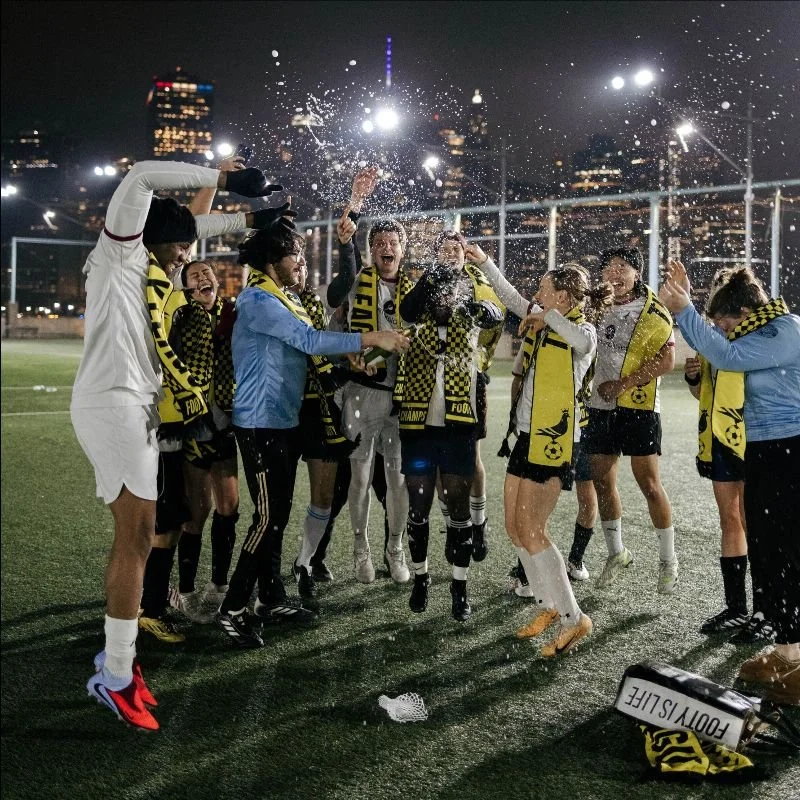
Another break in text for you. This time, a field with lights that has given so many New Yorkers the best possible soccer memories for nearly 15 years!
For fifteen years, we have built community in New York City parks.
We have helped tens of thousands of New Yorkers get outside, be active, meet people, and create routines around sport. We have been one of the city’s largest permit holders for years. We represent roughly 60,000 New Yorkers who use NYC Parks for recreational soccer.
And in all that time, not once has Parks Department leadership reached out to ask how they can better support the communities we are building, how we might partner more effectively, or what they, in partnership with us, can do to better serve the New Yorkers who rely on these fields.
Not once.
That is worth sitting with.
Because over those same fifteen years, we have not simply complained. We have repeatedly tried to help. We have proposed professional-grade goal donations at numerous fields. We have offered to fund temporary lights and even secured free permanent lighting from a partner (deployed at non-soccer field locations). Two years ago, we were central to securing $2 million in funding for lights at St. Vartan Park, working alongside then-Council Member Keith Powers. Sadly, the Parks Department has still not taken the action necessary to put those dollars to work.
We have brought forward ideas, support, resources, and persistence. We have followed the process, respected the system, and continued showing up in good faith even when it was clear our efforts would not be seriously considered.
When we have tried to invest in the city’s parks and fields in tangible ways, we have been met not with partnership, but with delay, deflection, and silence.
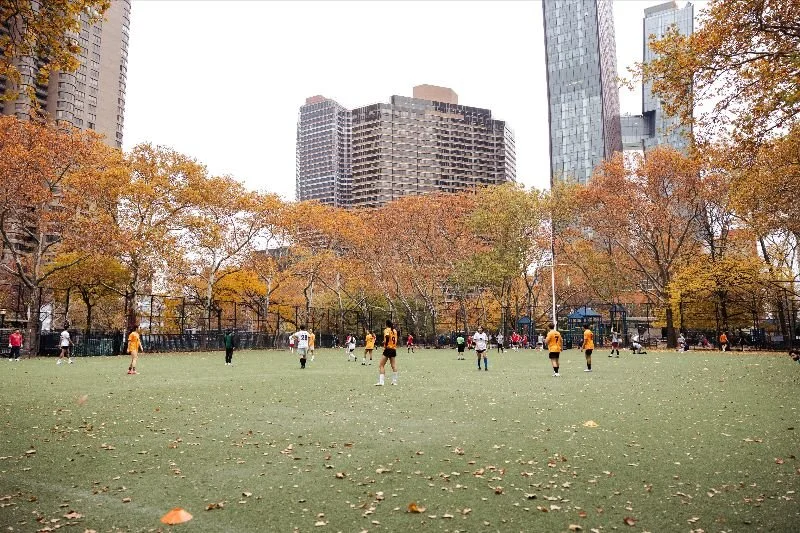
St. Vartan Park has the funding for lights - but next steps are not yet in sight.
This pattern shifted my focus towards elected leaders, where recently we've engaged the offices of Council Members Restler, Hankerson, Marte, Maloney, and Epstein, all of whom represent parks that our players use and that still lack adequate lighting.
Council Member Hankerson, who chairs the Parks and Recreation Committee, has been especially important in this process and Council Member Maloney helped ensure newly-appointed Parks Commissioner Tricia Shimamura received a letter I wrote laying out the full picture and the scale of the opportunity before the city.
You can find that letter here.
This effort expands on years of advocacy, years of follow-up, years of attempting to solve these issues through patience, relationships, and direct engagement. I'm hopeful, but as you'll see, we need help.
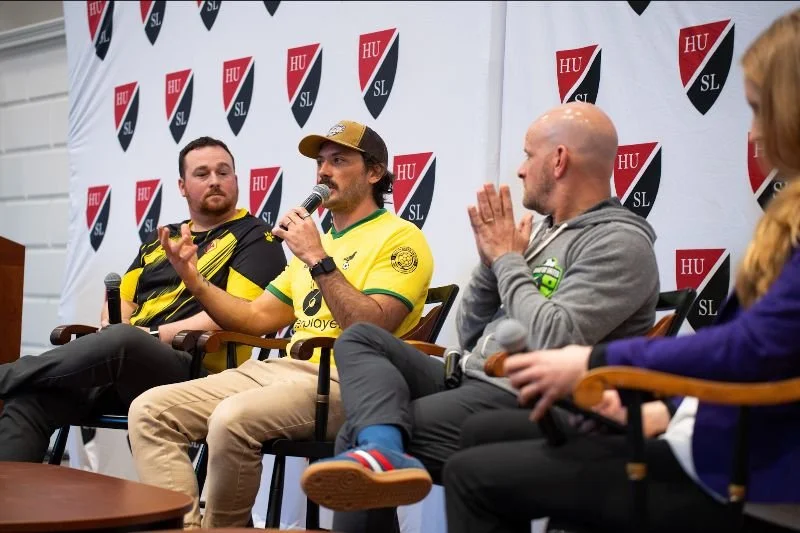
My panel discussion on community at Harvard University last week took a different tone after a "meeting" the previous night with Parks.
A Critical Meeting With Parks Leadership Is Secured
Why am I choosing now to share all of this with you? Well, you're about to find out.
Recently, our work appeared to be reaching a turning point.
After years of advocacy, we succeeded in building a meaningful coalition of council members whose districts would directly benefit from expanded lighting and better equipment access.
In fact, Council Member Hankerson and his special advisor, Clive Destiny, had spoken directly with Commissioner Shimamura, who was reportedly enthusiastic to find immediate solutions: if NYC Footy would pay for the lights, the Department would make it happen. That was the understanding. That was the opportunity.
And that effort helped lead to what would be our first ever meeting with Parks Department senior leadership. A meeting to finally advance this lighting effort.
It would be the most important meeting in the history of our relationship with the Department.
The date and time of that meeting were specifically set to accommodate the schedules of the Department’s Chief Strategy Officer and Chief Marketing Officer. It was the culmination of years of work and the first moment that felt like it might convert advocacy into actual progress.
It landed on a Friday afternoon during a family trip to Boston (see above photo). I left my wife and daughters at the museum so I could be fully prepared and fully present for a conversation I believed could change the trajectory of field access in this city.
Except the two executives from Parks leadership whose schedules had dictated the meeting, the Chief Strategy Officer and the Chief Marketing Officer, didn't show up.
There was no warning and no explanation. There was no meaningful follow-up. No indication that the significance of the moment was understood. Instead, the call consisted of me, representatives from three council offices, and the head of permits — someone with whom I had already had countless conversations on this very topic.
That moment clarified something painful: when community organizations do years of work, assemble public support, offer private funding, and come to the table with real solutions, Parks Department leadership still does not reliably meet that effort with seriousness.
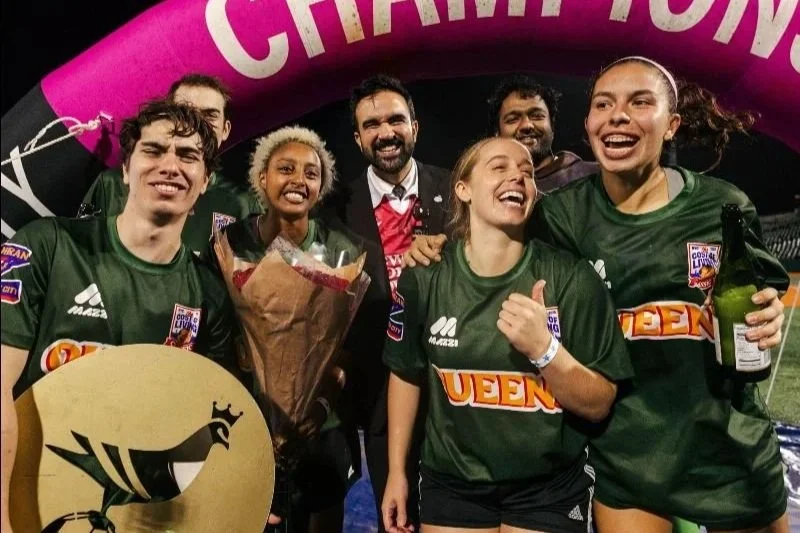
Another break in play. Enter The Mayor's Office
Working with the Mayor's Office
As many of you know, Mayor Mamdani is a veteran of NYC Footy. NYC Footy also produced his campaign's Cost of Living Classic tournament last fall. Therefore, we know, quite confidently, that this administration, like no other, knows the importance of field access and its impact on communities.
I also recently testified at a City Council hearing on the World Cup’s economic impact which questioned the Mayor's office and the EDC on what they are doing to ensure this city benefits tremendously from what will be the largest entertainment event in the history of this great town. If interested, you can read that testimony here.
At that hearing, I said plainly that without lit fields, our playing capacity is severely restricted and the city is leaving enormous social and economic value on the table. It's a citywide issue that becomes even more urgent with the World Cup approaching.
What made that hearing especially frustrating, however, was hearing the mayoral-appointed World Cup czar state that the administration was already in dialogue with leagues on these issues.
I want to be careful and fair in how I say this. I respect the current administration and I can only imagine how long it takes to properly get up to speed, let alone understand where Parks access falls on the massive list of priorities. I also want to be clear that I believe this administration has people who genuinely want to get things right.
But I also owe you honesty.
That statement did not reflect our experience at the time.
Before that hearing, we had made no fewer than five separate attempts to reach that office and sadly not one received a response. So when public claims are made that this engagement is happening, while the truth is that our real efforts are being ignored, that gap matters. It matters because accountability matters. And it matters because our community deserves to understand just how hard we have tried before asking anything of you.
The good news is that since that hearing (and because of that hearing), I am in regular communication with two members of the mayor's office on World Cup matters. It goes without saying that this is encouraging news.
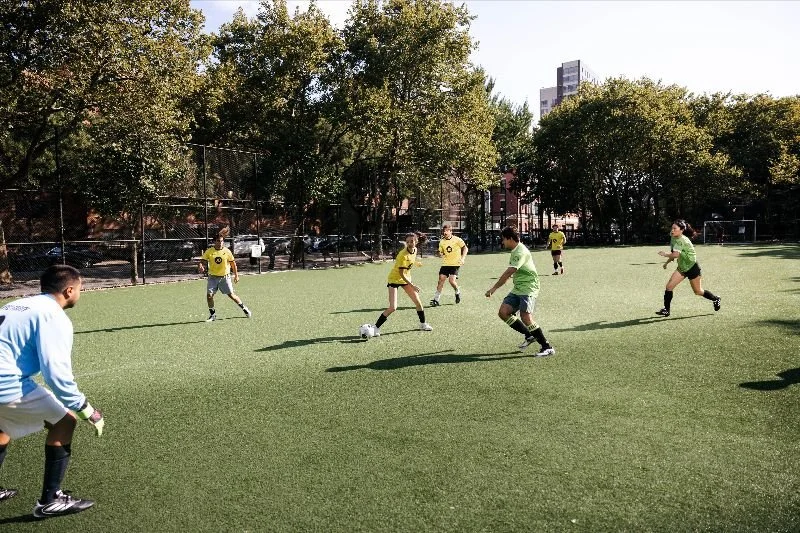
Nike Field, a field that has already successfully implemented temporary lighting
What it may take to be seen as a true partner
Where does all of this leave us?
It leaves us with the reality that the deeper issue is the absence of a real partnership model between the city and the organizations that bring people into its parks.
Our goals should be aligned. We are helping New Yorkers get active, connected, and outside. We are doing the work of community-building that public agencies say they want to support. And yet, for years, the relationship has too often felt transactional at best and adversarial at worst.
That is not sustainable. That is not good enough. It needs to change.
What we are pushing for is not special treatment. It is a functional and modern relationship in which leagues that serve the public are recognized as partners, and where support, donations, infrastructure investment, and practical ideas are actually met with engagement.
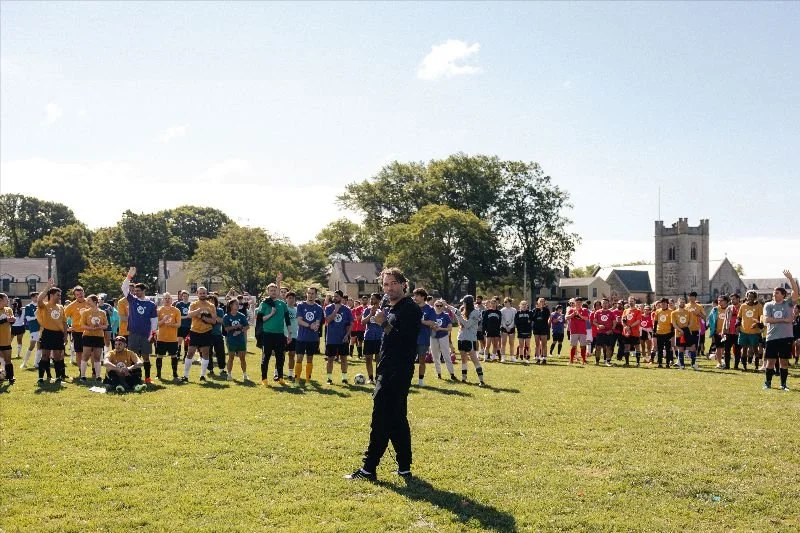
Will you join me in creating greater accessibility?
Finally, how can you help?
I understand that a letter like this — lengthy, not particularly optimistic, and sent to our full community — will likely make its way back to the Parks Department. And I’ll be honest: based on our experience, I worry it may be received with frustration or even contempt, and not as an opportunity to lean in. In short, I worry that we could find ourselves on the receiving end of pushback rather than partnership.
I hope that’s not the case. Because this is written out of a genuine desire to solve a problem that affects countless New Yorkers.
As I hope you now gather, I have done everything I can to avoid putting this burden on you and other members of our community. But we are nearing the point where collective action is necessary.
I have written all of this to ask this one thing of you: Be prepared to act.
Soon, we will come to you with a formal ask — signatures, voices, and public support. When that moment comes, I hope you will stand with us.
Every match you play is proof that this fight matters. You deserve fields you can actually use, infrastructure that reflects the role this sport plays in New York City, and a city that sees this community for what it is: a powerful force for health, connection, and public life.
Bye for now,
Tarek
Co-Founder & CEO, The Footy League
NYC Has a Soccer Problem — and the World Cup Can't Fix It Alone
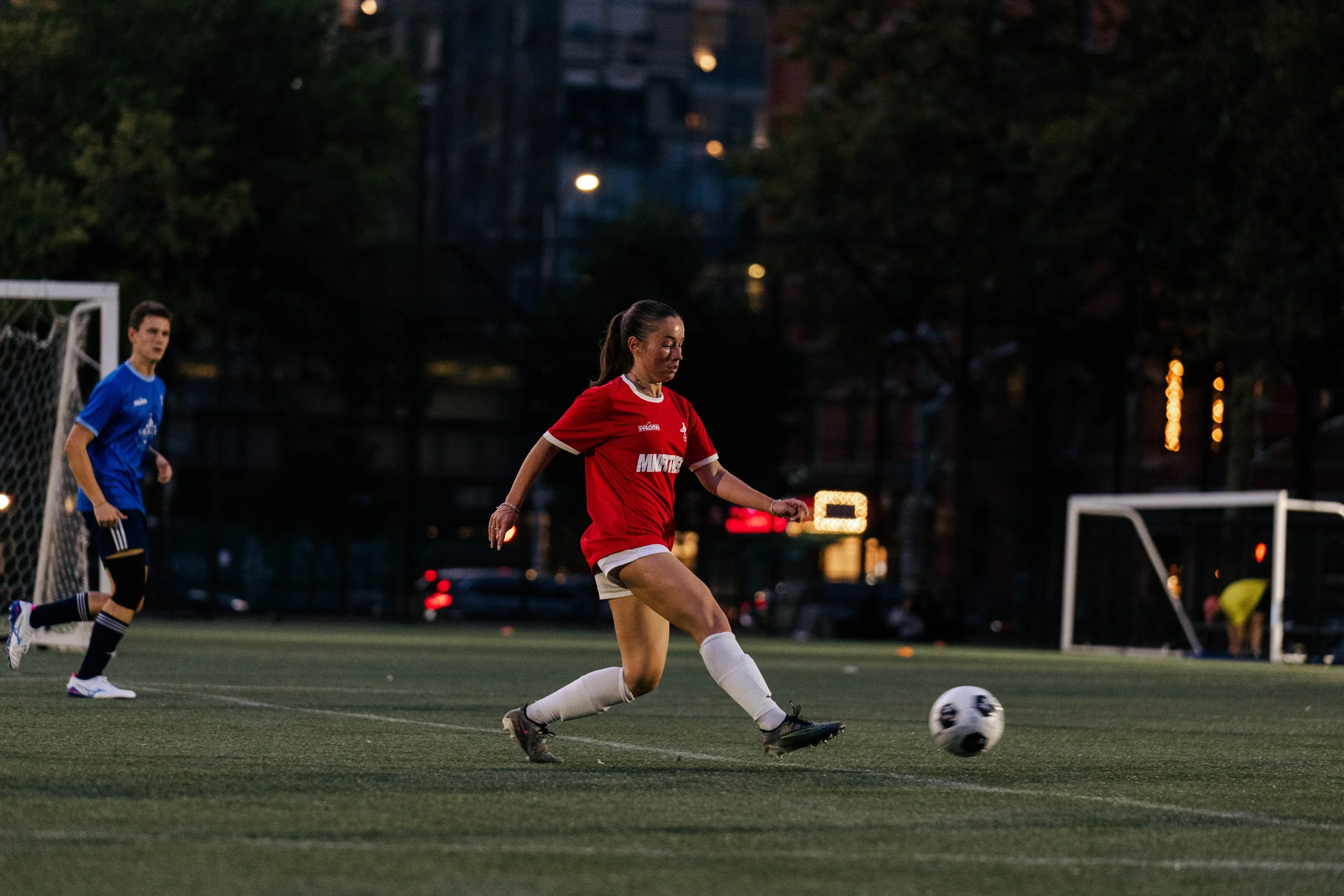
Want more evening matches? We’ve got a game plan in place - and need you on board!
New York City is home to one of the largest recreational soccer communities in the country. So why can't most of its players find a field to play on after dark?
With the World Cup coming to New York City, millions of eyes are about to turn to this city and its relationship with the beautiful game. But beneath the excitement of that moment lies a harder story — one about the tens of thousands of New Yorkers who want to play soccer and simply cannot.
Not because there are no fields. New York already has fields. But because most of them go dark when the sun goes down, thanks to a permitting system built for another era (The Dark Ages, perhaps) that still governs who gets to use them.
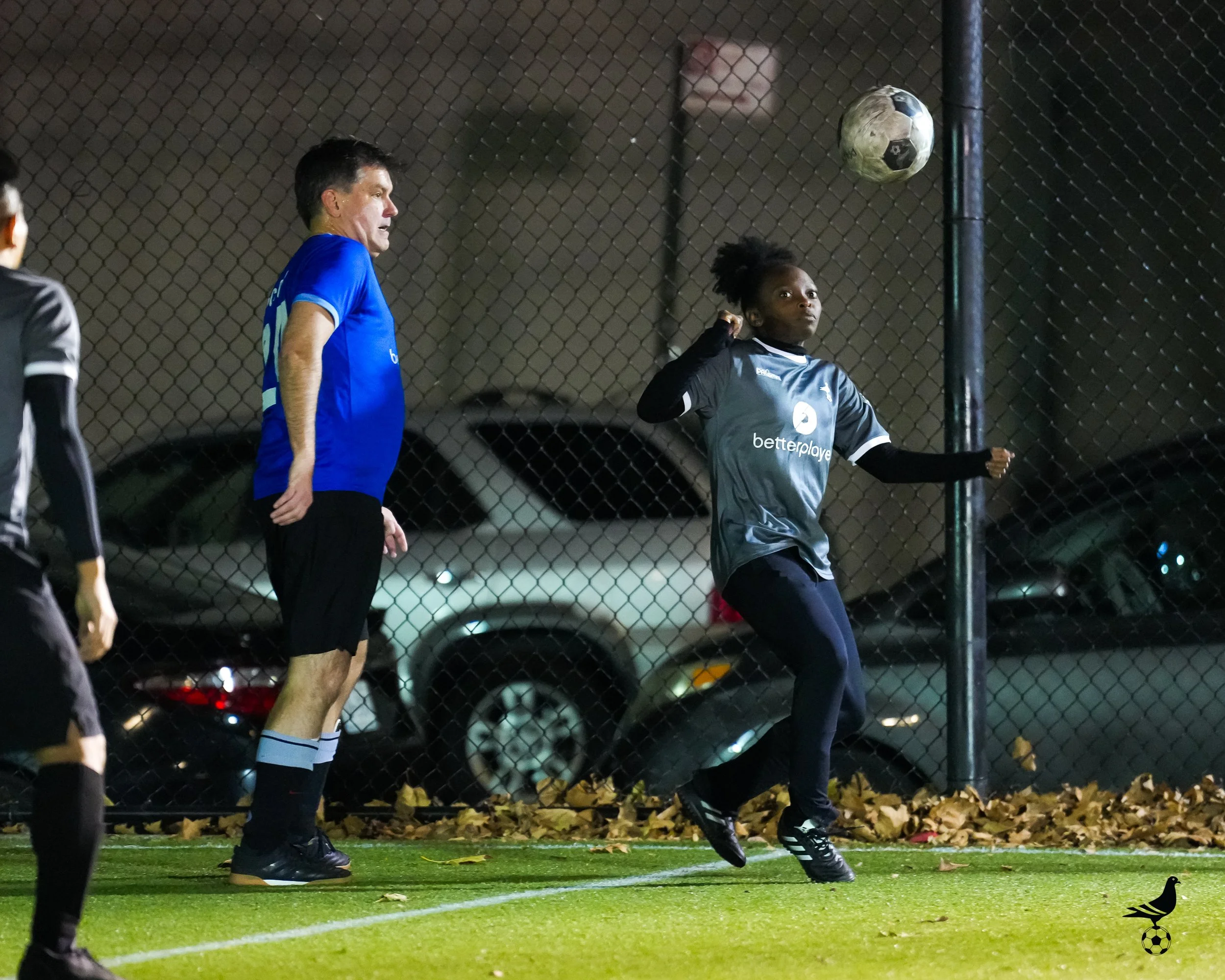
Tanahey Playground is one location where a lighting solution was added - only to be removed.
When the lights go out, the game stops
For working adults, families, and anyone who can't be on a field at noon on a Tuesday, the absence of lighting is not a minor inconvenience. It is a direct barrier to the kind of physical, mental, and social routines that sport makes possible.
The city's permitting framework compounds the problem. Multi-purpose fields are prioritized for baseball and softball in spring and summer — the very seasons when daylight and weather are most favorable. Soccer's priority window is fall and winter, when shorter days and cold sharply limit available hours. This framework may have made sense when it was designed, but it no longer reflects how New Yorkers actually use public space or what they're asking for.
"By the Parks Department's own admission, soccer demand in this city is as much as seven times greater than baseball and softball. Yet the rules and infrastructure still do not reflect that reality."
Fifteen years of showing up — and being ignored
The Footy League has been one of the city's largest park permit holders for years. We have proposed goal donations at numerous fields. We offered to fund temporary lighting. We even secured free permanent lighting from a partner — lighting that was ultimately deployed at non-soccer locations. Two years ago, we helped secure $2 million in funding for lights at St. Vartan Park. As of today, that money has not been put to work.
What's perhaps most striking is this: in fifteen years of building community in New York City parks, Parks Department leadership has never once reached out to ask how they could better support the communities we're building, or what a real partnership might look like.
Not once.
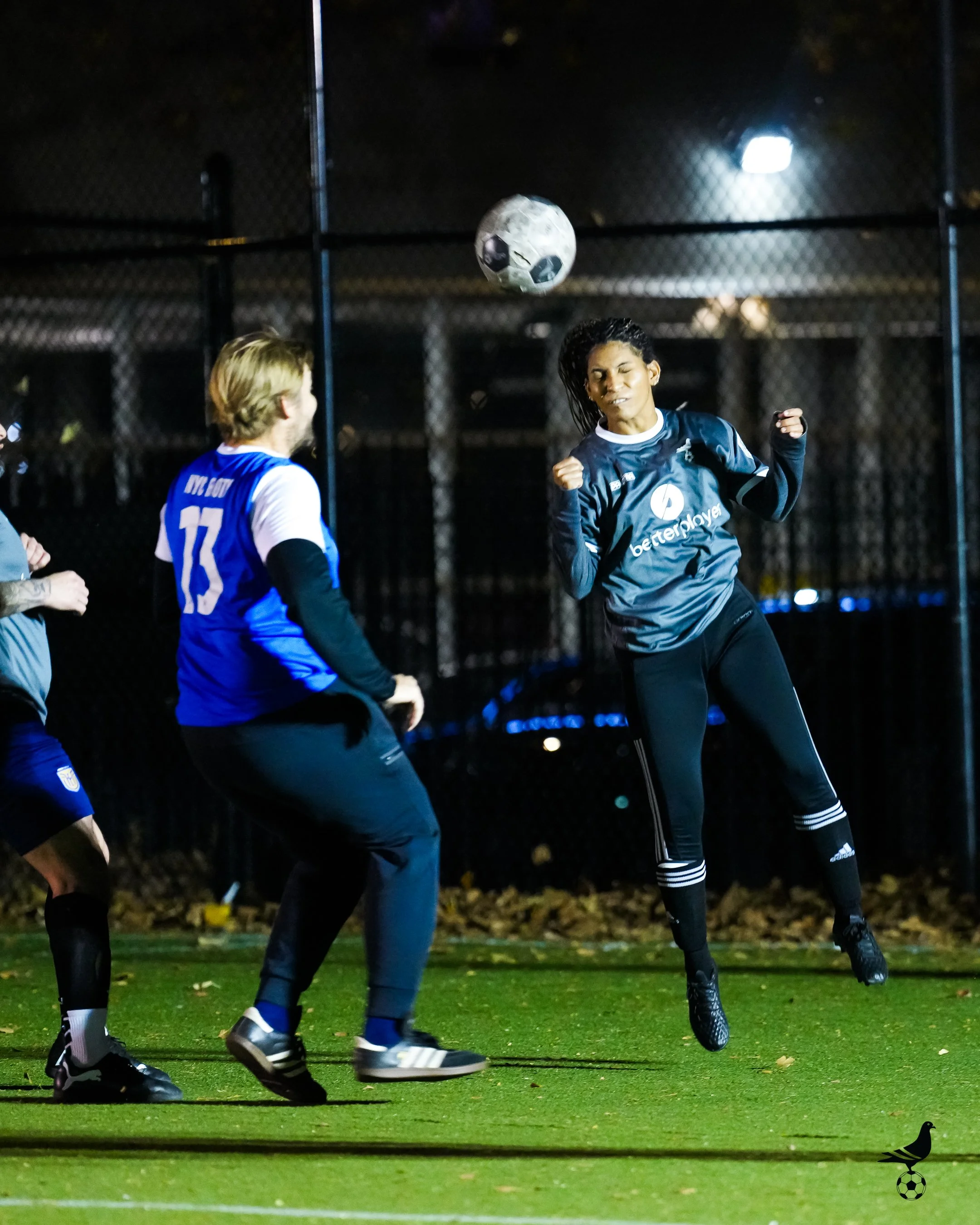
Solutions exist - it’s just a matter of getting into the right headspace
A meeting that wasn't
Earlier this year, years of advocacy appeared to be reaching a turning point. A coalition of supportive council members had been assembled. Commissioner Shimamura had reportedly expressed enthusiasm for a solution. A meeting with Parks Department senior leadership — the most significant in our organization's history — was finally scheduled.
The meeting was set specifically to accommodate the schedules of the Department's Chief Strategy Officer and Chief Marketing Officer. And then, without warning or explanation, they didn't show up.
"When community organizations do years of work, assemble public support, offer private funding, and come to the table with real solutions, Parks Department leadership still does not reliably meet that effort with seriousness."
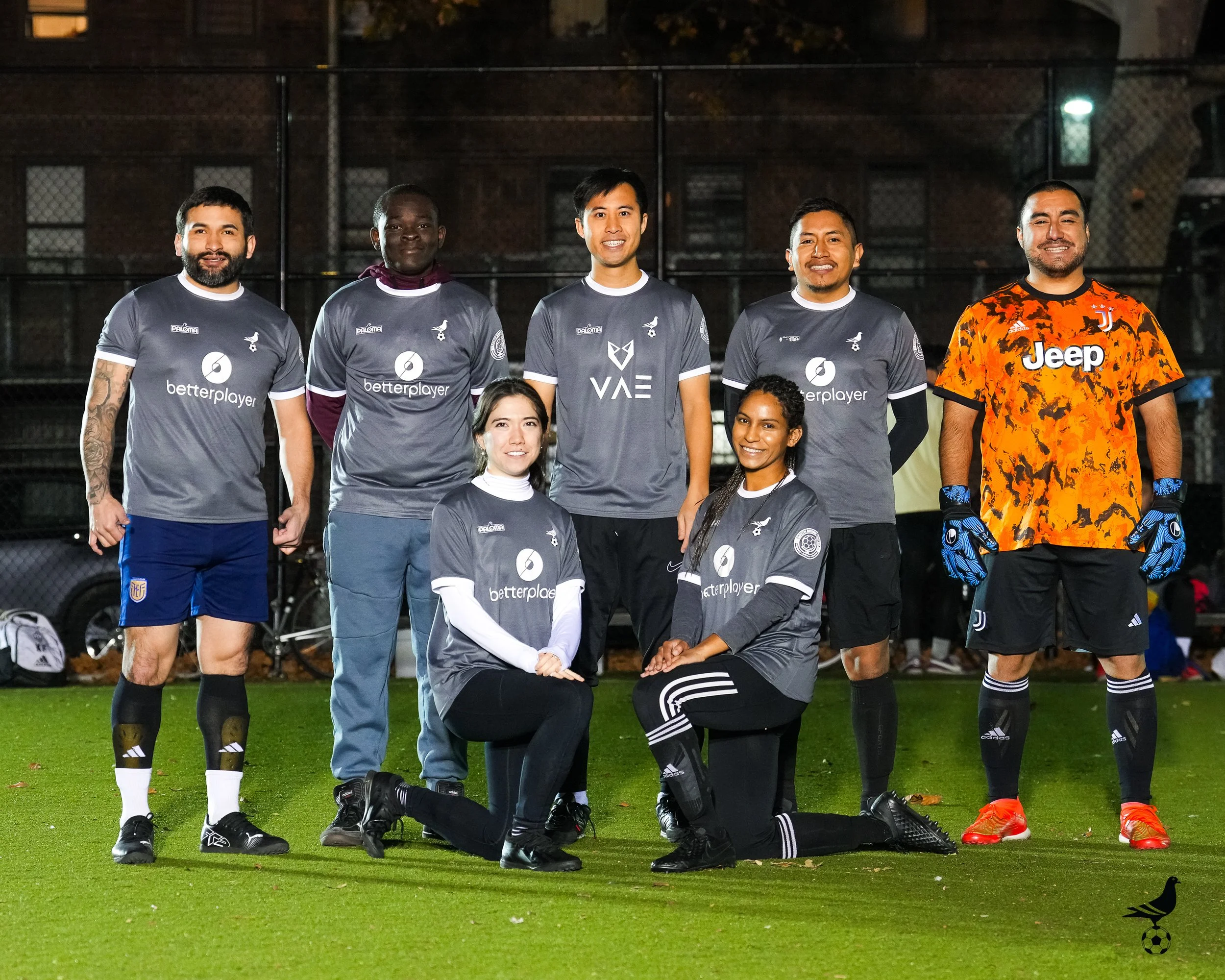
Rally the squad - it’s time to take action.
Where things stand now
The good news: this fight is reaching more ears. We've engaged the offices of Council Members Restler, Hankerson, Marte, Maloney, and Epstein. Council Member Hankerson, who chairs the Parks and Recreation Committee, has been a key ally. And since testifying at a City Council hearing on the World Cup's economic impact, we're now in regular communication with members of Mayor Mamdani's office — a mayor who, notably, is himself a veteran of NYC Footy.
The World Cup is both an opportunity and an obligation. Without lit fields and a modernized permitting system, this city is leaving enormous social and economic value on the table — and failing the hundreds of thousands of New Yorkers for whom soccer is not a spectator sport, but a way of life.
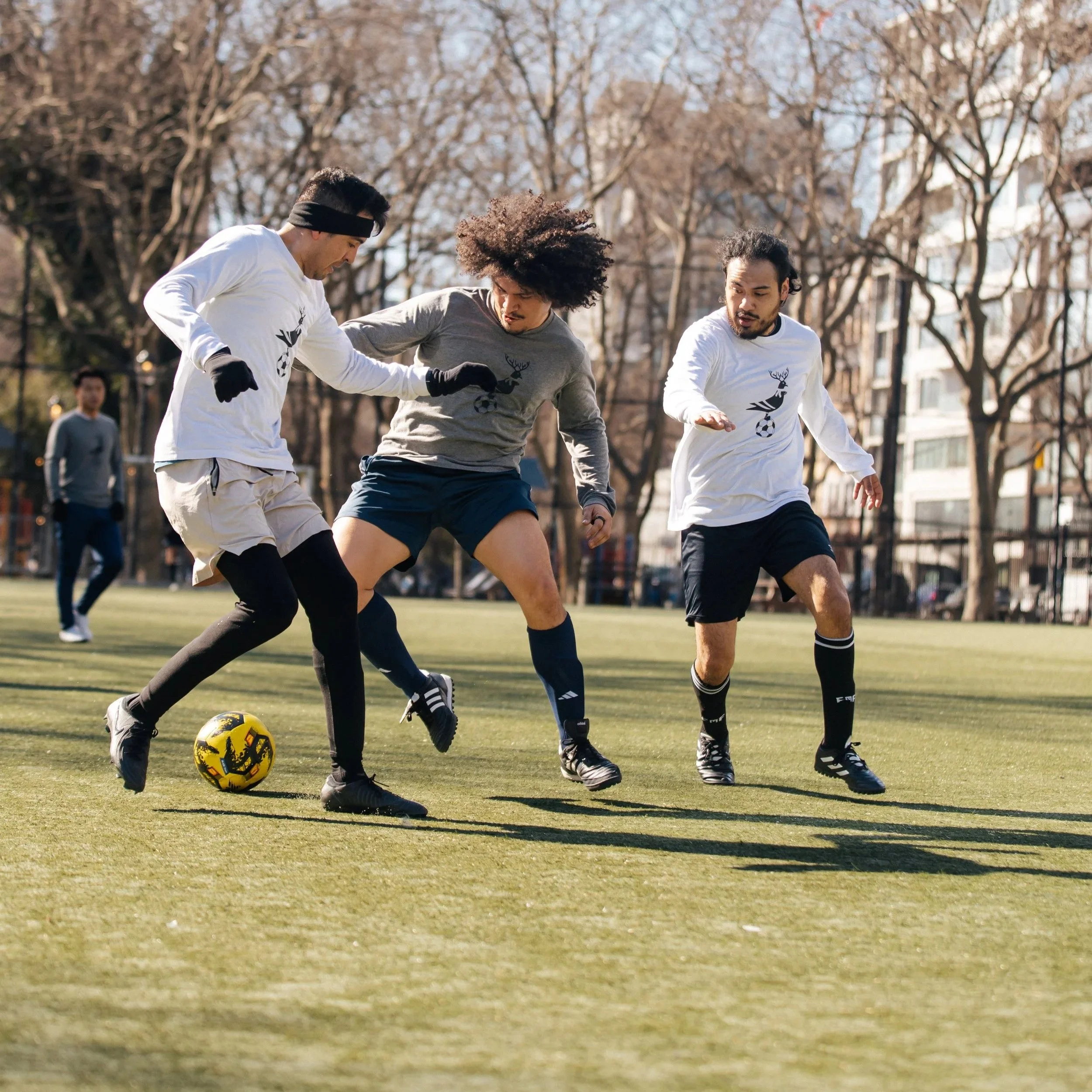
Nike Field is in need of new turf - will you help us advocate for safer playing conditions?
What comes next
We are not asking for special treatment. We are asking for a functional, modern relationship — one where leagues that serve the public are recognized as partners, and where years of good-faith effort are met with genuine engagement.
Soon, we'll be making a formal ask of our community: signatures, voices, and public support. When that moment comes, we hope you'll stand with us.
A Letter Submitted to the NYC Council - Committee on Parks and Recreation
The following testimony was submitted to the New York City Council - Committee on Parks and Recreation in March of 2026 by NYC Footy Founder & CEO Tarek Pertew.
My name is Tarek Pertew. I am the Founder and CEO of NYC Footy, New York City's largest adult recreational soccer organization. We represent nearly 60,000 adult New Yorkers across all five boroughs — men and women of every background, age, and ability level — who come together week after week to play, compete, and build community on the city's parks and fields.
I submit this testimony in support of increased investment in parks infrastructure, permitting staffing, lighting, field equipment, and the repair and replacement of unsafe playing surfaces across the city. These are not niche concerns for a narrow constituency. They are investments in the physical and mental well-being of millions of New Yorkers, in the economic vitality of surrounding neighborhoods, and in the city's ability to fulfill its stated commitment to public health and community resilience.
I have worked within this system for more than fifteen years. What follows is not theoretical. It is drawn from direct, daily experience operating programs at parks throughout New York City.
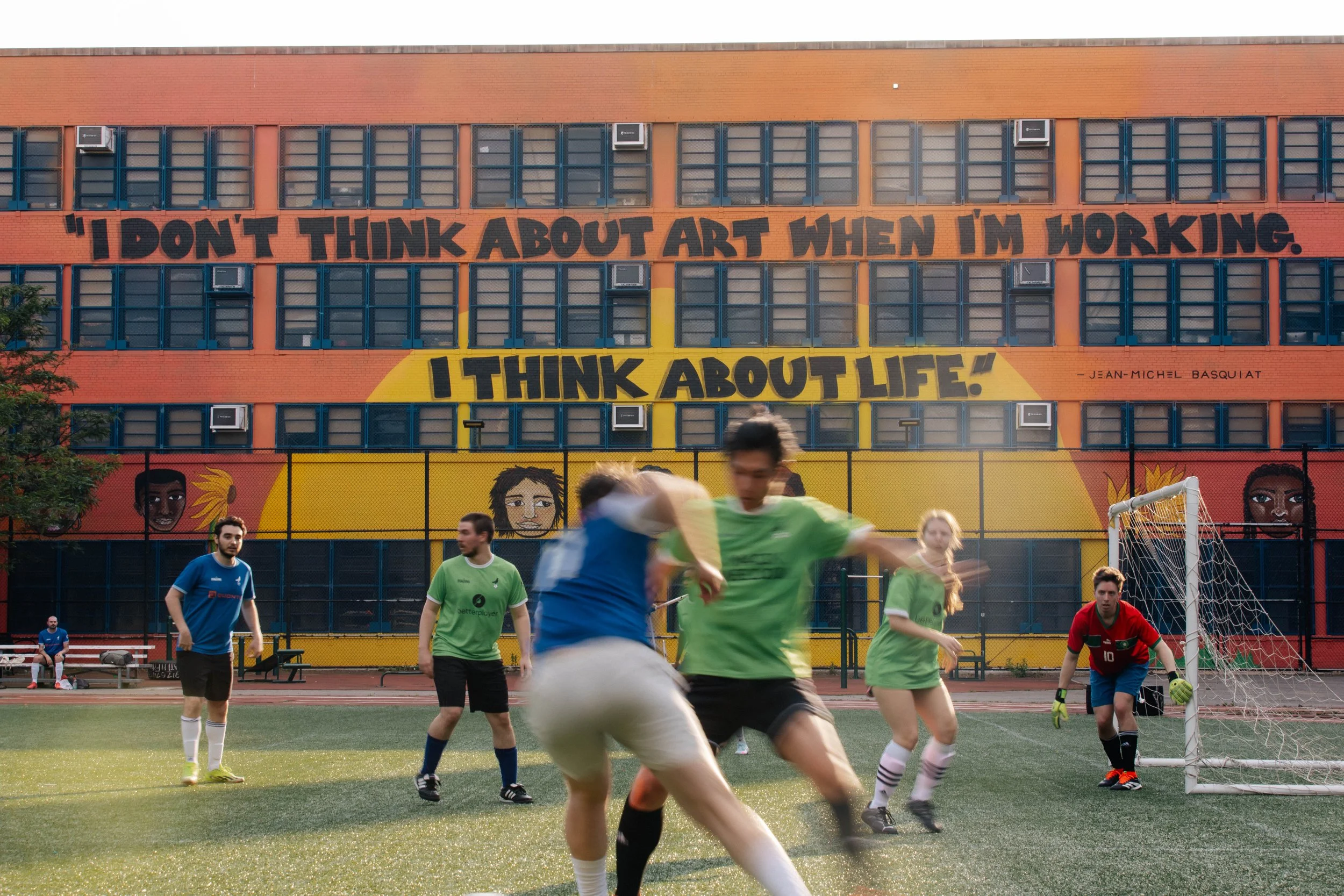
The demand to jump into an NYC Footy league has never been greater.
1. New Yorkers Want to Play. The Demand Is Unambiguous.
Participation in adult recreational sports in New York City has never been higher. Our waitlists are growing. Our programs fill within hours of opening. The appetite to play — to be outside, to move, to connect — is real, powerful, and citywide. NYC Parks records 527 million park visits per year, and 99% of New Yorkers live within a ten-minute walk of publicly accessible green space. The potential is enormous.
Soccer, in particular, has seen sustained and accelerating growth. It is uniquely accessible: it requires minimal equipment, accommodates a wide range of ages, genders, skill levels, and cultural backgrounds, and allows large numbers of people to share space efficiently. As the World Cup comes to New York City this summer — the single largest sporting event this city has ever hosted — the moment to invest in the infrastructure that supports this participation has never been clearer.
New Yorkers want to be outside. They are showing up, in growing numbers, every single week. The barrier is not desire — it is infrastructure.
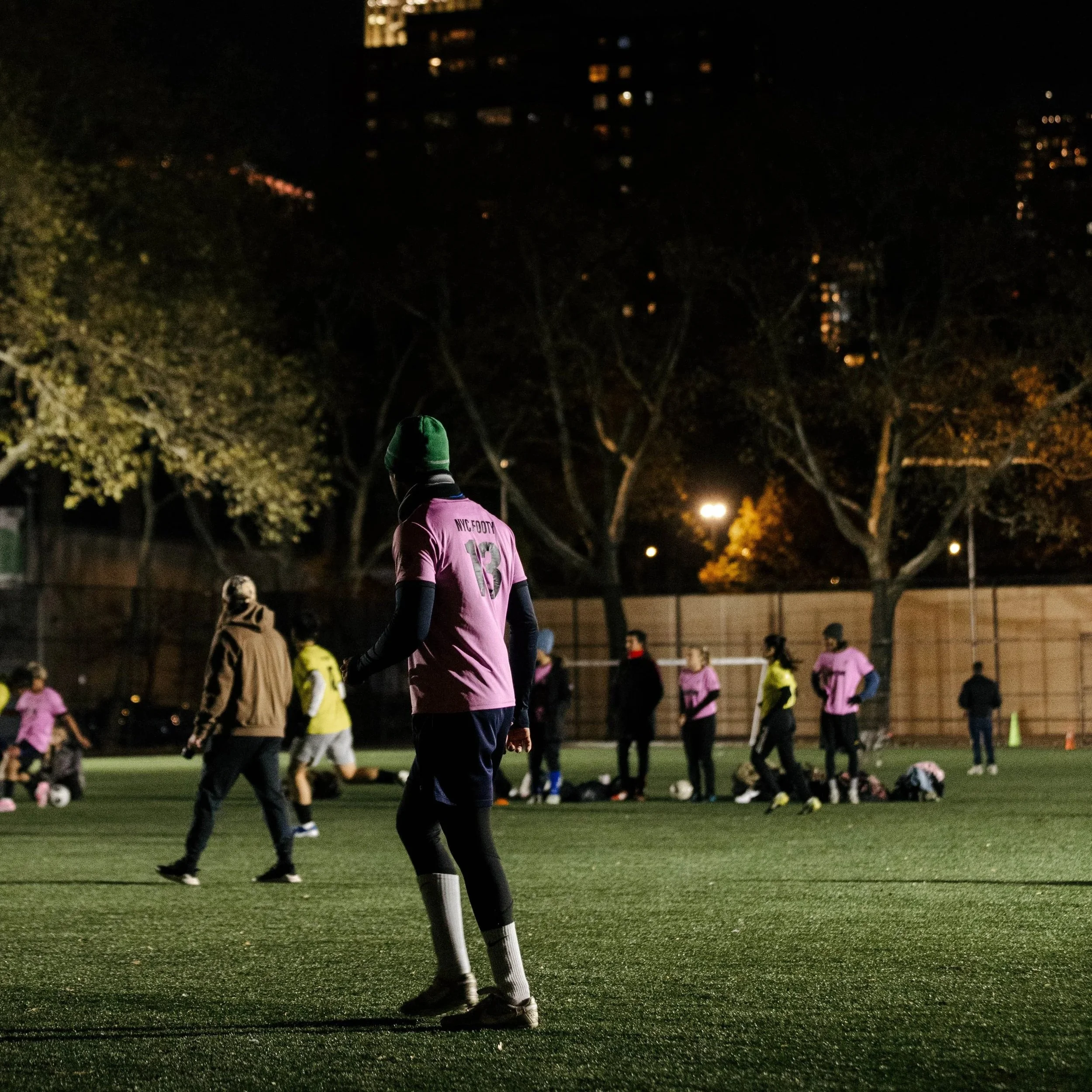
Chelsea Park is a prime example of a popular field that can attract players at all hours.
2. Lighting: Darkness Is Eliminating Access for Working New Yorkers
For working adults, evening hours are when play happens. A field that is dark at 5:30 p.m. is a field that does not exist. Once daylight savings ends and sunset drops below 6:00 p.m., unlit fields become entirely unusable for the working men and women who rely on them. This effectively eliminates months of play for a significant portion of our participants.
The solution does not have to wait for permanent infrastructure. Fuel-powered temporary lighting is already operational at three parks in our network, and has experienced zero incidents of vandalism or theft. This is a proven, lower-cost bridge solution that could activate fields across the city immediately. We respectfully urge the Committee to support a dedicated budget line for temporary lighting at high-demand permitted fields during fall and winter months, alongside continued investment in permanent lighting infrastructure.
We also note that when fields are closed due to significant snowstorms, permit holders lose hours of paid time with no credit or refund. This is a financial hardship for organizations that budget tightly to keep participation affordable. We ask the Committee to examine this policy directly.
● Fund a pilot program for fuel-powered temporary lighting at high-use unlighted fields during fall and winter.
● Prioritize permanent lighting installation at fields with demonstrated high permit demand. ● Establish a credit or refund policy for permit hours lost to weather-related closures.
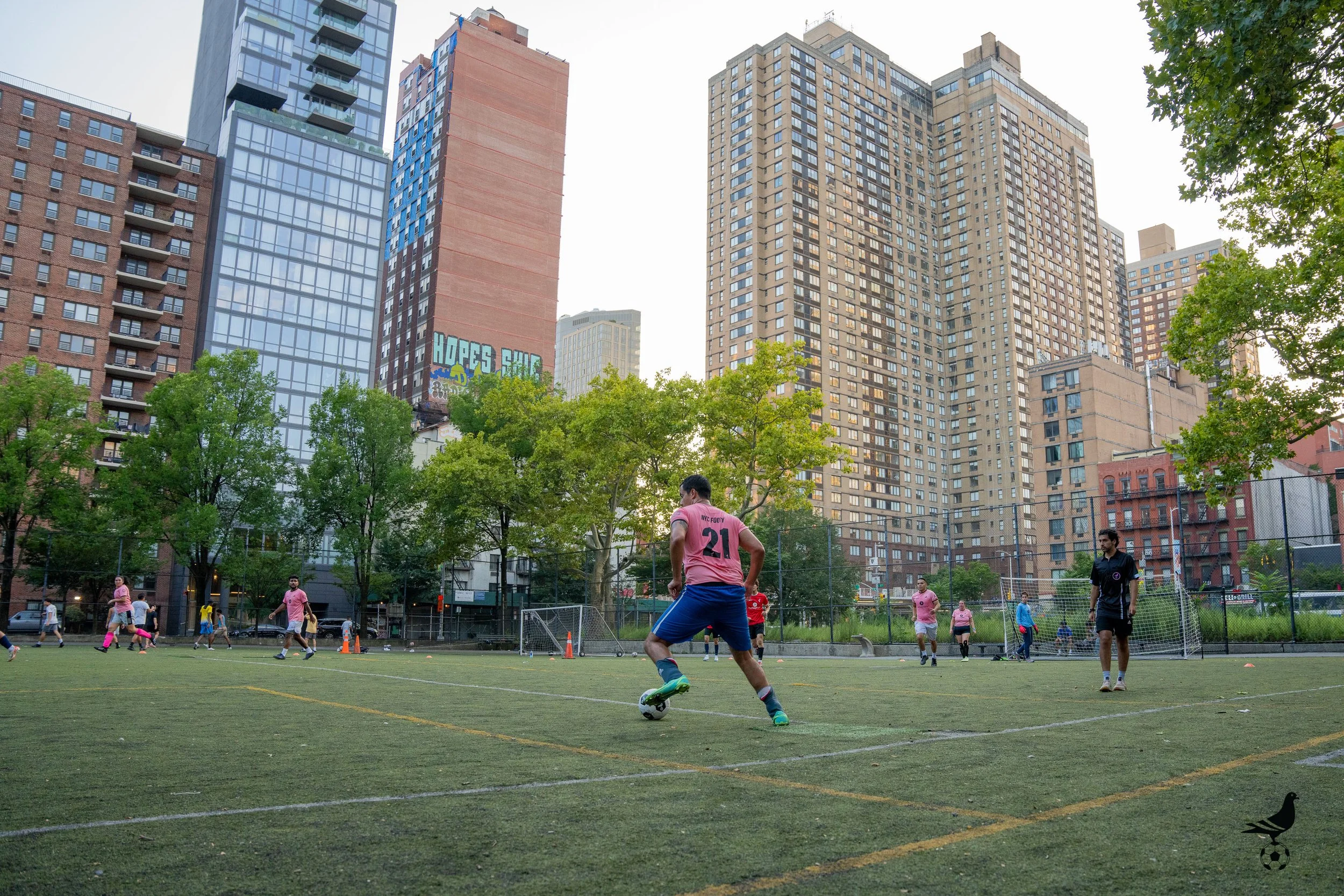
The turf at Marx Bros Playground is no laughing matter.
3. Field Conditions: Dangerous Turf Is Not Acceptable
High participation numbers are being celebrated by city leadership, and rightly so. But the fields where that participation happens are, in many cases, dangerously deteriorated. Worn turf, uneven surfaces, exposed infill, and deteriorating equipment create real injury risk for the New Yorkers using these spaces every week.
Three fields our participants use regularly — Murray Playground, Marx Brothers Playground, and Sara Roosevelt Park — are in conditions that require immediate attention. These are not marginal facilities. They are among the most heavily used fields in our network. The fact that they are heavily used should be celebrated as proof of demand; it should not be the reason maintenance is deferred.
Across the system, too many fields sit in chronic disrepair. The Trust for Public Land's analysis of NYC Parks found that the system generates over $9.1 billion in annual recreational value to New Yorkers. That value depends entirely on the fields being safe and usable.
4. Permitting Staffing: The Bottleneck That Blocks Access
NYC Parks is operating with nearly 1,000 fewer workers than the prior year. The NYC Council has called for a $38.2 million restoration to bring back 659 positions that were eliminated through budget cuts and a citywide hiring freeze. The permitting office is among the most in need.
The consequences are felt directly by the organizations and individuals trying to access parks. Permit processing times have lengthened significantly. Renewal timelines are unpredictable. Communications go unanswered for weeks. The staff that remain are clearly working hard under impossible conditions, but the system is not resourced to serve the demand placed upon it.
This is not a minor administrative inconvenience. Delays in permitting translate directly to lost play time, reduced program enrollment, and organizations being unable to plan the schedules their participants depend on. For a family trying to sign a child up for a Saturday program, or a working adult planning an evening soccer league around their childcare schedule, permitting delays have real, material consequences.
This doesn’t factor the growing demand to host community events in the build up (and during) the World Cup, but all requests for tournaments have gone unanswered to date, making our ability to leverage NYC Parks for these community events all but impossible.
Every week a permit is delayed, New Yorkers lose access. Staffing the permitting office is not overhead; it is access.
● Fully restore the 659 Parks Department positions recommended by the NYC Council, with priority hiring in the permitting office.
● Establish permitting response time standards with public accountability metrics. ● Invest in permitting technology to reduce administrative burden and processing time.
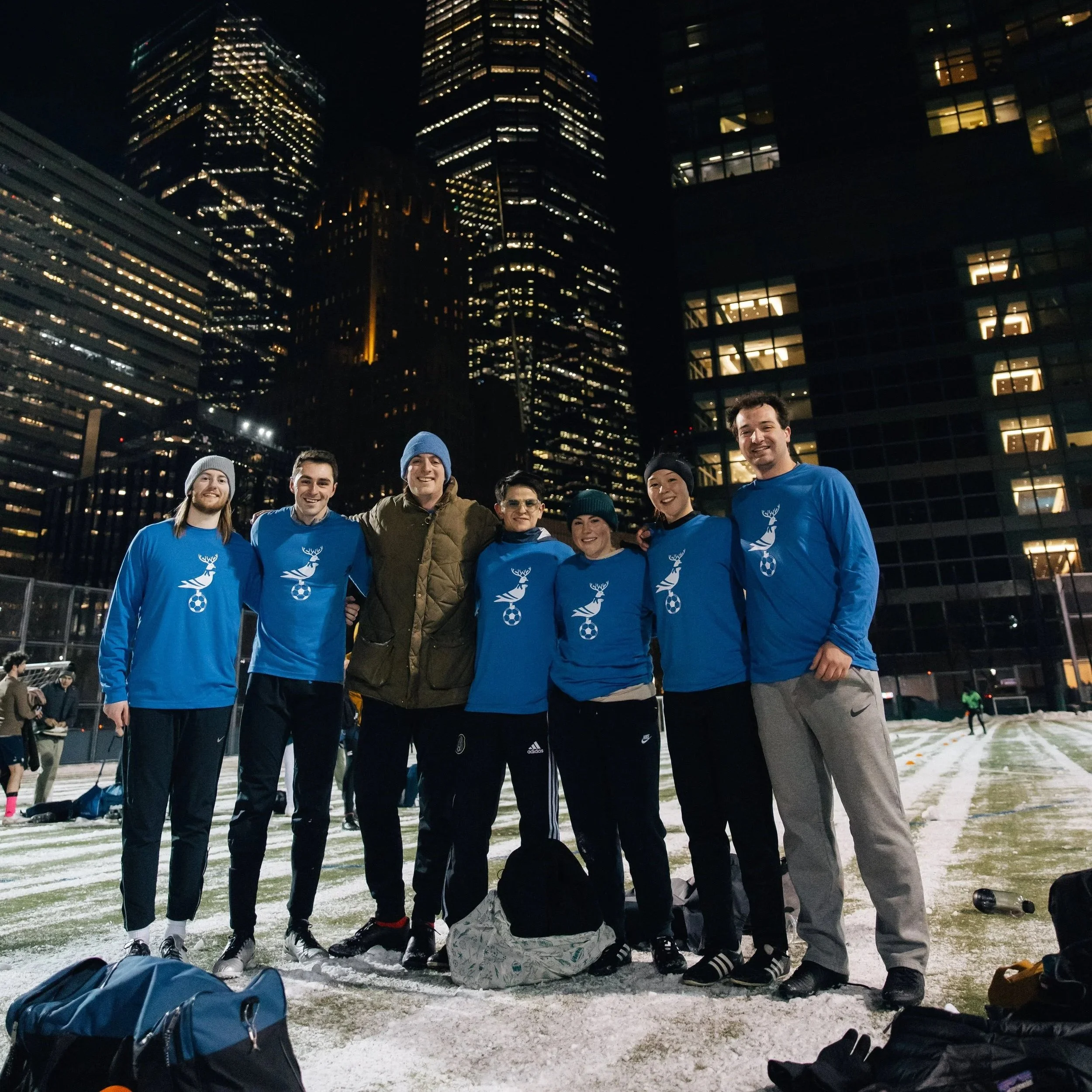
Team sports create much desired social connections - especially in NYC’s colder months.
5. The Loneliness Epidemic: Parks Are the Prescription
New York City is facing a loneliness crisis. According to the NYC Department of Health, more than half of all New Yorkers report feeling lonely at least some of the time. The U.S. Surgeon General has designated loneliness a public health epidemic, comparable in its health consequences to smoking 15 cigarettes per day, with documented links to elevated risk of depression, anxiety, cardiovascular disease, dementia, and premature death.
Recreational parks and permitted programs are among the most effective and scalable antidotes to social isolation we have. They provide what technology and remote work have taken away: a predictable, recurring reason to show up in person, alongside the same people, week after week. The social bonds formed in a recreational soccer league — the teammates who know your name, the opponents who see you every Saturday — are not trivial. They are the connective tissue of a resilient, healthy community.
In a dense and often isolating city like New York, parks infrastructure is mental health infrastructure. It is a community health infrastructure. Failing to invest in it is not a budget-neutral choice. Instead, it shifts costs onto emergency services, mental health systems, and healthcare, where the price tag is far higher.
The data make the case plainly: physical activity, consistent social interaction, and access to outdoor green space are among the best-documented predictors of long-term physical and mental health. The city has, within its parks system, one of the most powerful and underutilized public health tools available. We are asking the Committee to treat it that way.
6. The Economic Case: Parks Pay For Themselves
Investing in park infrastructure is not a budget burden, but an economic driver. The Trust for Public Land's comprehensive analysis of the NYC Parks system found that it generates $9.1 billion in annual recreational value, contributes over $15.2 billion in increased property values for homes within 500 feet of parks, and translates to at least $101 million in annual property tax revenue for the city.
NYC residents spend an estimated $681 million annually on sports, recreation, and exercise equipment, which flows directly through local businesses. And domestic travelers who visit New York City in part to participate in outdoor recreational activities spend an estimated $17.9 billion in a typical year. Every park that is well-lit, well-maintained, and accessible activates that spending. Every field that sits dark or unusable does not.
The business corridors and neighborhoods surrounding active parks — delis, cafes, pharmacies, retail stores, restaurants — all benefit when those parks draw people in. The expanded investment needed to properly fund parks infrastructure is not a cost to the city. It is a return on investment that pays back in property values, tax revenue, local spending, and avoided healthcare costs.
The question is not whether the city can afford to invest in parks. The question is whether it can afford not to.
7. Summary of Recommendations Informing a Critical Budget Increase in Parks
● Restore the 659 Parks Department positions, with priority staffing for the permitting office, to address permit processing delays that directly block access.
● Fund a pilot program for temporary fuel-powered lighting at high-use unlighted fields during fall and winter months, building on the zero-incident track record already established. ● Accelerate permanent lighting installation at fields with documented high permit demand, prioritizing locations with the greatest adult recreational use.
● Immediately inspect and repair or replace the playing surfaces at Murray Playground, Marx Brothers Playground, and Sara D. Roosevelt and establish a transparent, rolling lifecycle plan for all synthetic turf fields.
● Establish a formal, sanctioned equipment partnership pathway for responsible permit holders to donate and maintain goals and basic field equipment at specific parks, with a roadmap to expand equitably across the system.
● Implement a credit or refund policy for permit hours lost to weather-related closures, preventing financial harm to organizations that keep programs affordable for New Yorkers.
● Recognize parks investment as public health investment, and budget accordingly, with the understanding that every dollar spent on safe, accessible, well-lit parks returns multiples in tax revenue, local economic activity, and avoided downstream healthcare costs.
New York City is on the eve of hosting the world. Soccer, the most inclusive, accessible, and globally unifying sport, is about to be at the center of the world's attention here. This is not a moment to let fields sit dark, surfaces go unrepaired, or permits go unprocessed. This is a moment to lead.
I represent tens of thousands of New Yorkers who want nothing more than to be outside, to move, to connect, and to play. They are showing up. The infrastructure needs to show up too.
I welcome the opportunity to provide any additional data, meet with Committee staff, or support the work of strengthening the parks system for every New Yorker it serves. Thank you for your time and your service to this city.
Respectfully submitted,
Tarek Pertew
Founder & CEO, NYC Footy
Field Access & Equity: A Letter to NYC Parks
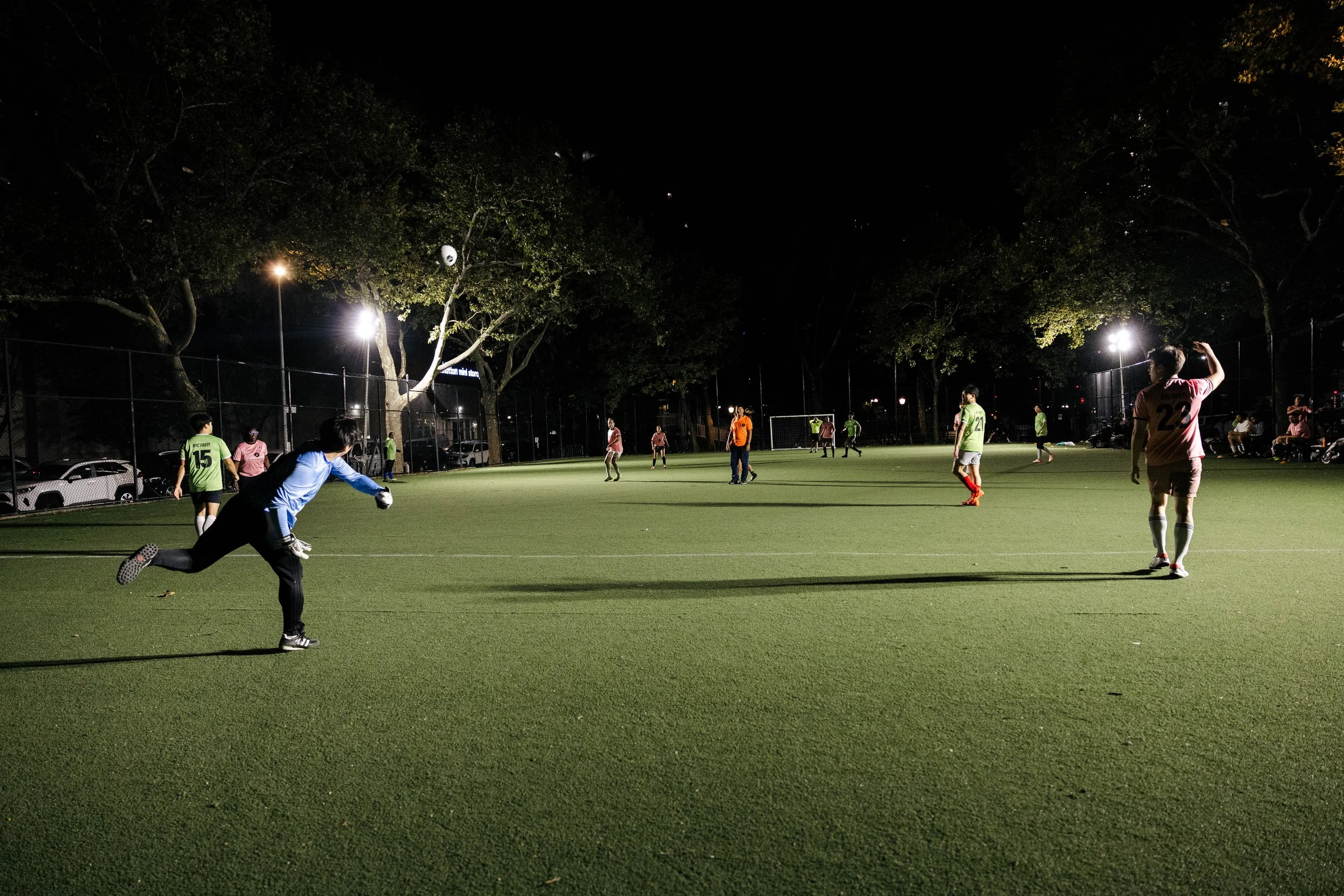
In a city that never sleeps, soccer is in demand day and night..
The following letter, written by Tarek Pertew, CEO and Co-Founder of NYC Footy and The Footy League, was sent to the NYC Department of Parks and Recreation Commissioner Tricia Shimamura.
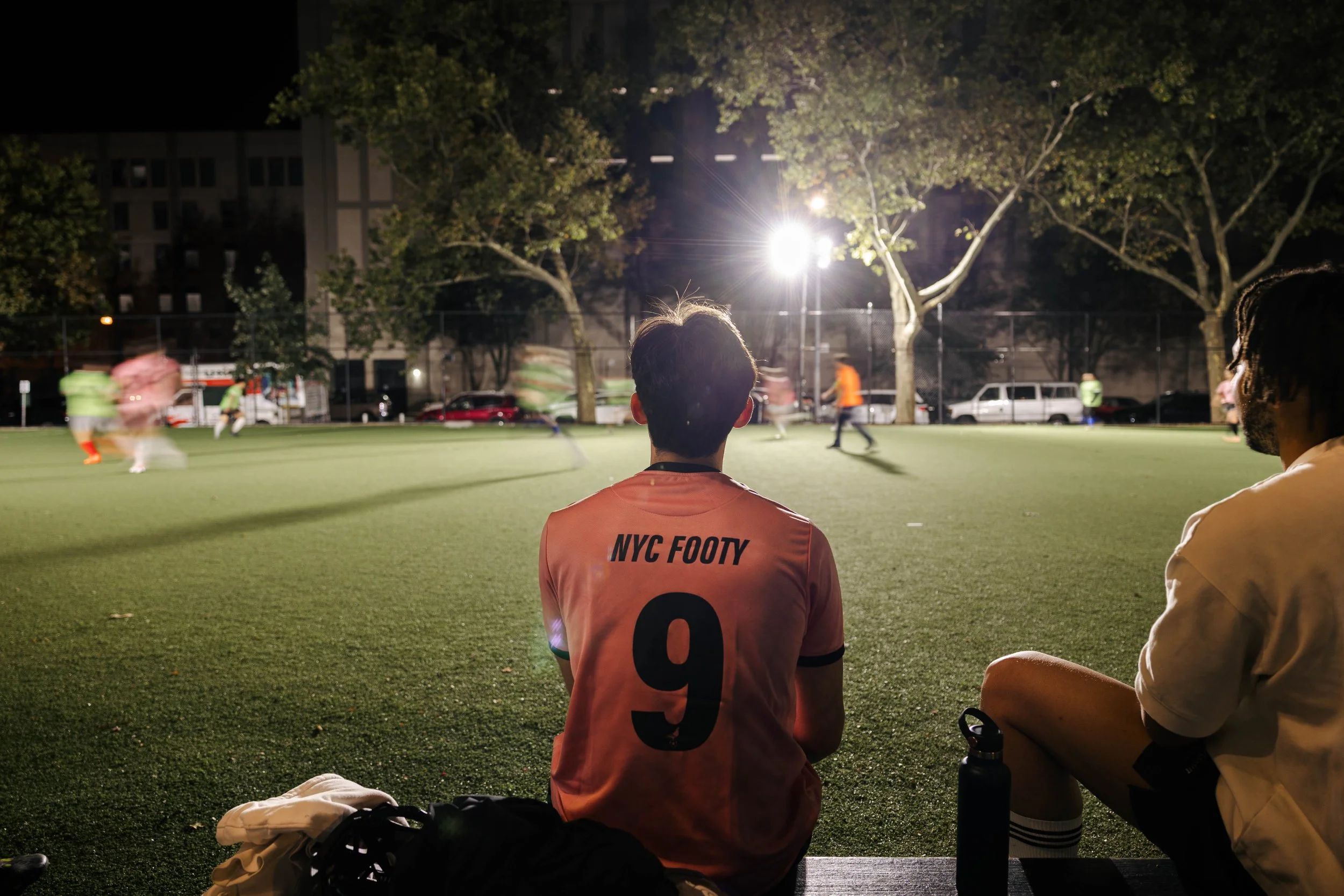
An NYC Footy player looks on during an evening game at Tanahey Playground.
Dear Commissioner Shimamura,
I am writing to raise concerns related to equity and modernization in access to NYC Parks athletic fields.
I want to begin by acknowledging the tremendous scope of work your team carries and the wide range of citywide stakeholders whose competing needs make that work especially complex. I’m not being performative when I acknowledge that the demands placed on NYC Parks are immense, and it is clear that recent updates to the permitting process were undertaken in an effort to reduce conflict and create a more consistent experience for applicants. Through numerous conversations and decisions that have directly impacted our organization, I have seen firsthand how challenging it is to balance the needs of youth programs, schools, community groups, and adult organizations.
My intent in reaching out is not to overlook those efforts, but to add context from the perspective of someone who has worked within this system for more than fifteen years. There are a few root issues that the recent changes do not yet address, and several concerns have surfaced about those changes. I believe we can bring great news to New Yorkers when it comes to field access, strengthening a system that better serves the residents who rely on parks as their primary access to physical activity, social connection, and overall wellness.
As one of the city’s largest permit holders, representing nearly 60,000 adult New Yorkers, I feel a particular responsibility to raise these concerns with urgency. New York City is on the eve of hosting the World Cup — the single largest sporting event this city has ever seen. Soccer demand is at an all-time high and growing rapidly. We are experiencing it directly: our programs are overrun, waitlists are growing, and the appetite to play has never been stronger. And yet, this season, we have lost more permitted field access than in any prior season. At the precise moment when New Yorkers are turning to soccer in unprecedented numbers, the system is producing less access, not more. I would be failing in my responsibility if I did not say plainly: it is irresponsible for the city to make soccer less accessible on the eve of the World Cup. This is not just a missed opportunity — it is a contradiction of the city’s stated commitment to public health, recreation, and community well-being.
It is also important to acknowledge a reality I believe the Department already understands well: permitted programs exist because New Yorkers actively choose them. They do so because these programs provide predictable, safe, and structured opportunities to play, allowing people to build routines around work, family, and caregiving responsibilities. Just as importantly, permitted programs offer a consistent community — a reliable place for people to reconnect week after week, build relationships, and strengthen the social bonds that underpin healthy, resilient communities. In a city where isolation and disconnection are growing challenges, social continuity is a meaningful public good.
Soccer-based permitted programs, in particular, have seen sustained and accelerating demand not only because they offer this structure, but because soccer itself is uniquely accessible, inclusive, and scalable. It accommodates a wide range of ages, genders, skill levels, and cultural backgrounds, requires minimal specialized equipment, and allows large numbers of participants to share space efficiently. In a dense city like New York, these attributes matter. The growth in adult soccer participation is not incidental; it reflects how well the sport aligns with the realities of urban life.
1. Adult Access and the Priority Framework
The current sport-specific priority framework can and should continue to reflect youth needs without unnecessarily restricting adult access. The Department recognizes two priority periods: spring and summer for bat-and-ball sports, and fall and winter for rectangular-field sports. This structure makes sense for youth institutions whose sports are tied to scholastic calendars. However, applying the same framework to adult recreation creates inequities, as adult participation is not institutionally dependent on seasons.
Based on Parks Department data, soccer receives up to seven times more permit applications than baseball and softball, including during bat-and-ball priority seasons. Yet bat-and-ball sports continue to receive priority during spring and summer, while soccer — the fastest-growing and most in-demand adult sport in the city — is constrained by seasonal rules that do not reflect how adults actually play. For adult recreation, where there is no scholastic or institutional requirement, access should be driven by participation levels and community demand.
This misalignment is not theoretical. The two renewable weeknight fields our organization held consistently for years during the spring and summer were recently reclassified and are no longer renewable. As a result, all of our high-demand weeknight access is now subject to seasonal priority timelines, despite sustained demand and demonstrated community use as the city’s largest soccer league. As soccer participation accelerates toward a World Cup summer, the current priority framework is producing less stability and less access for the very sport New Yorkers are choosing in growing numbers.
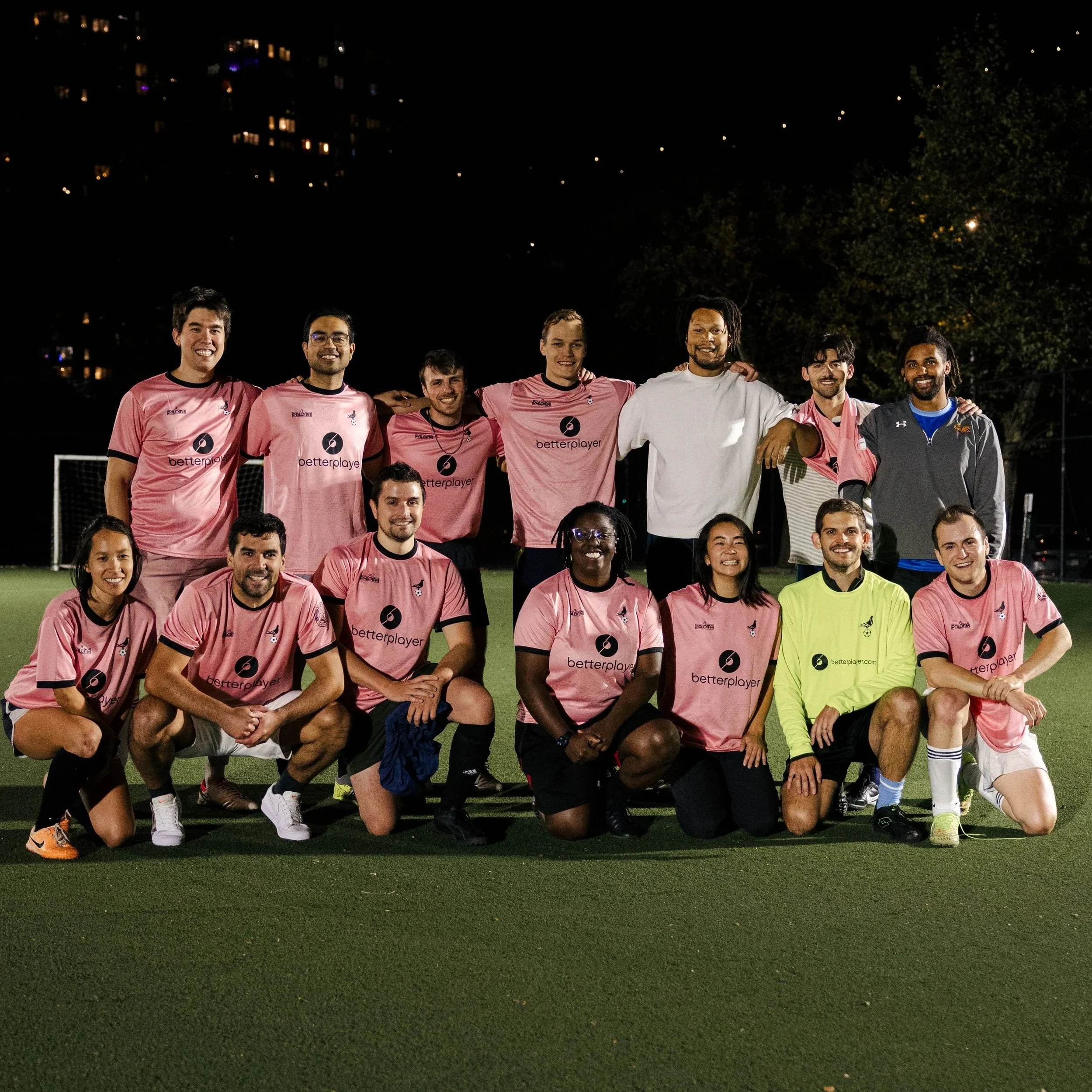
An NYC Footy team poses for a photo. Social connection is what powers Footy leagues.
2. Lighting: Immediate Solutions Exist
Spring and summer permits have already been issued, and the opportunity to reshape distribution in favor of the city’s most in-demand sport ahead of the World Cup has passed. The only solution to accommodate the demand and support a city eager to express itself ahead of the World Cup is through temporary lighting installments and strategically chosen locations.
Further, to address a larger infrastructural challenge, there are significant inequities in fall and winter access. Daylight disparities coupled with seasonal weather patterns make fall and winter uniquely challenging. Once daylight loss pushes sunset earlier than 6:00 p.m., fields become effectively unusable for working adults unless they are lit.
I was grateful to have the chance to briefly speak with you about this issue, Commissioner, and I heard clearly that lighting is a priority for the Department. I also understand the concern raised about short-term lighting solutions: past installations of battery-powered lights invited vandalism, with batteries stolen from unlocked gates. That experience is understandable, and I do not dismiss it. However, I want to respectfully raise a distinction that I believe is material.
Fuel-powered temporary lighting is already operational at three parks in our network and has not experienced incidents of vandalism or theft. This is not a hypothetical — it is a working model. The conditions that created past problems (unlocked gates, unattended battery units) are not inherent to all temporary lighting; they are specific to a particular implementation. Fuel-powered lights in active, staffed use represent an immediate, lower-cost pathway to activating fields that currently sit dark and unusable during the most challenging months. I would strongly encourage the Department to explore this approach as a bridge while permanent lighting infrastructure — which I know is costly and time-intensive — continues to move forward. The communities that depend on these fields cannot wait years.
Additionally, and to further exemplify the priority season inequity, when a significant snowstorm hits, hours of paid permit time go unused due to unplayable field conditions — and this lost time is not covered by credits or refunds, which can be financially crippling for permit holders, as it has been this past winter. By way of example, NYC Footy accumulated nearly $20,000 in paid permit time that we were unable to use. What is already a heavily reduced season in terms of accessibility is only exacerbated by likely and expected weather disruptions without any downside protection for our financial commitments.
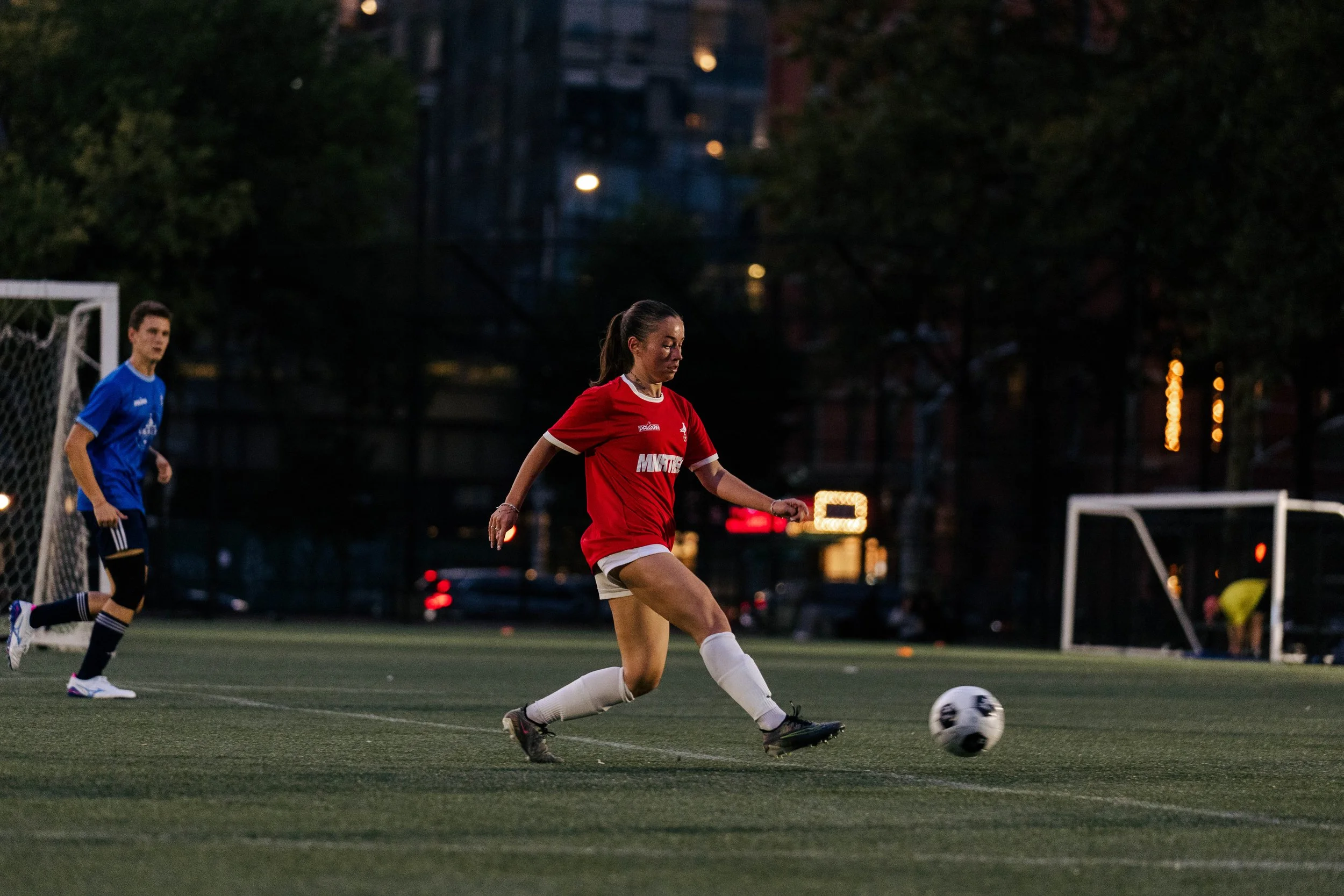
A Chelsea Park match taking place in evening hours (aka when adults have time to play)
3. The Direction of Access Policy
I also want to be clear that these concerns have been raised directly with the permitting office over time and always in good faith. I have hesitated to elevate them further precisely because we have a strong, professional working relationship. Unfortunately, in more recent conversations, I have found it concerning that some discussions have focused less on how to expand access and more on how to constrain it.
For example, the notion that fields should not be used “too much” because they need to rest — particularly when applied to artificial surfaces — raises difficult questions. While field longevity is important, it is hard to reconcile prioritizing the rest of a synthetic field over the physical and mental wellness of New Yorkers who depend on these spaces. If increased use accelerates wear, that is a challenge the City must plan for and adapt to, rather than a justification for limiting access. Similarly, proposals to subdivide large fields into smaller, separately permitted spaces would raise costs for permit holders — particularly following recent fee increases — and overlook the operational reality that leagues require multiple concurrent games to function. Without that flexibility, leagues become smaller, less viable, and ultimately less accessible to the communities they serve.
4. Equipment Partnerships: A Better Model Is Possible
There is also a meaningful opportunity to strengthen the partnership between NYC Parks and community organizers around field equipment. In recent months, the Department removed goals, lock boxes, and shared equipment that leagues had accumulated over time to ensure timely starts, full use of permitted hours, and avoidance of transporting heavy equipment to and from fields. These assets existed not to circumvent rules, but to solve real access constraints when time on fields is already extremely limited.
In conversations with the Department, I had multiple calls to present a specific and strategic expansion of an existing donation precedent across three (3) key locations. Despite multiple conversations, I have yet to receive a response to any of those discussions. More recently, after expressing this concern, I was instead directed to the “Adopt a Park” program as the appropriate pathway for equipment donations. I appreciate that guidance, and I want to engage with it seriously (as of this writing, I continue to wait a reply to my March 4th inquiry). However, the Adopt a Park program requires a minimum $10,000 commitment and, critically, does not designate how the donation is used. That structure is not suited to the targeted, operational need leagues have, which is simply to ensure that goals and basic equipment are available at the specific fields where leagues operate.
I also understand the equity concern that has been raised: if one park receives a donation, it may not be fair to others that do not. I want to address this directly, because I believe it deserves a stronger response than the current policy provides. Denying access improvements to a community because other communities have not yet received them is not an equity policy — it is a policy that produces uniformly reduced access. The alternative is to begin a plan: create a formal, sanctioned pathway for equipment partnerships with responsible permit holders, and build toward expanding it across parks over time. Equity is achieved by lifting more communities up, not by holding all communities to the same constrained baseline.
Leagues are currently required to transport heavy goals and equipment to and from parks each week, creating safety risks, increasing costs, and reducing playable time within already constrained permits. A clear pathway for equipment donation would immediately improve access and safety for communities that cannot bring their own equipment.
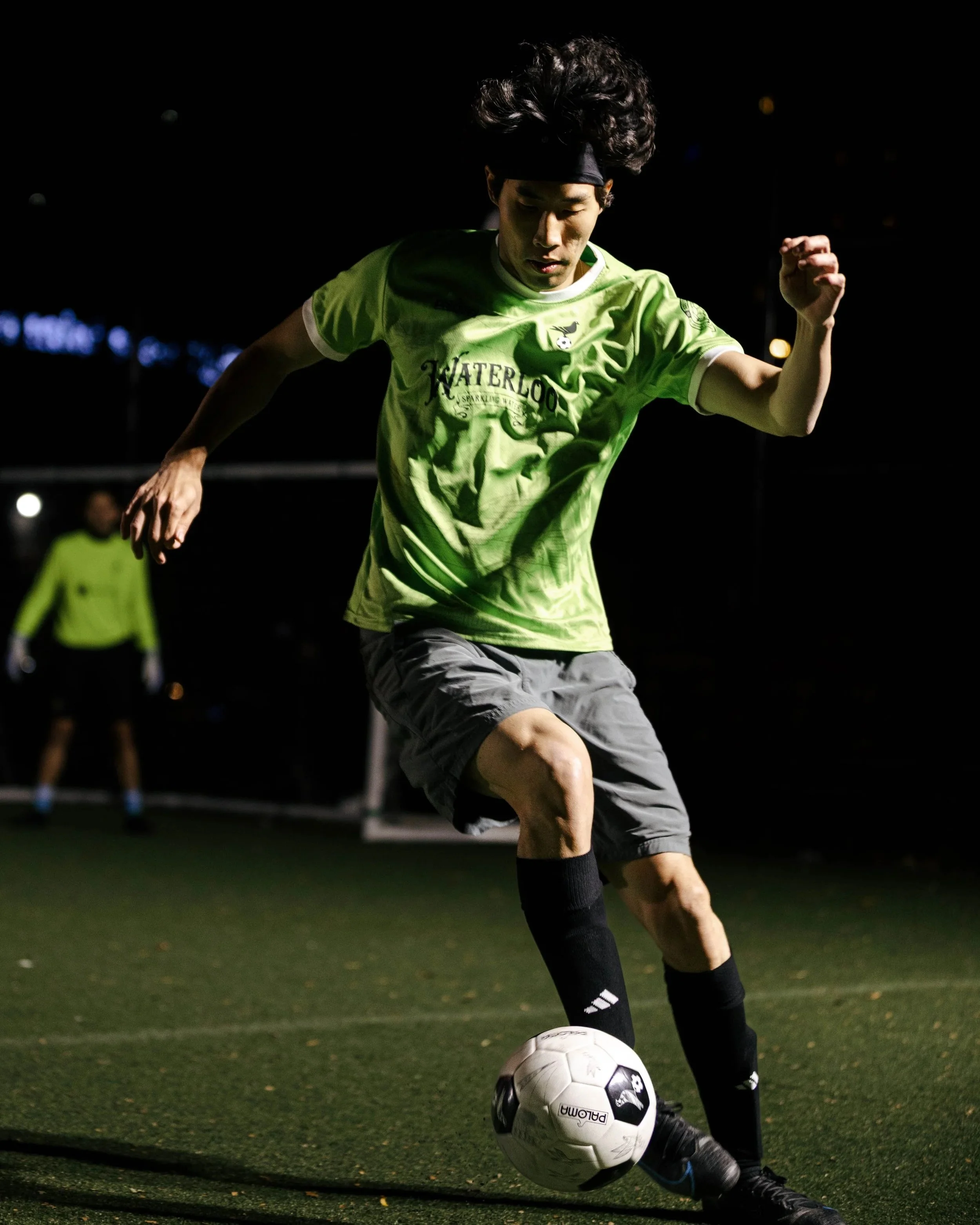
Moving forward is made possible when we all work together.
5. A Path Forward
New York City deserves a parks system that reflects how its residents actually play. Soccer is not a niche activity. It is one of, if not the most diverse, accessible, and unifying recreational sports in the city — and it is about to be at the center of the world’s attention when the World Cup comes to New York. This is a rare moment to lead. I respectfully ask the Department to consider:
• Modernizing the adult priority framework to reflect participation levels and community demand rather than sport-specific seasonal windows that were designed for youth institutional schedules.
• Adopting fuel-powered temporary lighting as an immediate bridge to expand accessible field hours, recognizing its proven track record in our current parks without incident.
• Investing in permanent lighting infrastructure in the areas of highest adult recreational soccer demand.
• Creating a clear, strategic pathway for equipment partnerships with responsible permit holders — with a roadmap to expand equitably across parks over time.
• Addressing permit credit or refund policies for weather-related field closures that leave paid permit time unused.
My decision to raise these concerns here reflects both the urgency of the issues and my responsibility to the tens of thousands of New Yorkers we fight for. I hope this outreach is interpreted as an appropriate step to address structural challenges at the leadership level. My goal is to support your team in strengthening a system that works for more New Yorkers, not fewer. To shift the relationship between Parks and permit holders from one that is adversarial to one built on the spirit of true partnership.
I would welcome the opportunity to meet, share data, and explore these ideas further. Thank you for your leadership and for your continued service to New York City’s parks.
Warm regards,
Tarek Pertew
Founder & CEO, NYC Footy
A Footy League Guide to the Best World Cup Bars: Toronto Bracket
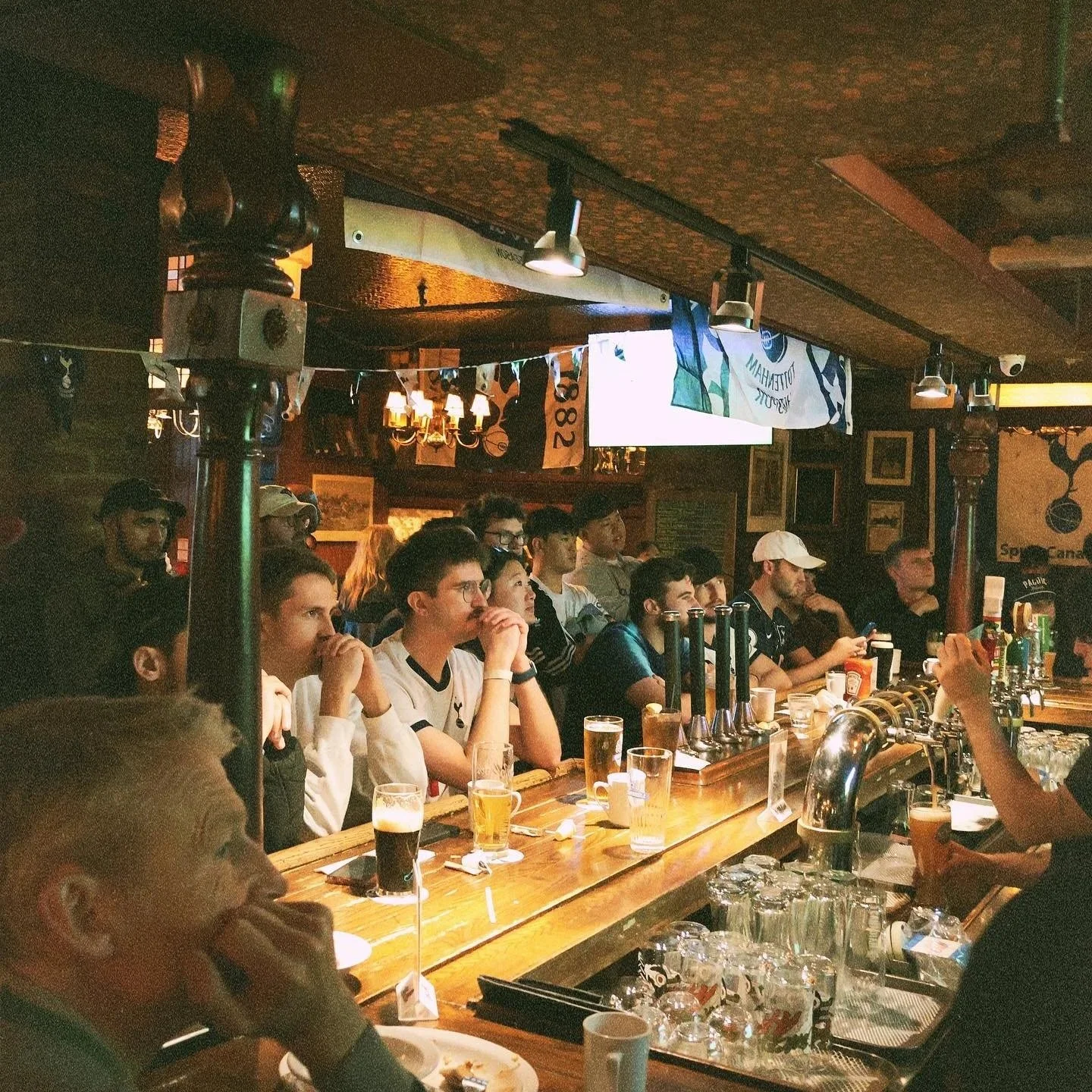
Concerned looks everywhere? You’ve probably stumbled into a soccer bar! Photo: Scotland Yard
The 2026 World Cup is on the horizon — and we’re excited. 48 teams. 16 venues. 12 groups. One winner.
As we ramp up to the big event, The Footy League will be sharing all the information you need to know — plus plenty you didn’t know you needed. This guide shines a light on the best bars to catch a game if you’re in town without a ticket. Today’s edition: Toronto!
Footy’s Top Shelf | Toronto
Toronto didn’t discover soccer in 2007 when it landed an MLS team — it flashed a spotlight on what was already there. Immigrant communities made World Cup season a sacred ritual long before it was cool. This city has been living the beautiful game for decades.
With Toronto co-hosting the 2026 World Cup, the energy is about to hit another level. Expect spontaneous fan zones to form around street corners in Little Italy and along the Danforth, with downtown patios packed wall to wall. Toronto’s diversity shows up loudly in its soccer culture — English pubs, Italian trattorias, and bars flying flags from every corner of the globe — while big watch parties at Fort York and The Bentway pull the whole city together.
#1: Cafe Diplomatico
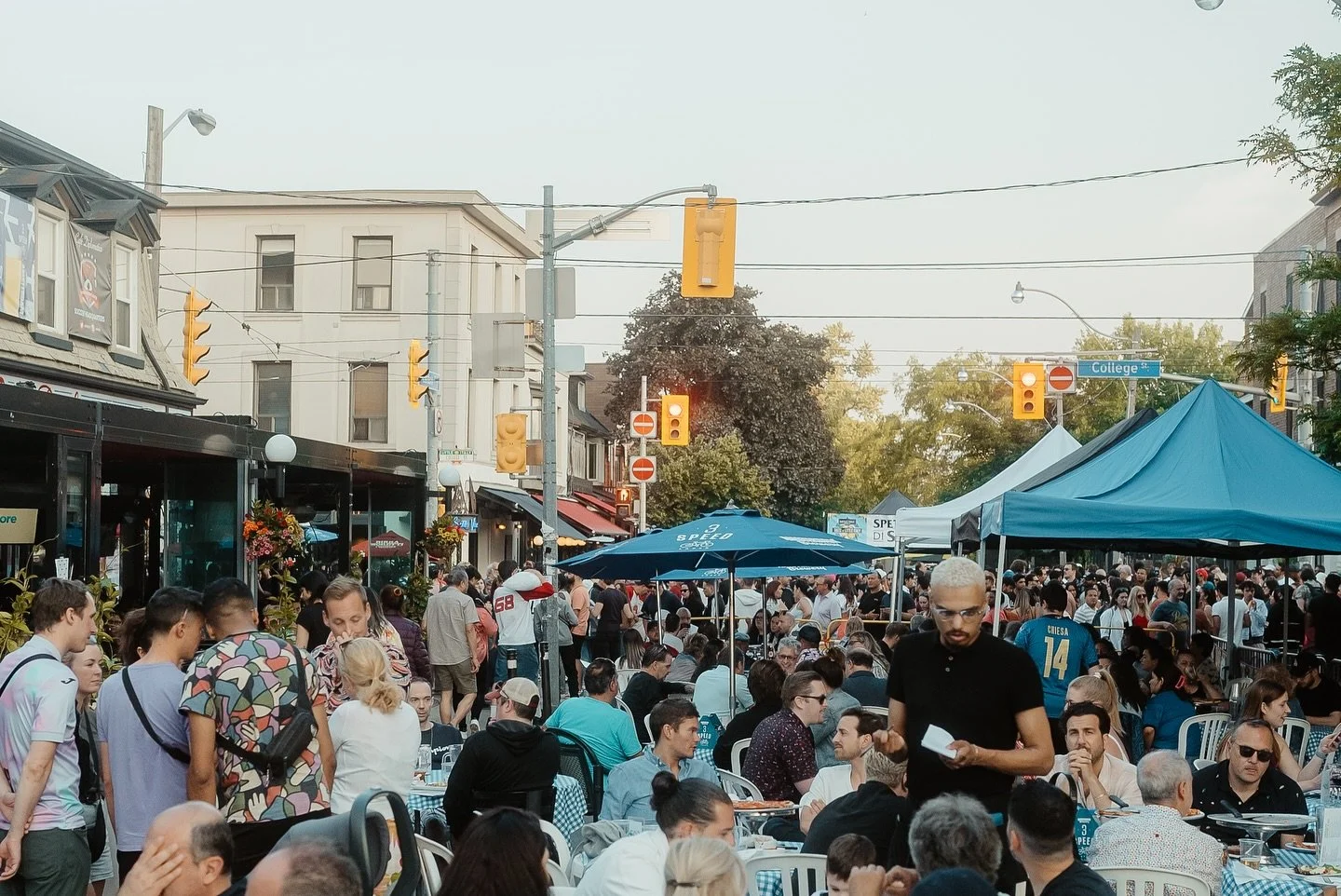
The Dip is Toronto’s spot to scoop up all the action this summer. Credit: The Dip
Address: 594 College St, Toronto, ON M6G 1B3
Why it’s great for World Cup games:
A Toronto soccer institution since 1968, Cafe Diplomatico — known locally as “The Dip” — is pure matchday tradition. Rooted in the city’s Italian community, it’s famous for its packed patio, big screens, and street-level energy that spills well beyond the front door during major tournaments. When the World Cup is on, College and Clinton feels like an open-air fan zone.
Best for: Classic World Cup atmosphere, outdoor viewing vibes, and fans who want the game to take over the entire block.
Good to know: Seating fills fast for big matches. Arrive early — and if you don’t get a table, the standing-room energy outside is part of the experience.
Instagram: Cafe Diplomatico
Website: Cafe Diplomatico
#2: Scotland Yard
Watch the game indoors, scream about your team losing outdoors. Photo: Scotland Yard
Address: 56 The Esplanade, Toronto, ON M5E 1A6
Why it’s great for World Cup games:
A fixture in Old Town Toronto since 1976, Scotland Yard is a true football pub — no gimmicks, just passion. Best known as a home base for Tottenham Hotspur supporters, it welcomes fans of every nation. Expect English accents, nonstop chants, and a room that lives and breathes the match. When it gets loud, it really gets loud.
Best for: Traditional pub energy, diehards, and supporters who want chants, nerves, and real football culture.
Good to know: Weekend mornings and marquee games fill up quickly — arrive early if you want a good sightline (or a seat).
Instagram: Scotland Yard
Website: Scotland Yard
This guide will be updated with more host cities as the 2026 World Cup approaches. Check out our Vancouver recs here.
A Footy League Guide to the Best World Cup Bars: Vancouver Bracket
Planning a trip to Vancouver? Seek out Shark Club for brews & game views .Photo: Shark Club
The 2026 World Cup is on the horizon — and we’re excited. 48 teams. 16 venues. 12 groups. One winner.
As we ramp up to the big event, The Footy League will be sharing all the information you need to know — plus plenty you didn’t know you needed. This guide shines a light on the best bars to catch a game if you’re in town without a ticket.
We kick off in Vancouver, where soccer will temporarily outrank hockey between June 11 and July 19. Where possible, we’ve picked spots that prioritize soccer all year round — not just when the big tournaments roll into town.
Vancouver does a great line in sports bars, and with most World Cup matchday action centred around downtown, there are plenty of quality options nearby — with public transit making it easy to hop between neighbourhoods if you’re feeling adventurous.
Footy’s Top Shelf | Vancouver
Top Ranked: Shark Club Sports Bar & Grill
Address: 180 W Georgia St, Vancouver, BC V6B 4P4
Instagram: Shark Club
Website: Shark Club
Why it’s great for World Cup games:
If you want that “stadium without the ticket” feeling, Shark Club is as close as it gets. It’s right near BC Place in the heart of downtown Vancouver, and it’s built for big occasions — with massive screens and a layout designed to make sure you don’t miss a second.
Best for: Big groups, high-energy games, and fans who want a full-on event atmosphere.
Good to know: It’s a very popular pre-match spot, so expect it to fill quickly. We recommend grabbing a seat at least an hour before kick-off.
Heading to Vancouver soon? Stop by Score on Davie for a proper stein. Photo: Score on Davie
Second in Command: Score on Davie
Address: 1262 Davie St, Vancouver, BC V6E 1N3
Instagram: Score on Davie
Website: Score on Davie
Why it’s great for World Cup games:
Located in Vancouver’s lively West End, Score on Davie is a little more personality-driven — the kind of place where the soccer can get serious, but the mood stays light. Soccer gets priority here during major tournaments, and early kickoffs are part of the culture. The drinks lean fun (their Caesars are a local talking point), and you’ll find everything from diehards to casual fans — plus swells of visiting supporters during World Cup season.
Best for: Brunch kickoffs, mixed groups, and a more social matchday crowd.
Good to know: For big World Cup games, arrive 30–45 minutes before kickoff — Vancouver fills up quickly when there’s something on the line.
A Brief History of Shin Guards
The precursor to modern day shin guards. Photo: The Met
We've all been there: you fly into a tackle and, while you've taken nothing but ball, your opponent's studs have raked you to pieces and left you clutching a severely grazed shin!
Avoiding such scenarios is a key reason why NYC Footy's referees strictly enforce its uniform and equipment guidelines. Players not wearing real shin guards (FYI, newspapers and balled up socks do not count!) are not allowed to take the field, and metal cleats are also prohibited at all our fields.
With that refresher out of the way, let's sidestep safety regulations and focus on the fascinating backstory of shin guards and their evolution from cricket pad to 'credit card'!
Greaves and Widdowson
Samuel Widdowson gets the credit for saving shins
Although the use of 'greaves' - armour to protect the shin made of bronze - traces back to ancient civilisations such as the Greeks, the first football shin guards were invented in the late 19th century.
The credit for inventing the modern-day shin guard is often given to a British footballer (and cricketer!) named Samuel Widdowson. The story goes that Widdowson was playing for Nottingham Forest in a match against Sheffield United in 1874 when he suffered a broken leg after being kicked in the shin.
As a result, Widdowson sewed pieces from cricket pads into his football socks to prevent such injuries, and word has it that his Nottingham Forest team-mates followed suit and adopted shin guards in the English First Division during the 1887/88 season.
The 1990s: A game changer
What is surprising is that an entire century passed between their invention and shin guards becoming an essential piece of football equipment. It was only in 1990 that world governing body FIFA ruled that shin guards must be worn by all players in every game.
Back then, shin guards were clunky and shielded both a player’s ankle as well as their shin - former England captain Bryan Robson memorably carting around his cumbersome 'Sondico Gold' pads at the start of the Premier League era.
Football was a different game and skilful players required as much protection as they could get from 'hard men' such as Wimbledon midfielder (and, later, Hollywood star) Vinnie Jones.
However, career-ending injuries to legendary Netherlands striker Marco van Basten heavily influenced FIFA’s decision to introduce the 'tackle from behind' rule in 1998. This aimed to prevent players from being hit without warning and the ruling was revised in 2005 (to remove "from behind") to further sanction dangerous play.
'Micro-protection'
Jack Grealish is known for pushing the tiny shin guard trend to the top of your feed.
As the rules evolved to safeguard attacking players, shin guards - admittedly crafted from state-of-the-art materials - have been shrinking rapidly, to the point that some of today's pads are undetectable by the naked eye.
Bayern Munich forward Michael Olise has openly expressed his dislike for shin protection, while England international Jack Grealish has become a style icon for tiny shin guards. Increasingly, though, many players are opting for nothing more than a small piece of sponge.
'Smart' shin guards, which collect data on a player's speed, sprints, shots, crosses and passes, are a new development, but it will be interesting to see what the next decade holds for a piece of equipment which is increasingly shunned by players at elite level.
Whatever happens, and however out of fashion they become, always wear a pair in your NYC Footy league - your shins will thank you.
Introducing The Footy League: Bringing the NYC Footy Experience Nationwide
For more than a decade, NYC Footy has been building what many players consider the gold standard for recreational soccer. Since launching in 2010, the league has grown into the largest co-ed recreational soccer community in the country — known for its consistency, quality, and culture.
Now, as NYC Footy enters its next chapter, that experience is going national with a new entity, The Footy League (TFL).
Why the Change, and Why Now?
Tampa Bay is the newest addition within The Footy League.
According to Footy League CEO Tarek Pertew, the shift is both simple and long overdue.
“The purpose of The Footy League is to take what we’ve done with NYC Footy and bring it nationally. That’s the simplest story,” Pertew said. “We have developed what we believe to be the greatest recreational soccer experience in the country — and there are a lot of people who have left New York to go to other cities and wish it was there.”
Over the years, NYC Footy has regularly heard from former players who moved away and found themselves searching — unsuccessfully — for a comparable league in their new city. The Footy League was created to fill that gap.
Rather than exporting “NYC Footy” everywhere, the organization is establishing The Footy League as the governing body under which all local Footy markets will live — including NYC, New Jersey, Westchester, Miami, Tampa, and Dallas, with more to come.
“The Footy League is where all these local leagues ultimately report into,” Pertew explained. “Miami Footy plays in The Footy League. NYC Footy plays in The Footy League. If you’re playing in a market with ‘Footy’ after it, you know it’s part of the same governing body.”
Local Identity, National Standards
Berni and FC Bayern Munich joined us this year to celebrate our Brooklyn Bridge Park champions.
One of the core reasons for the change is respect for local communities.
“No one in Miami wants to get an email from someone from NYC Footy,” Pertew said. “What worked in New York is not necessarily going to work in Miami. That’s why we need local intelligence — people who live and breathe those cities.”
Under The Footy League model, each market maintains its own local leadership, referees, partnerships, and community voice — while benefiting from national infrastructure, shared resources, and consistent standards.
What Stays the Same Across Every Footy Market
The Footy League’s signature Paloma ball, coming to a goal near you!
While each city will feel local, the experience on the field will be familiar everywhere.
“What you’ve grown to love in New York is the product you’re going to get everywhere,” Pertew said.
Across all Footy League markets, players can expect:
Co-ed leagues
Skill-based divisions (starting with core levels, expanding over time)
Consistent rules and referee training
Mandatory shin guards
Clear codes of conduct
High-quality jerseys
Events and bar partnerships
A strong emphasis on community and sportsmanship
“Consistency is important,” Pertew said. “If you play Footy in New York, you should know what you’re getting in Miami, LA, or Seattle.”
Where Things Will Differ
Miami Footy is all about authentic representation of our Magic City community
Not everything will be identical — by design.
Formats, pricing, and locations will reflect local preferences.
“Seven-a-side versus five-a-side versus 11-a-side — we’re going to lean into what the market wants to play,” Pertew explained. “Where we play is going to be the thing that’s most informed by the community.”
That flexibility allows Footy League markets to thrive in both cities and suburbs — whether it’s Manhattan, Westchester, Pembroke Pines, or outside Tampa.
Why The Footy League Matters Right Now
The timing isn’t accidental.
Pertew points to broader cultural shifts — from remote work to social isolation — as part of why recreational sports matter more than ever.
“The nation has suffered measurably from COVID and advancements in technology that have isolated people,” he said. “More than ever, people need hobbies that force them out of the house.”
With the World Cup approaching and soccer continuing its rapid growth in the U.S., the sport is uniquely positioned to bring people together.
“Soccer just welcomes everybody,” Pertew said. “You don’t have to be a freak athlete. It’s the perfect balance of team dynamic, individual strengths, and socialization.”
A Consistent, Elevated Experience
Pertew compares The Footy League to brands like Equinox or WeWork — experiences where expectations are clear the moment you walk in.
“One of our promises is that you know what you’re going to get,” he said. “That’s why we’re investing so heavily in media — so you can actually see the experience before you step on the pitch.”
From communication and customer service to uniforms and officiating, the goal is clarity and quality.
“You step on the field knowing you’re dealing with an organization that values a high-quality experience,” Pertew said.
When Is It Time for Footy to Come to Your Town?
Did we mention The Footy League hosts post match social hours?
According to Pertew, the signs are usually obvious.
“If there’s a strong soccer culture but no structured, organized, casual league — or it’s underwhelming — it’s time for Footy to make an appearance,” he said.
Or, more simply:
“If you find yourself saying, ‘It’s hard to meet people here,’ then Footy should probably be in your town.”
From converting large pickup groups into organized leagues to partnering with local referees and businesses, The Footy League is built to scale — without losing its soul.
And for those who’ve played before?
“If you move to a new market, you can jump right in,” Pertew said. “You already know the rules. You already know the culture.”
That’s the vision behind The Footy League: local leagues, national standards, and a shared love of the game — everywhere.
State of the Flock - Winter Edition: 2025 Wins, New Cities & What’s Coming Next
Welcome to the winter season edition of what our Footy team is working on behind the scenes - our annual State of the Flock address! For 2026, we'll be releasing seasonal State of the Flock newsletters focused on select areas of our business we believe you'll find interesting, if not damn right fascinating.
Consider this State of the Flock content series a collection of off-the-field calls we've made (or are in the process of making) to better serve our entire community across the board.
The last State of the Flock covered what we set out to do in 2025. This one is about what actually happened — the wins, the pinch-me moments, the “did that really just happen?” milestones — and a little peek into what early 2026 already has cooking.
We’re writing this one feeling equal parts proud, grateful, and mildly confused about how fast time is moving. One݂ minute we’re borrowing cones, the next we’re launching new cities, hosting mayors, and welcoming one of the biggest clubs on earth to Brooklyn Bridge Park. You don't have to be a goalkeeper to know your shot at capturing the moments comes at you fast.
Before we dive in, a quick reminder of two truths that continue to guide us:
Providing a safe space for all to play guides our process.
Community beats scale every single time — even as we scale.
Now that the warm-up pep talk is over. It's time to talk about what you helped make possible.
The Flock Keeps Expanding (Yes, Again)

Our first league in Pinellas Park (Tampa) launched earlier this month (and more are OTW)
Tampa Bay & Westchester: Officially Footy Cities (January 2026)
This month, we officially launched our first Footy league in both Tampa Bay and Westchester County NY— with more weekly options already warming up in both markets. Not only that, we landed in Dallas late last year and have been running pickups that are forging a cohesive, coed soccer community within the Lone Star State.
We've also created a consistent presence after a slower than expected start in New Jersey, and look forward to offering more west of the Hudson offerings with NJ Footy every season moving forward.
This one has been a long time coming - and not just for our Westchester County commuting contingent.
During the COVID years, while visiting Tampa Bay and spending more time walking, running, and playing wherever space allowed, something became very clear: there was plenty of soccer to be found, but very little in the way of a proper, consistent, coed recreational experience that put community first.
Fast forward to now, and we couldn’t be more excited to land in a city that is deeply invested in health, wellness, and showing up for one another. Tampa Bay feels like a place where Footy doesn’t just fit — it belongs.
Welcome to the flock, Tampa Bay and Westchester County! 🐦⚽
MIA Footy running hot out of the gate for 2026 - we can’t believe how fast a year flies!
This month also marks one full year of Footy in Miami — four seasons in the books.
And this winter? It was our largest Miami season ever, featuring 13 teams total vying for a shot at adding a championship scarf to their collection (it does get a little cool in Miami now and then, doesn't it?).
Miami is gaining momentum and without giving too much away: 2026 tournament plans are already locked in (more on this classic chance for an epic adventure to come).
To all our snowbirds who took a chance on traveling down to Miami that first season — thank you for helping us lead the way.
NYC Still Hits Different: The Far and Wide Impact
As much as we have to shoutout our new markets, the NYC Footy community hits different. This is our home perch. It's where an idea was born and has flown to the highest rooftops (thanks NYC Footoy drone operators and our beloved members who have helped rescue said drones from trees)
Here's the quick 2025 highlight reel of the clubs and cultural moments that made the cut on forever memories we'll never shake.
FC Bayern Munich x NYC Footy at BBP
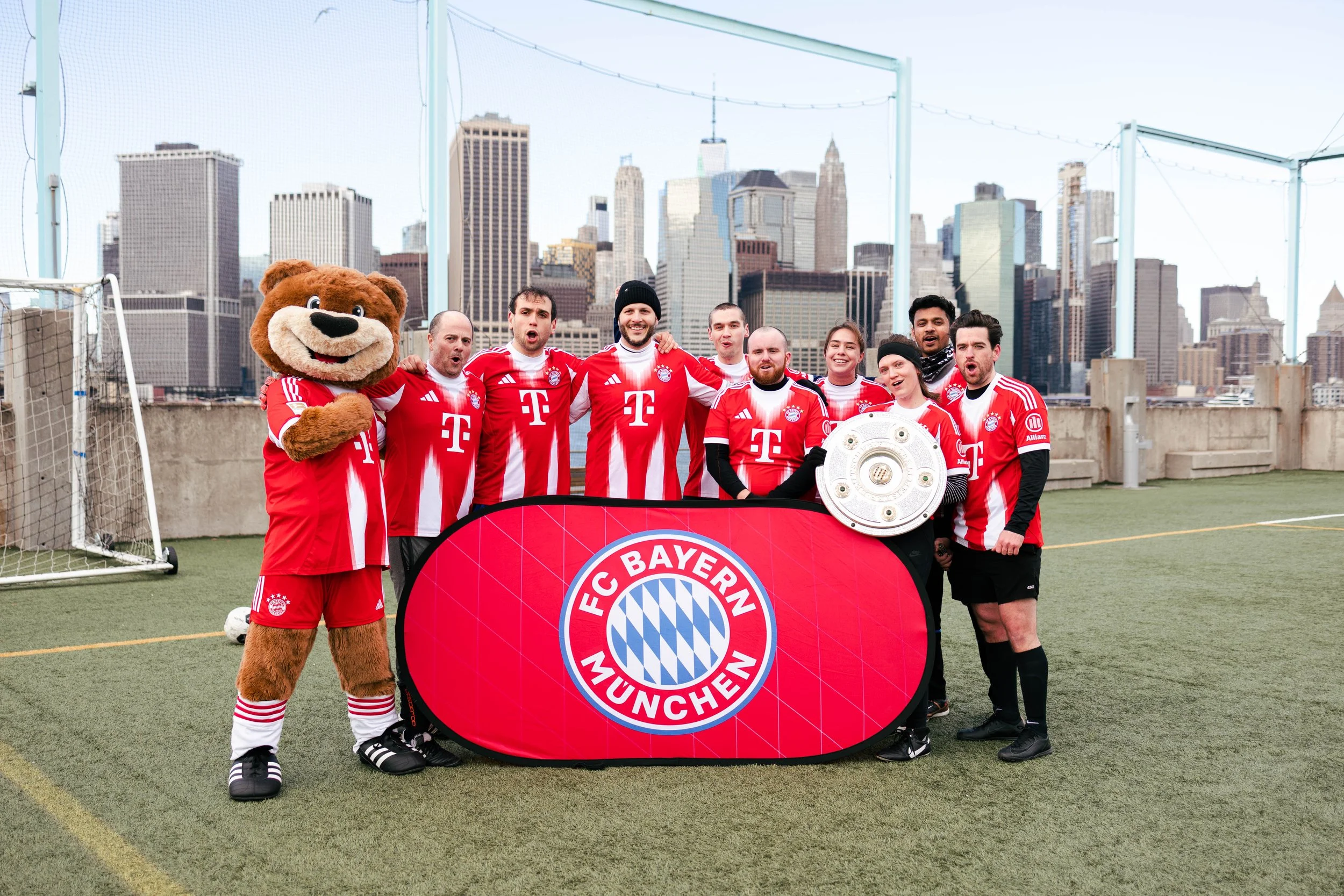
A BBP championship celebration with Berni and the Bundesliga. Yes, that really did happen - and more will come!
Yes, that FC Bayern Munich.
This past December, Bayern made the trek to Brooklyn Bridge Park to help us crown our fall Champions with their mascot Berni and an opportunity to be photographed with the Bundesliga trophy. Somehow, this casually planned encounter managed to make an already iconic location feel even more surreal.
Watching our champions decked out in complimentary jerseys from one of the most storied clubs in the world was one of those moments where everything briefly slowed down and we collectively thought:
“Wow… this is actually happening.”
More to come on this partnership — and trust us when we say this is just the beginning. In fact, if you want to start brushing up on your skills by taking a BetterPlayer class, that wouldn't be a bad idea
The Cost of Living Classic: One for the City
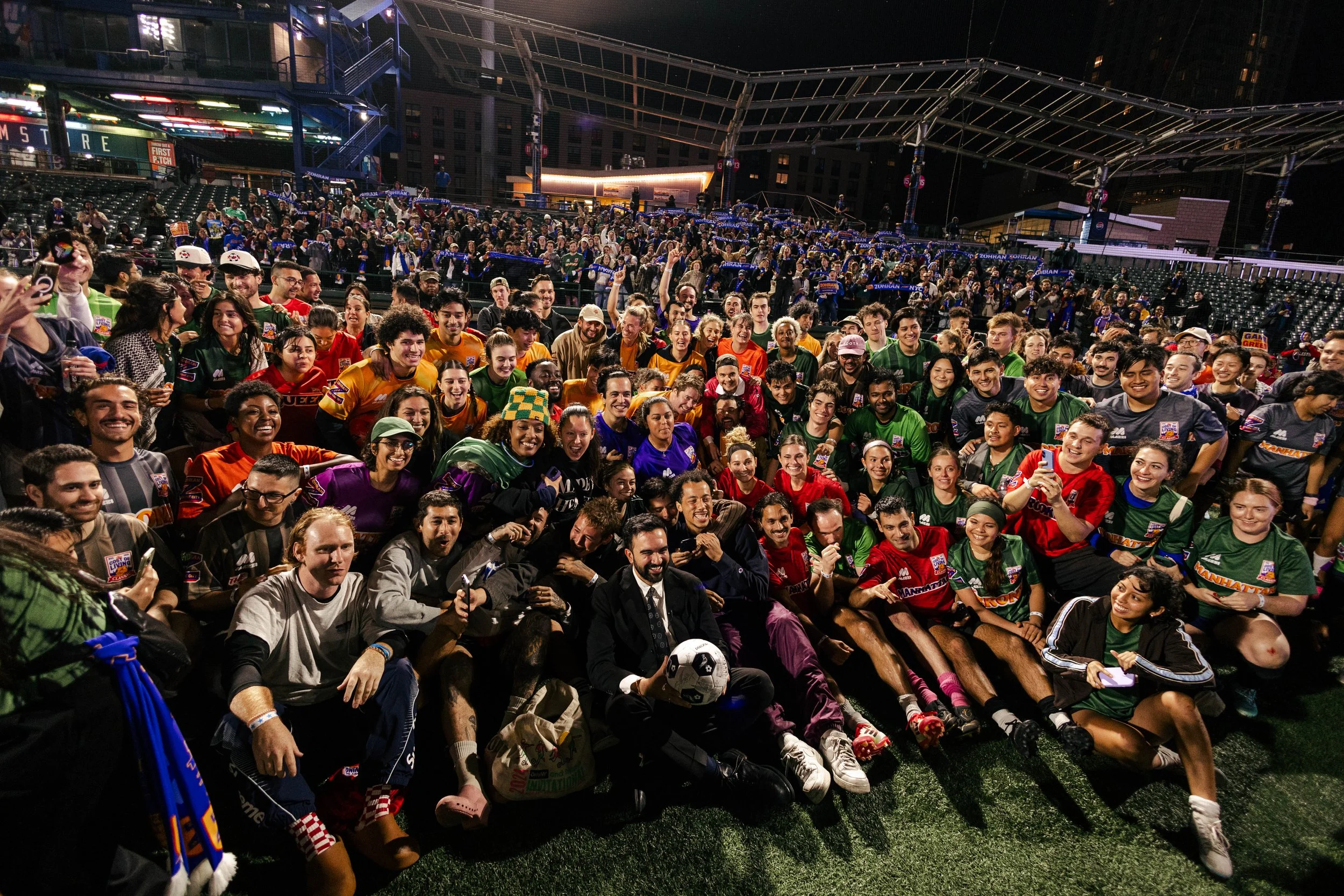
The Cost of Living Classic is the moment everyone understood: soccer is the great uniter.
If there was ever a day that captured what Footy is really about, it was the Cost of Living Classic.
Featuring NYC Footy’s very own Zohran Mamdani (P2 fyi) — current Mayor of New York City (still wild to type that sentence), this event brought players from all five boroughs together for a day of incredible matchups, genuine joy, and a powerful reminder of what’s possible when New York shows up as one city.
For players across the city, this wasn’t just a tournament — it was a moment. And one we won’t forget anytime soon.
The Record Breaking Seasons keep coming
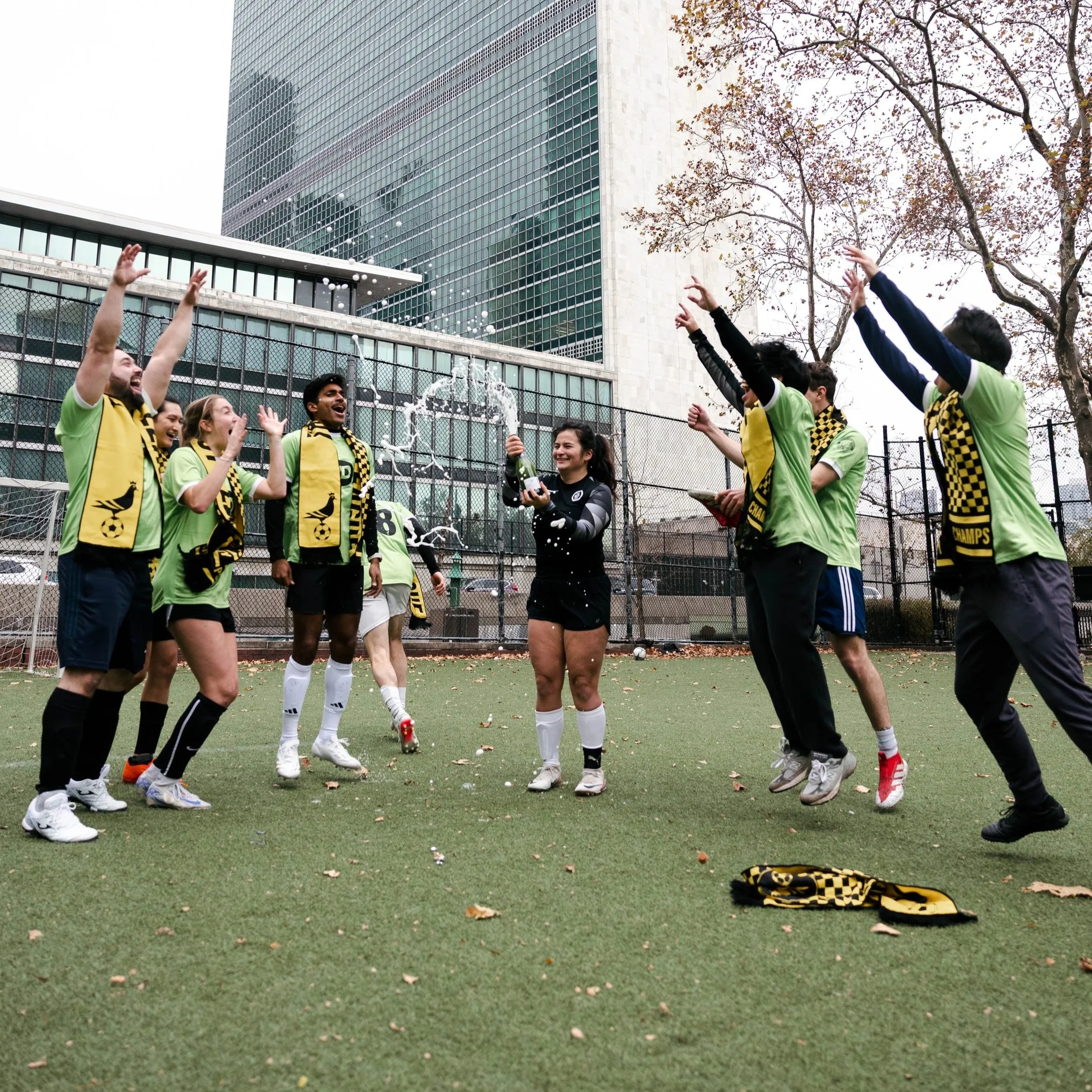
Robert Moses Playground, one of the many leagues where champions are born and celebrated. With champagne. A tasty one.
We're always keeping track of the score because it helps us understand where we were, where we're at, and how much we've grown.
Though the field in front of us doesn't have an end (the ones you play on do though we promise!), here's what we're incredibly proud of when we look back at the numbers from 2025:
3 back-to-back 700+ team seasons (spring, summer & fall 2025)
A record-setting winter season (559 teams)
Our weekly leagues are the heartbeat of what makes Footy run - they connect us to our local communities, develop meaningful relationships, and remind us about the power and need for accessible green spaces.
We Produced & Played in a Record # of Tournaments
If there was one offering that completely outclassed itself in 2025, it would have to be Footy's tournament division.
Under the leadership of our Events and Partnerships Lead, Fabricio Lima, our community accomplished the following together on the tournament front:
6 completely SOLD OUT tournaments
Our first-ever indoor tournament: The Etihad Corporate Cup
The 1st Ever Cost of Living Classic
We know this record will likely be short-lived as World Cup-related events, not to mention the expected return of a majority of the 2025 lineup, will make 2026 the year Footy tournaments across the nation planted its pigeon flag.
More to come - we're here to help you set your 2026 calendar and will be dropping all the confirmed tournaments you can hold dates for in the coming week.
Content, Press & Sponsorship Wins
Okay, we're approaching the end of the second half here and ready to wrap this up, but we can't leave without calling out the following major milestones
Social Media: Our @nycfootyofficial Instagram community is now over 75k with engaging rec soccer series like Planet Footy, Field Guides, and one-of-a-kind tournament recaps leading the way. If you enjoy or plan on strapping on shin guards and identify as an earthling, this is your first and only stop for a taste of rec soccer culture.
Press: Our notoriety within international press outlets like The NY Times broke through in 2025. NYC Footy is being recognized as the first resource journalists need to check in with for soccer-related stories. We appreciate all of the members of our community who've supported our press endeavors, and look forward to finding new opportunities to share our perspective.
Sponsors: Our 2025 sponsorship lineup includes both new and returning partnerships, and we'd like to thank the following supporters for their community involvement: JD Sports, Old Parr, Waterloo Sparkling Water, Mack Weldon, Chobani, Just Bjorn, Dumbo Moving, El Buho Mezcal, Paloma, and BetterPlayer.
The Field (of Vision) Ahead
Our signature Paloma ball is putting on the miles this year - be ready to go when you hear where its about to land.
From Tampa Bay to Miami to Brooklyn Bridge Park, the throughline remains the same:
Make soccer accessible
Build mixed-gender communities that feel welcoming and competitive
Create spaces where people show up for more than just the game
None of this happens without you — the captains, free agents, team players, referees, partners, and supporters who keep believing in where the bar for exceptional rec soccer needs to be.
If you’ve been with us since the early NYC days or just joined your first Footy team this year, thank you for being part of this journey. It continues to mean more than we can properly put into words.
Questions, feedback, ideas, or personal Footy triumphs and heartbreaks you want to share? You know where to find us. And before we say our goodbye, just know we’re grateful as always that you’ve chosen Footy as the place to share your passion for the pitch.
P.S. Early 2026 already has some very fun surprises lined up. Stretch accordingly.
The State of the Footy Flock
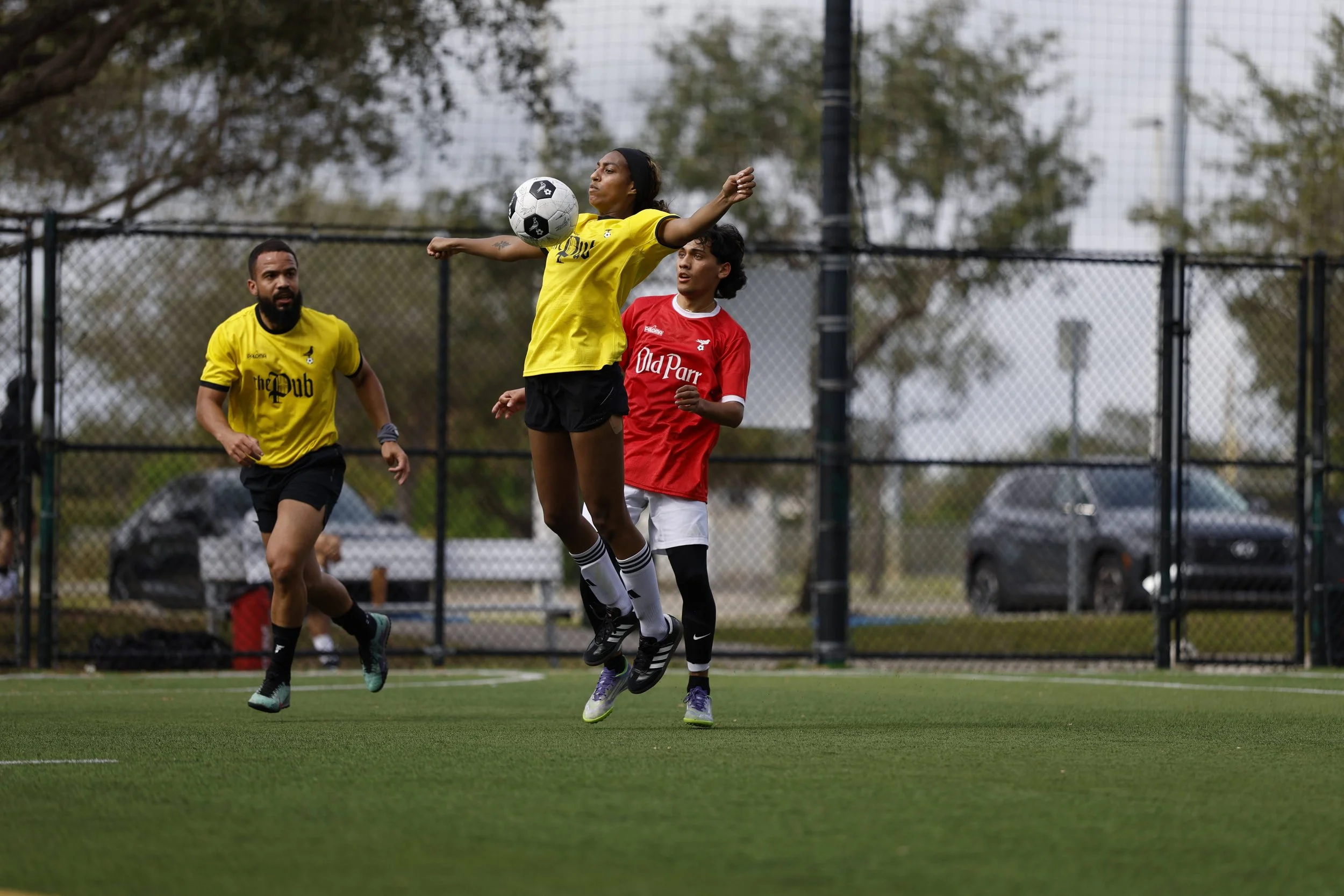
We’re flying high into 2026 with a look back at the big wins from 2025 and the future looks bright.
A message from the Footy CEO, Tarek Pertew
2025 was perhaps the wildest year to date for NYC Footy. We started our 14th year by bringing Footy to Miami, both as a tournament and a league. We launched the first ever Fuchs Fest in Warwick, NY in partnership with EPL winner Christian Fuchs. We exceeded 50,000 players in NYC alone and capped the year with one of the most memorable events in our history, the Cost of Living Classic with Zohran Mamdani and his campaign leading up to the mayoral election.
But that’s not all. Check out the first of a series of videos sharing more about what we’ve stitched together and what’s to come in 2026.