

A Brief History of Shin Guards
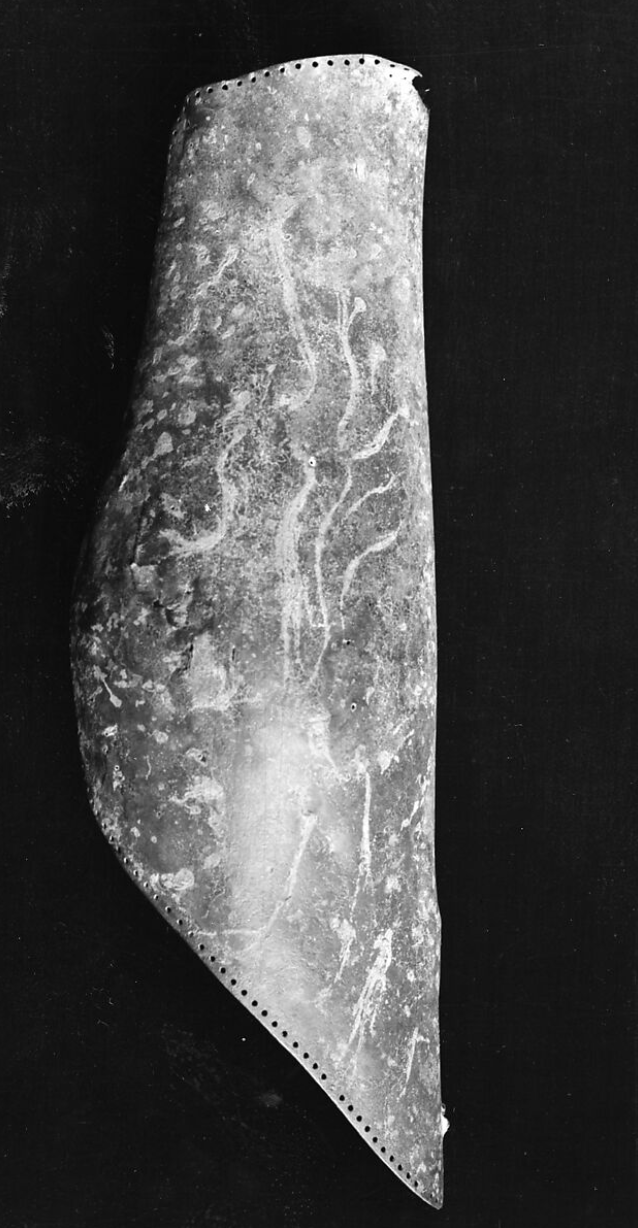
The precursor to modern day shin guards. Photo: The Met
We've all been there: you fly into a tackle and, while you've taken nothing but ball, your opponent's studs have raked you to pieces and left you clutching a severely grazed shin!
Avoiding such scenarios is a key reason why NYC Footy's referees strictly enforce its uniform and equipment guidelines. Players not wearing real shin guards (FYI, newspapers and balled up socks do not count!) are not allowed to take the field, and metal cleats are also prohibited at all our fields.
With that refresher out of the way, let's sidestep safety regulations and focus on the fascinating backstory of shin guards and their evolution from cricket pad to 'credit card'!
Greaves and Widdowson

Samuel Widdowson gets the credit for saving shins
Although the use of 'greaves' - armour to protect the shin made of bronze - traces back to ancient civilisations such as the Greeks, the first football shin guards were invented in the late 19th century.
The credit for inventing the modern-day shin guard is often given to a British footballer (and cricketer!) named Samuel Widdowson. The story goes that Widdowson was playing for Nottingham Forest in a match against Sheffield United in 1874 when he suffered a broken leg after being kicked in the shin.
As a result, Widdowson sewed pieces from cricket pads into his football socks to prevent such injuries, and word has it that his Nottingham Forest team-mates followed suit and adopted shin guards in the English First Division during the 1887/88 season.
The 1990s: A game changer
What is surprising is that an entire century passed between their invention and shin guards becoming an essential piece of football equipment. It was only in 1990 that world governing body FIFA ruled that shin guards must be worn by all players in every game.
Back then, shin guards were clunky and shielded both a player’s ankle as well as their shin - former England captain Bryan Robson memorably carting around his cumbersome 'Sondico Gold' pads at the start of the Premier League era.
Football was a different game and skilful players required as much protection as they could get from 'hard men' such as Wimbledon midfielder (and, later, Hollywood star) Vinnie Jones.
However, career-ending injuries to legendary Netherlands striker Marco van Basten heavily influenced FIFA’s decision to introduce the 'tackle from behind' rule in 1998. This aimed to prevent players from being hit without warning and the ruling was revised in 2005 (to remove "from behind") to further sanction dangerous play.
'Micro-protection'

Jack Grealish is known for pushing the tiny shin guard trend to the top of your feed.
As the rules evolved to safeguard attacking players, shin guards - admittedly crafted from state-of-the-art materials - have been shrinking rapidly, to the point that some of today's pads are undetectable by the naked eye.
Bayern Munich forward Michael Olise has openly expressed his dislike for shin protection, while England international Jack Grealish has become a style icon for tiny shin guards. Increasingly, though, many players are opting for nothing more than a small piece of sponge.
'Smart' shin guards, which collect data on a player's speed, sprints, shots, crosses and passes, are a new development, but it will be interesting to see what the next decade holds for a piece of equipment which is increasingly shunned by players at elite level.
Whatever happens, and however out of fashion they become, always wear a pair in your NYC Footy league - your shins will thank you.