
By the Numbers: What NYC's Own Field Data Shows
A follow-up to our letter to NYC Parks Commissioner Tricia Shimamura
This spring, we wrote to NYC Parks & Recreation Commissioner Shimamura about field access and equity — the seasonal priority framework, the case for lighting, and what it's like to run the city's largest soccer league inside a system that wasn't built to accommodate changes in demand by sport or age, with both soccer and adult sports struggling to find time when so few fields have lights.
We shared that letter with our community and received a great public response, ultimately leading to great exposure through interviews that helped drive the summer light extension from 10pm to 11pm.
But there remained an opportunity to understand just how much this city suffers due to a lack of lights, and we set out to do the maths. The data was far more eye opening than anyone at team Footy expected.
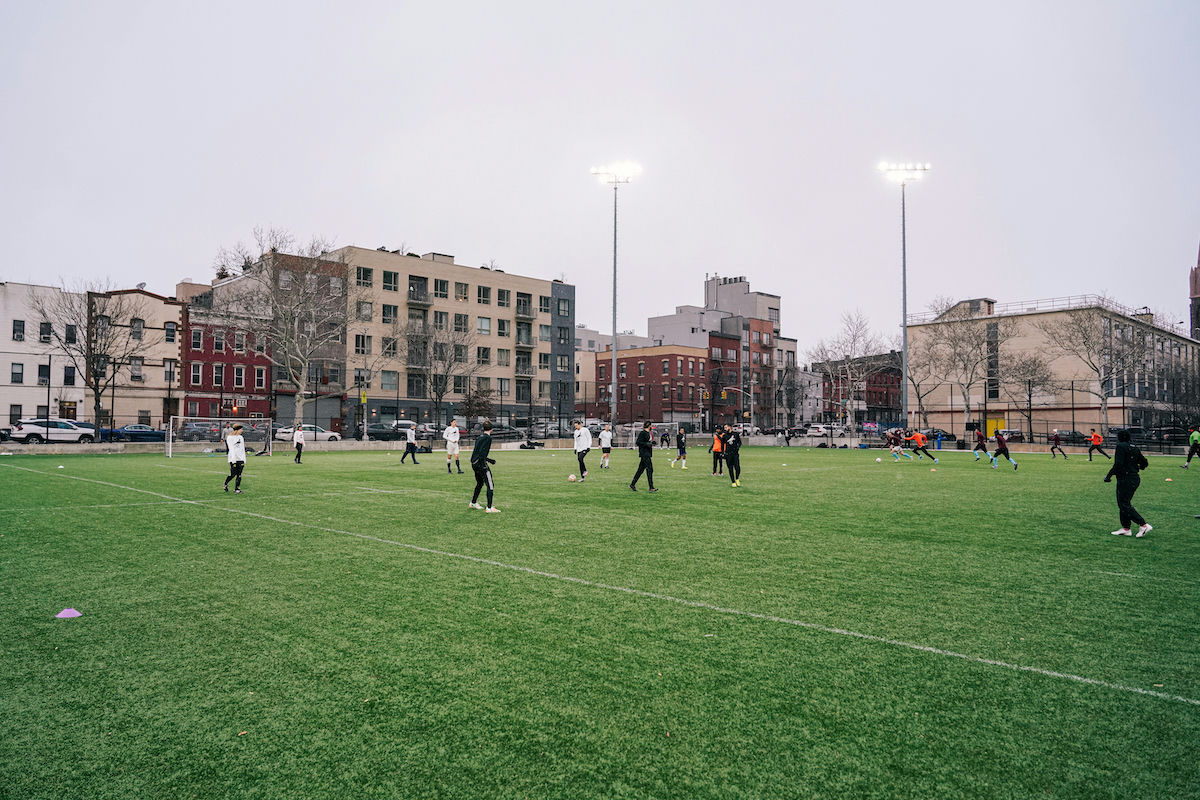
Sternberg Park. One of the few fields where soccer can be played under the lights
We started with NYC Parks' own citywide facility dataset, added in the actual permit rules, and — for good measure — used our own Fall 2026 permits, broken down field by field, hour by hour, to see what the impact of lighting could be.
What we found didn't just support the letter. In a few places, it made a stronger case than we'd realized we had.
1. Soccer isn't fairly resourced.
Rank NYC's sports by how much physical field space each one gets, and soccer comes in 5th on the list — behind handball, basketball, diamond sports (baseball and softball, combined), and tennis. Diamond sports alone hold more than double soccer's citywide field inventory: 760 fields to soccer's 376. If this were a conversation about who's taking up too much field space, especially with soccer demand outpacing all sports, diamond sports would be the ones fielding the question, not soccer.
Worth noting, these spaces include concrete fields as well.
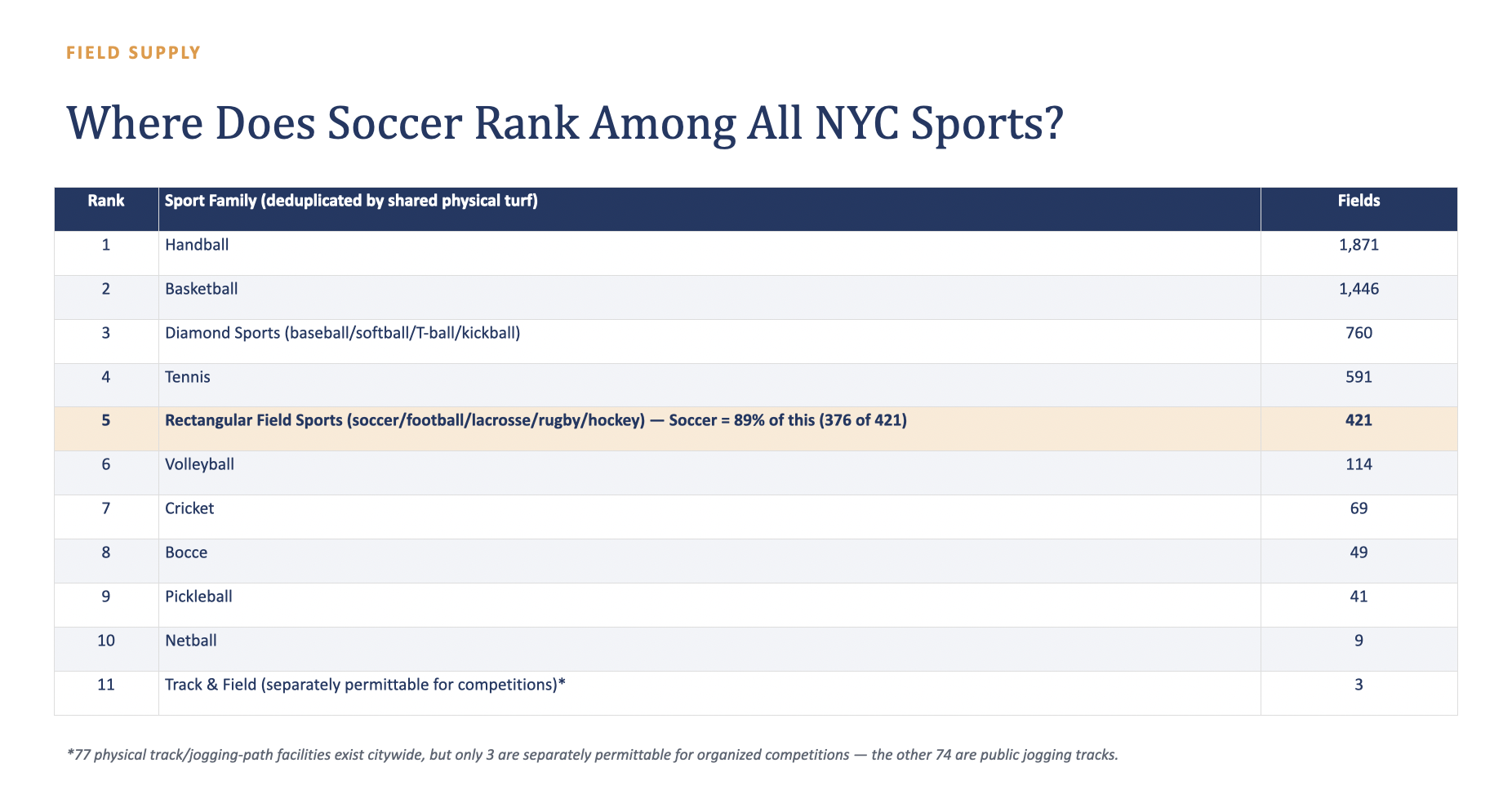
Source: NYC Parks Athletic Facilities dataset (Active + Closed Temporarily)
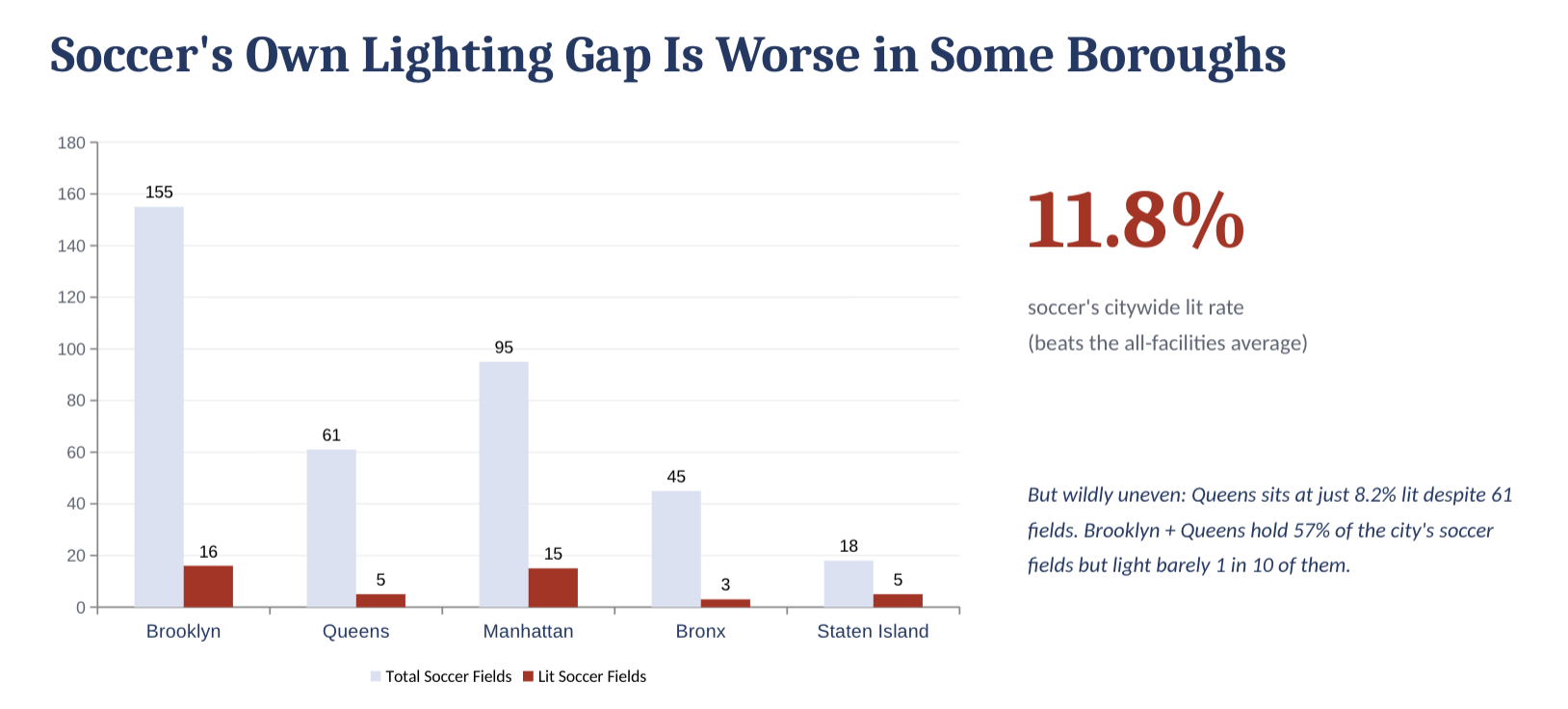
2. Only 11.8% of NYC's soccer specific play spaces have lights.
This is the number that explains almost everything else in this post. Roughly 1 in 10 soccer fields are lit. Worse, when you consider all parks citywide, just 318 of 5,890 total athletic facilities — across every sport, not just soccer — have lighting. That’s just 5.4%! Queens is the worst-served borough at 3.9%; even Manhattan, the best, is under 7%. This isn't a soccer problem. It's an infrastructure problem that happens to hit soccer hard, because soccer plays in the exact hours — after work, after school, after the sun goes down — that unlit fields simply can't offer.
3. Fall & winter are soccer-priority seasons with an urgent need for lights.
Fall loses 122,000 light hours across all play spaces compared to summer. You read that number right. And winter loses over 180K, which is half of summer’s total supply!
Fall, being the season directly in front of us, sees a 43.6% drop from summer on unlit fields during peak-time hours (3pm and later Monday-Thursday). If we wait until winter to talk about lighting, we've already lost the season where the problem is most severe against the backdrop of demand (winter having less overall demand than fall).
4. We ran the numbers on our own permits — and found the same problem, live.
Talk is one thing. So, as one of the city’s largest permit holders, we opened up our own Fall 2026 permit sheet and did the same analysis on ourselves that we'd want NYC Parks to do citywide.
Here's what we found: Of the 15 unique fields where we have games during peak Monday-Thursday times across NYC, over half (8) are unlit. We call these "sunset permits" internally, because that's exactly what they are: games that have to kick off as early as 5:00pm to get a full session in before dark. Across these 8 unlit weeknight fields, we lose roughly 80 hours of playable time, in a single season (enough to accommodate a minimum of 400 additional New Yorkers into a full league season).
5. Footy is a rounding error against the city's total supply.
However you slice it — full-day citywide capacity, peak-time hours only, hours after 5pm specifically — NYC Footy's entire Fall footprint stays under 1% of total citywide soccer field-hours. Even measured against the single scarcest resource in the whole system (lit fields, Monday through Thursday, after 5pm), we hold just 2%.
Think about that. As the city’s largest soccer league by far and one of the city’s largest permit holders, we hold about 2% of available soccer field time after 5pm on peak hours (Monday through Friday after work) in the fall.
We’re sharing this because so often the focus is on redistributing soccer field space amongst groups already severely underserving their own communities, when it couldn’t be more clear that this will not even remotely move the needle.
So, what’s the solution for NYC Footy and all soccer organizations throughout the city?
6. The fix is smaller and the benefit far larger than people think.
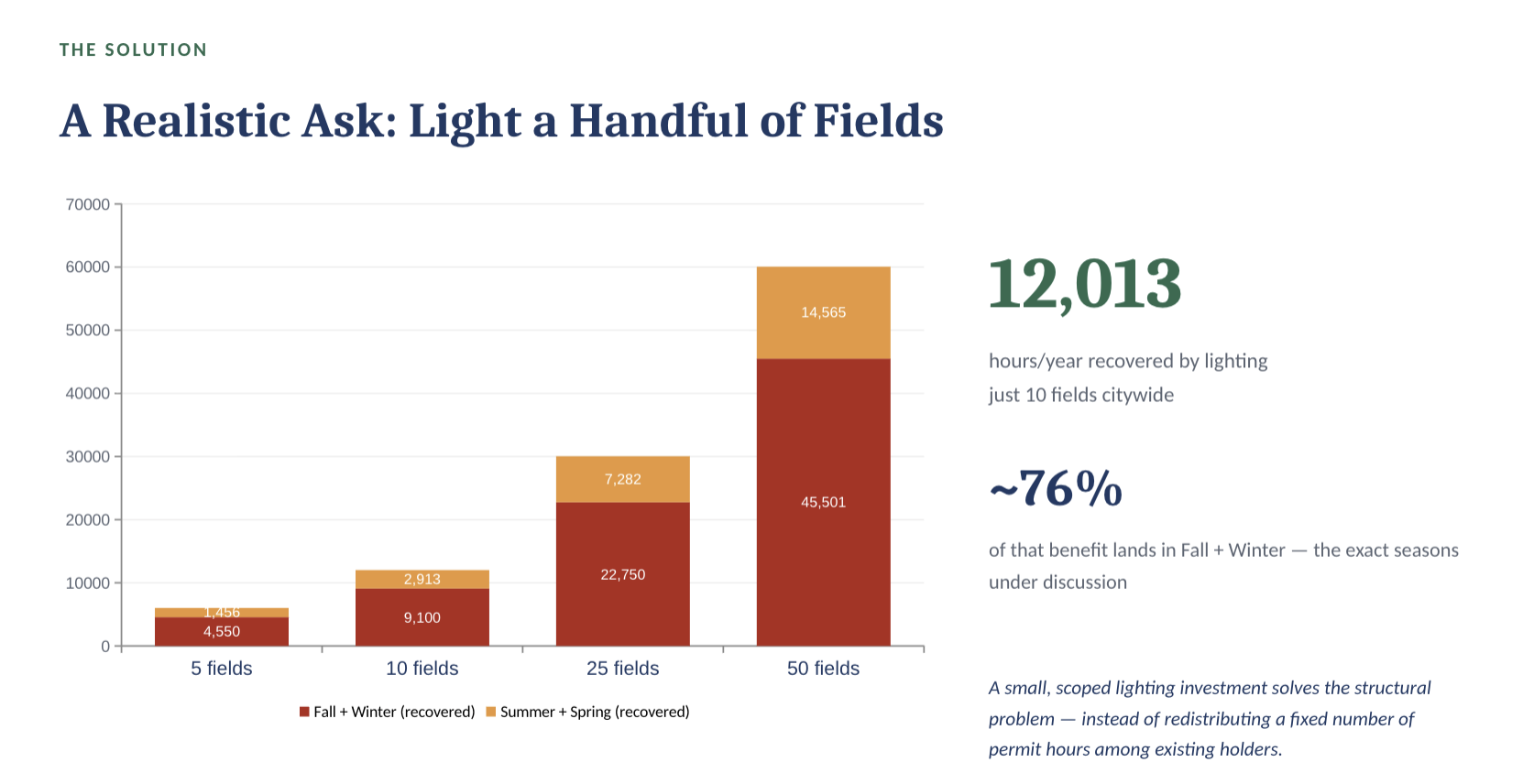
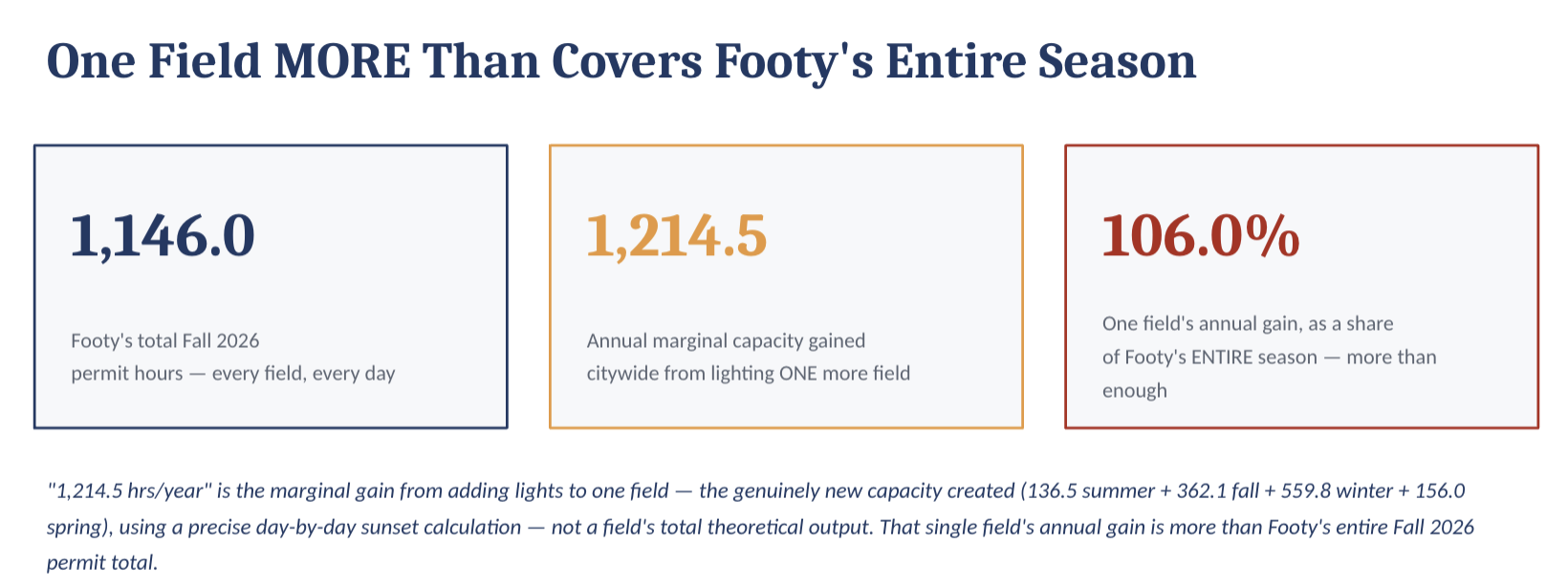
This is the most important number in this whole post: lighting just one additional currently-unlit field adds an estimated 1,215 hours of new playable capacity per year, citywide. If lights stay on till 11 (as it used to), that number jumps to 1580 hours!
Currently, NYC Footy’s entire Fall 2026 season — every game, every field, every hour from Monday through Sunday we've permitted as an organization — adds up to 1,146 hours.
So, a single lit field provides more extra hours of play than NYC Footy’s entire fall season of play!
Not only does this solve the city’s field accessibility challenges without having to build a single new field, but it unlocks a real revenue opportunity for the city.
We’re going to share this same data directly with NYC Parks, because we think the strongest version of this conversation is one built on shared facts, not competing impressions. The Department is managing an enormously complex system with real constraints, and we don't take that lightly. But the numbers are the numbers: New Yorkers are playing more soccer than ever, the fields that could serve them best are sitting dark most evenings, and the fix — lighting a handful of fields — is smaller and more immediate than the scale of the problem might suggest.
As always, we’ll be reporting back on our progress.